
Amnesty law signing reignites debate over the King's role
The investiture pact and amnesty law spark a constitutional standoff regarding the King's powers, including law sanctions and the €8.4 million Royal House budget.
English · Original discussion in Spanish · Published
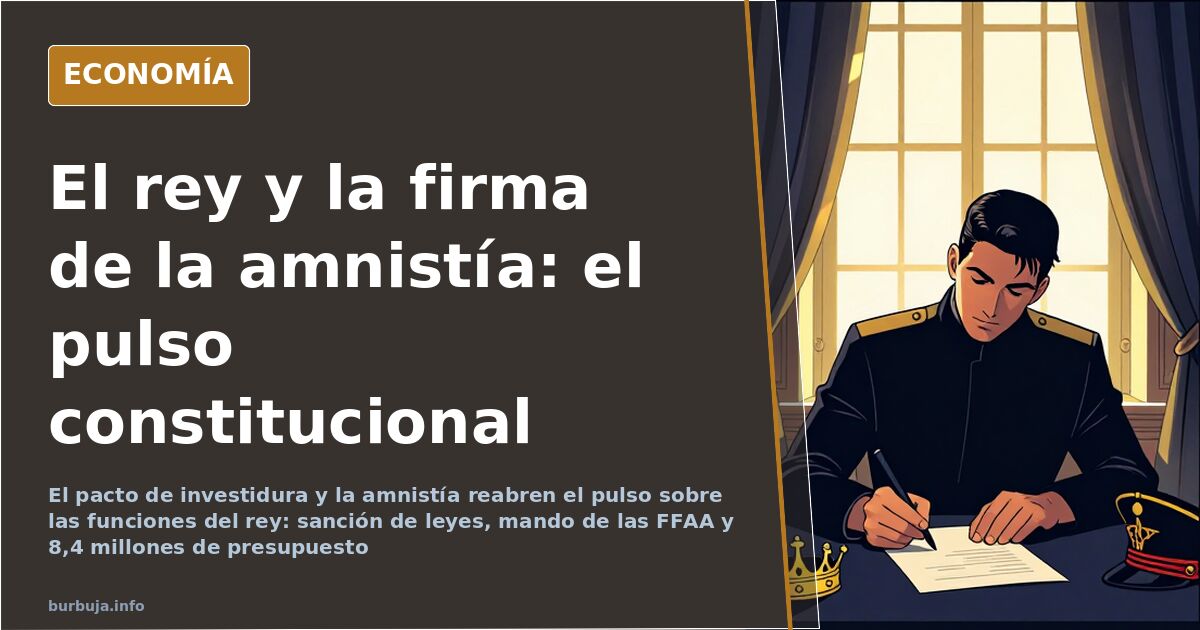
Amnesty law signing tests the King's constitutional role
Pedro Sánchez's investiture and the pact supporting it—an amnesty law agreed upon with pro-independence parties—have shifted the focus to the person who, on paper, holds little decision-making power: the King. Whether Felipe VI is obliged to sanction and promulgate this law, whether he can refuse, or whether he must simply comply with the will of Congress has become the central question, overtaking the actual content of the agreement. The tension is no longer about what was agreed, but about the signature that finalizes it.
The trigger was a gesture. During the investiture ceremonies, the monarch's somber expression—interpreted by some as discomfort and by others as mere protocol—served to fuel various interpretations of his mood. This image has built a debate where constitutional articles, the Royal House budget, and comparisons with two centuries of Spanish history coexist.
What are the King's powers under the Constitution?
The Constitution precisely distributes the functions of the Head of State. His duties include the sanctioning and promulgation of laws, supreme command of the Armed Forces, and the proposal of a candidate for investiture, among others. None of these tasks are defined as discretionary: they are regulated acts requiring mandatory countersignature. Consequently, much of the analysis insists that the monarch's actual margin for maneuver is minimal.
Against this reading, another current argues that the King had the space to not propose Sánchez as a candidate. "He was free to designate OR NOT to designate Sánchez as a candidate; he is the Head of State and supreme commander of the Armed Forces, no one could force him," summarizes one of the most frequent positions. This is countered by the argument that these powers are strictly defined and that deviating from them would trigger an unprecedented institutional crisis.
The oath "by my conscience and honor" appears in almost every discussion on the matter. Some use it as proof that commitment to the Constitution should outweigh the signature; others see it as an empty formula that cannot be legally enforced.
Can the King refuse to sign the amnesty law?
In practice, refusing to sanction a law approved by the Cortes (the Spanish Parliament) has no precedent in the current democracy. Those defending this path frame it as an act of political rather than legal resistance: to hold the line, force a crisis, and let the system decide. "It is in his hands not to sign," is argued, with the idea that a refusal would force a complete reset of the political landscape.
The objection is twofold. First, technical: an official act performed against an approved law would break the logic of a parliamentary monarchy. Second, political: the cost would fall on the institution itself, which would appear as a partisan actor. Some point out that such a blockade would provide the best argument for those who have been calling for the abolition of the Crown for years.
There is also the next link in the chain: the Constitutional Court. Part of the analysis assumes it will uphold the law, which removes the last legal safeguard some had invoked. With that front closed, the discussion returns to the same point: the royal signature.
The cost of the Royal House: €8.4 million per year
The other flank of the criticism is economic. Public accounts allocate a global amount to the maintenance of the Head of State which, in the reference fiscal year, amounts to 8,431,150.00 euros, according to the corresponding budget application. The figure is cited in the debate as proof that the expenditure does not translate into an equivalent function.
This leads to ironic comparisons. A recurring idea proposes converting the palaces into visitor spaces: "If we abolish the monarchy and charge admission to see La Zarzuela and the other palaces, we would earn more than paying the King and his family to live in a state home." The calculation is not fully detailed, but the intention is clear: to put a price on a service considered purely symbolic.
From Fernando VII to 23F: historical comparisons
History serves as an arsenal of analogies. References to Fernando VII—the monarch who wrote flattering letters to Napoleon while Spain bled in the War of Independence—are used to underscore a supposed dynastic continuity in duplicity. The phrase "this is his lineage" summarizes the connection many draw between that king and the current one.
A closer comparison is with Juan Carlos I. "His father did more than him during 23F," is repeated, in allusion to the attempted coup d'état in 1981. That reference is now used to reproach the son for not standing up to what is described as a challenge to the constitutional order.
The reference to Chamberlain completes the picture: appeasement, concession, and cowardice in the face of pressure. The comparison is not gratuitous, but it is not rigorous either. No one denies that the context is different.
A republic proclaimed from the right
A curious twist in the matter is that much of the momentum against the Crown no longer comes from the left. "The conservatives will be the ones to end up proclaiming the republic. A centralized republic is much better than a plurinational monarchy," argues one of the most widespread theses. The idea is that the monarchy, as managed by the two-party system, is no longer fit to contain territorial challenges.
This approach makes the left uncomfortable, as they have spent decades calling for a referendum on the form of government and now see it arriving at the hands of sectors that do not share their model. The result is a cross-front: some want a republic to recentralize, others to distribute sovereignty, and none agree on the purpose.
Meanwhile, the most biting criticism is summarized in a phrase that has circulated insistently: it is a theater, and the protagonist "continues to live like a king" while the country debates his place. The accusation is directed less at the person than the institution, but it reaches both.
The point where everything stalls is the same as at the beginning: no one knows for certain what the King will do when the law reaches his desk. Sanctioning it seems predictable. Refusing would be an earthquake. And, between those two scenarios, the debate remains, like the somber expressions, hanging on a signature that has not yet arrived.
Pedro Sánchez's investiture and the pact supporting it—an amnesty law agreed upon with pro-independence parties—have shifted the focus to the person who, on paper, holds little decision-making power: the King. Whether Felipe VI is obliged to sanction and promulgate this law, whether he can refuse, or whether he must simply comply with the will of Congress has become the central question, overtaking the actual content of the agreement. The tension is no longer about what was agreed, but about the signature that finalizes it.
The trigger was a gesture. During the investiture ceremonies, the monarch's somber expression—interpreted by some as discomfort and by others as mere protocol—served to fuel various interpretations of his mood. This image has built a debate where constitutional articles, the Royal House budget, and comparisons with two centuries of Spanish history coexist.
What are the King's powers under the Constitution?
The Constitution precisely distributes the functions of the Head of State. His duties include the sanctioning and promulgation of laws, supreme command of the Armed Forces, and the proposal of a candidate for investiture, among others. None of these tasks are defined as discretionary: they are regulated acts requiring mandatory countersignature. Consequently, much of the analysis insists that the monarch's actual margin for maneuver is minimal.
Against this reading, another current argues that the King had the space to not propose Sánchez as a candidate. "He was free to designate OR NOT to designate Sánchez as a candidate; he is the Head of State and supreme commander of the Armed Forces, no one could force him," summarizes one of the most frequent positions. This is countered by the argument that these powers are strictly defined and that deviating from them would trigger an unprecedented institutional crisis.
The oath "by my conscience and honor" appears in almost every discussion on the matter. Some use it as proof that commitment to the Constitution should outweigh the signature; others see it as an empty formula that cannot be legally enforced.
Can the King refuse to sign the amnesty law?
In practice, refusing to sanction a law approved by the Cortes (the Spanish Parliament) has no precedent in the current democracy. Those defending this path frame it as an act of political rather than legal resistance: to hold the line, force a crisis, and let the system decide. "It is in his hands not to sign," is argued, with the idea that a refusal would force a complete reset of the political landscape.
The objection is twofold. First, technical: an official act performed against an approved law would break the logic of a parliamentary monarchy. Second, political: the cost would fall on the institution itself, which would appear as a partisan actor. Some point out that such a blockade would provide the best argument for those who have been calling for the abolition of the Crown for years.
There is also the next link in the chain: the Constitutional Court. Part of the analysis assumes it will uphold the law, which removes the last legal safeguard some had invoked. With that front closed, the discussion returns to the same point: the royal signature.
The cost of the Royal House: €8.4 million per year
The other flank of the criticism is economic. Public accounts allocate a global amount to the maintenance of the Head of State which, in the reference fiscal year, amounts to 8,431,150.00 euros, according to the corresponding budget application. The figure is cited in the debate as proof that the expenditure does not translate into an equivalent function.
This leads to ironic comparisons. A recurring idea proposes converting the palaces into visitor spaces: "If we abolish the monarchy and charge admission to see La Zarzuela and the other palaces, we would earn more than paying the King and his family to live in a state home." The calculation is not fully detailed, but the intention is clear: to put a price on a service considered purely symbolic.
From Fernando VII to 23F: historical comparisons
History serves as an arsenal of analogies. References to Fernando VII—the monarch who wrote flattering letters to Napoleon while Spain bled in the War of Independence—are used to underscore a supposed dynastic continuity in duplicity. The phrase "this is his lineage" summarizes the connection many draw between that king and the current one.
A closer comparison is with Juan Carlos I. "His father did more than him during 23F," is repeated, in allusion to the attempted coup d'état in 1981. That reference is now used to reproach the son for not standing up to what is described as a challenge to the constitutional order.
The reference to Chamberlain completes the picture: appeasement, concession, and cowardice in the face of pressure. The comparison is not gratuitous, but it is not rigorous either. No one denies that the context is different.
A republic proclaimed from the right
A curious twist in the matter is that much of the momentum against the Crown no longer comes from the left. "The conservatives will be the ones to end up proclaiming the republic. A centralized republic is much better than a plurinational monarchy," argues one of the most widespread theses. The idea is that the monarchy, as managed by the two-party system, is no longer fit to contain territorial challenges.
This approach makes the left uncomfortable, as they have spent decades calling for a referendum on the form of government and now see it arriving at the hands of sectors that do not share their model. The result is a cross-front: some want a republic to recentralize, others to distribute sovereignty, and none agree on the purpose.
Meanwhile, the most biting criticism is summarized in a phrase that has circulated insistently: it is a theater, and the protagonist "continues to live like a king" while the country debates his place. The accusation is directed less at the person than the institution, but it reaches both.
The point where everything stalls is the same as at the beginning: no one knows for certain what the King will do when the law reaches his desk. Sanctioning it seems predictable. Refusing would be an earthquake. And, between those two scenarios, the debate remains, like the somber expressions, hanging on a signature that has not yet arrived.
Also available in: Deutsch
Summary of a discussion on Burbuja.info - Foro de economía, actualidad y política., translated from Spanish and reviewed before publication. Read the full discussion (507 replies).
More summaries
-
Sánchez: 'The King has been here for 20 years,' but Felipe VI ascended in 2014
Pedro Sánchez insists the King has been in power for over 20 years, but Felipe VI ascended in 2014. The criticism regarding Ceuta and Melilla hides a deeper debate...
-
Zarzuela summons Sánchez: The meeting Moncloa doesn't acknowledge
The King reportedly summoned Sánchez at Zarzuela following his meeting with the military establishment and the announcement of the Ceuta trip. The official agenda makes no mention of the encounter, and...
-
Conde Pumpido's Son Arrested for Alleged Sexual Assault
Son of the Constitutional Court President released without bail after a group sexual assault accusation amid amnesty proceedings.
-
Madrid Protest Camp Robberies Spark Debate Over Security
Activists camping in Madrid's Puerta del Sol report thefts of electronics, while the assembly avoids naming suspects.
-
Spain's Parasite Debate: Cultural Shock or Marketing?
Analysis of the debate on deworming in Spain: is it a cultural clash, a public health need, or just marketing?
-
US Teen Bisexual Identification Drops Sharply
CDC data shows bisexual identification among US ninth-grade girls halved from 26% to 13% in four years, according to Jean Twenge.