
Amaia Montero: her looks are masking the real problem with her concerts
Amaia Montero's return to the stage reopens the debate: the focus on her looks is drowning out the real criticism, a voice that no longer holds up in concert.
English · Original discussion in Spanish · Published
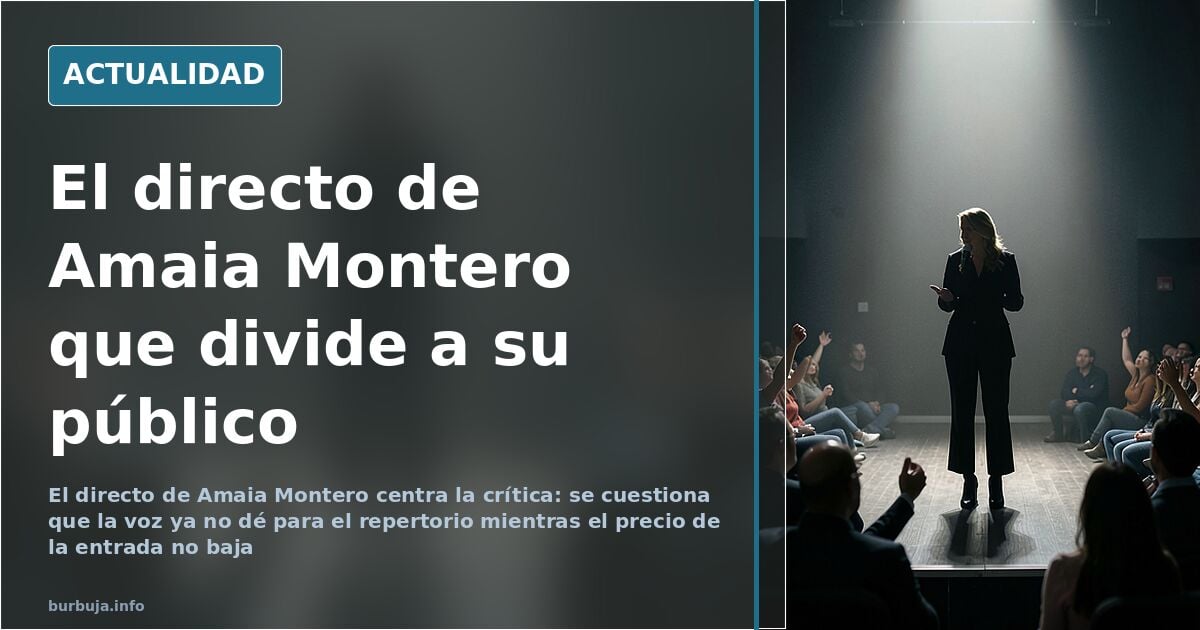
Amaia Montero is back on stage, and the focus is on her looks, not her voice
The promotional image for Amaia Montero's new tour has peine a debate that has been simmering for years: the Basque singer has announced concerts for this year, and public opinion has split in two. On one side, those who point to her physical appearance and wardrobe; on the other, those who argue that the real problem is not her body but her voice. In between lies a handful of uncomfortable truths: **according to some attendees, the singer has been undergoing treatment for some time** — medication, according to those who have trinc her trail — and she is returning to the stage in a state many consider fragile.
The trigger was not an interview or a press release. It was a photo. **The promotional image for her concerts this year**, with filters and retouching that the discussion itself takes for granted, has served as a distorted mirror: what you see does not match what you hear. And that is where it all begins.
Her looks as a smokescreen for the vocal problem
The most frequent criticism is not about her weight. It is about her throat. Some say it bluntly: looks do not define professionalism, but **screeching through a concert when you can no longer hit the notes** is a lack of respect for those who paid for a ticket. The comparison with other voices on the scene — Leire Díaz comes up in the conversation as a point of comparison — is not gratuitous: it serves to underline that the problem is not aesthetic but technical.
The argument has legs. One thing is for an artist to gain weight, grow older, or undergo surgeries that leave her unrecognizable — all of that is her private life — and quite another is **selling a live experience that cannot be delivered**. The public forgives looks. What it does not forgive is feeling cheated.
Her health condition and the treatment nobody specifies
About the singer's real condition, versions circulate without official confirmation. There is talk of **psychiatric treatment** and of problems that would date back to her father's death. Also of pills that cause bloating, of anxiety, of an instability that has dragged on. None of that is verified; these are claims circulating in the heat of the debate and should be treated as what they are: unconfirmed accounts.
What does seem beyond doubt is that **something broke in her relationship with the industry**. Some argue that her comeback responds more to contractual obligations than to a free artistic decision, and that the result is painful to watch. The word "victim" comes up insistently: a victim of her own hits, of opaque contracts, of a machine that squeezes the memory for all it is worth while the memory still makes money.
Proverbs as a social thermometer
The conversation has drifted toward proverbs. **"Tall and slim, God give her to me; fat and piggy she'll grow on her own"** — with its Valencian and Catalan variants, where it does rhyme — has served as a strange yardstick: some revive it as folk wisdom, others call it a sens relic that younger generations keep hidden. The squabble over whether the saying rhymes or not is, at its core, the same old debate in new wrapping.
And while the proverb is argued over, the underlying question remains unanswered: **should an artist retire when her physical or vocal condition no longer holds up?** There is no consensus. Some argue that if she fills concert halls, it is her business and her audience's. Others believe that respect for her legacy demands knowing when to lower the curtain.
The nostalgia industry and the contract that cannot be broken
The economic backdrop is the least mentioned and weighs the most. A tour is not cancelled out of dignity: it is cancelled when the numbers do not add up. If there are **signed contracts, paid promotions and venues booked**, the pressure to take the stage outweighs any artistic consideration. In that scheme, the singer is the last piece of a chain decided months ago.
That would explain why the promotional image is retouched to the point of absurdity and why the comeback is happening at a moment many consider premature. The industry does not sell the artist: it sells nostalgia for the artist. And nostalgia, unlike a voice, never goes off key.
The figure that does not add up is none of those bandied about regarding her weight or her surgeries. It is another one: **an entire tour built on a promise that her body and her throat may not be able to keep**. When the curtain rises, no filter will be able to hide it.
Also available in: Deutsch
Summary of a discussion on Burbuja.info - Foro de economía, actualidad y política., translated from Spanish and reviewed before publication. Read the full discussion (70 replies).
More summaries
-
Suno 5.5: AI music is now good enough to shake the industry
Suno 5.5 takes AI-generated music to professional levels. For musicians, is live performance all that's left? We look at the debate.
-
Leaked Nicknames of PSOE's 'Plumber' Spark Uproar in Ferraz
Leire Díez's agendas reveal insults to Yolanda Díaz, Patxi López, Pablo Iglesias and others. The list of nicknames shakes Ferraz.
-
Spanish hunter completes Africa's Big Seven with a bow
A hunter from Chiclana, Spain, has completed Africa's Big Seven with a traditional bow after 18 years of permits. The debate: is it hunting or a paid execution?
-
Microsoft patents system that could show ads while you play video games
Microsoft has patented a system for inserting ads into video games. The idea is to display advertising once a play "credit" runs out.
-
Three men violently assault elderly woman in her Ciudad Real home
Three men broke into a home on Calle Tinte in Ciudad Real, Spain, assaulted and gagged the carer, and robbed a 90-year-old woman with a disability.
-
Forum debate: abstention and tactical voting on the right
Forum users debate messages calling for abstention and their possible effect on right-wing voters, expressing skepticism about the figures involved.