
Alvise Pérez challenges Israel-Hamas narrative
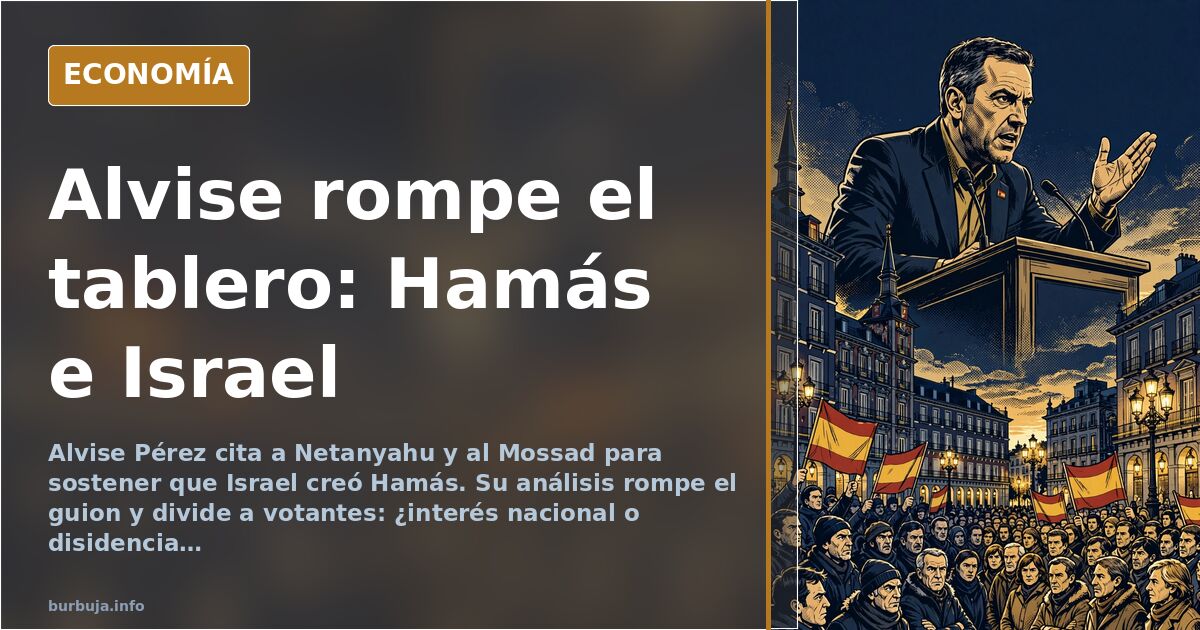
Alvise Pérez cites Netanyahu and Mossad to argue Israel created Hamas, breaking the script and dividing voters.
English · Original discussion in Spanish · Published
Alvise Pérez challenges Israel-Hamas narrative
A recurring scene in digital circles: someone discovers a politician they voted for or despised has said something that breaks the script. Here, the script is the Gaza war. Alvise Pérez, the agitator who surged into the European Parliament after June elections, published an analysis claiming Hamas is partly an Israeli creation. He states it unambiguously: "I can be anti-Hamas and explain, at the same time, Israel's responsibility for this terrorist structure existing."
This isn't bar-talk hyperbole. Pérez relies on three cited sources: a statement by Benjamin Netanyahu reported by The Jerusalem Post four years ago, where the Israeli PM said "anyone who wants to thwart a Palestinian state must support strengthening Hamas and transferring money to Hamas"; an article in Haaretz twelve months later stating the Mossad chief urged Qatar in Doha to keep channeling funds to Hamas; and a report from The Wall Street Journal fourteen years ago titled "How Israel Helped Create Hamas," quoting a senior Israeli intelligence official in Gaza: "Hamas, to my great regret, is Israel's creation."
The twist that unsettles allies and critics alike
What stands out isn't just the content, but who says it. Pérez built his political brand on confronting the system, denouncing corruption, and rhetoric many placed in pro-Israel right-wing orbits. His stance on Gaza shattered that expectation. "I expected team Israel," admits one commenter. Another celebrates: "Pérez is positively surprising me; he broke with U.S.-backed NWO pro-war policies in Ukraine and now hits the mark on Israel, further exposing Abascal's backward evangelical, pro-U.S., pro-Israel sect."
Reaction isn't unanimous. Some see a calculated move to capture disillusioned voters. "Everything points to a regime operation for survival," writes a skeptic. Another adds: "Many of his voters will look foolish once they get to know the character they voted for more deeply." Distrust is cross-cutting: some call him "controlled dissent," noting he appeared in Forbes in 2022 while announcing a general strike that never peine.
National interest as pretext
Pérez's core argument is patriotic, not geopolitical. "I owe allegiance exclusively to Spaniards and my country's interests, Spain, and I won't withhold from my audience a cold analysis consistent with their interests," he writes. He poses an uncomfortable question: "Will Israel support us against Segarro while Israeli companies profit from illegal exploration off the Canary Islands thanks to Segarro?"
This shift toward national interest connects with opinion rejecting Spanish involvement in foreign conflicts. "Real Spaniards don't care about Jovelandians and Jalubios," summarizes one message. "IT'S NOT OUR WAR," declares another. The idea that Spain must prioritize its own interests over automatic alignment with foreign powers gains ground.
The litmus test: real or controlled dissent?
Israel policy has become a test for critic authenticity. "Remember, the position on Israel is the true litmus test for whether someone is controlled dissent or not," writes a participant. "So far, Pérez passes, but barely (the correct position would be withdrawing recognition of Israel)." Coherence demands high standards: criticizing Hamas isn't enough; one must question the entire framework.
Others doubt sincerity. "I don't understand people's doubts about a guy who is clearly textbook controlled dissent," asserts one message. Suspicion that Pérez is a system product to channel discontent safely pervades comments. "It peine with Colau too; overnight she was everywhere in the mass media," recalls another.
Economic backdrop: Canaries, Segarro, and Spanish interests
Beyond Middle East conflict, Pérez introduces a rarely seen element: links between Israeli foreign policy and Spanish economic interests in the Atlantic. Mention of illegal exploration off the Canary Islands by Israeli firms with Segarro approval is data that, per Pérez, should outweigh ideological solidarity.
Discussion shifts to Spain defining foreign policy based on its interests, not automatic alignments. "We must start looking out for our interests. We have no stake in that war," argues a commentator. Neutrality in unrelated conflicts gains adherents, even among pro-Palestinians: "I'm totally pro-Palestine, but it's appreciated when someone says 'what matters here is Spain.'"
The calculation nobody details
Pérez's analysis includes a claim with notable economic consequences if confirmed: Israeli firms benefiting from illegal Canarian waters exploration via Segarro collusion. Full data—company names, business volumes—is absent, but the mention opens an investigation line few media explored. How much money is at stake? Which companies? What role does Spanish diplomacy play? These questions hang in the air.
Closing: a disorienting fact
While Gaza debate monopolizes headlines, Pérez's intervention achieved something rare: supporters and detractors agree he raised an uncomfortable issue. Cited data are public and verifiable. Conclusions are debatable. But the underlying question—who really benefits from unconditional support for Israel?—can no longer be ignored. In today's media ecosystem, that's nearly an anomaly.
A recurring scene in digital circles: someone discovers a politician they voted for or despised has said something that breaks the script. Here, the script is the Gaza war. Alvise Pérez, the agitator who surged into the European Parliament after June elections, published an analysis claiming Hamas is partly an Israeli creation. He states it unambiguously: "I can be anti-Hamas and explain, at the same time, Israel's responsibility for this terrorist structure existing."
This isn't bar-talk hyperbole. Pérez relies on three cited sources: a statement by Benjamin Netanyahu reported by The Jerusalem Post four years ago, where the Israeli PM said "anyone who wants to thwart a Palestinian state must support strengthening Hamas and transferring money to Hamas"; an article in Haaretz twelve months later stating the Mossad chief urged Qatar in Doha to keep channeling funds to Hamas; and a report from The Wall Street Journal fourteen years ago titled "How Israel Helped Create Hamas," quoting a senior Israeli intelligence official in Gaza: "Hamas, to my great regret, is Israel's creation."
The twist that unsettles allies and critics alike
What stands out isn't just the content, but who says it. Pérez built his political brand on confronting the system, denouncing corruption, and rhetoric many placed in pro-Israel right-wing orbits. His stance on Gaza shattered that expectation. "I expected team Israel," admits one commenter. Another celebrates: "Pérez is positively surprising me; he broke with U.S.-backed NWO pro-war policies in Ukraine and now hits the mark on Israel, further exposing Abascal's backward evangelical, pro-U.S., pro-Israel sect."
Reaction isn't unanimous. Some see a calculated move to capture disillusioned voters. "Everything points to a regime operation for survival," writes a skeptic. Another adds: "Many of his voters will look foolish once they get to know the character they voted for more deeply." Distrust is cross-cutting: some call him "controlled dissent," noting he appeared in Forbes in 2022 while announcing a general strike that never peine.
National interest as pretext
Pérez's core argument is patriotic, not geopolitical. "I owe allegiance exclusively to Spaniards and my country's interests, Spain, and I won't withhold from my audience a cold analysis consistent with their interests," he writes. He poses an uncomfortable question: "Will Israel support us against Segarro while Israeli companies profit from illegal exploration off the Canary Islands thanks to Segarro?"
This shift toward national interest connects with opinion rejecting Spanish involvement in foreign conflicts. "Real Spaniards don't care about Jovelandians and Jalubios," summarizes one message. "IT'S NOT OUR WAR," declares another. The idea that Spain must prioritize its own interests over automatic alignment with foreign powers gains ground.
The litmus test: real or controlled dissent?
Israel policy has become a test for critic authenticity. "Remember, the position on Israel is the true litmus test for whether someone is controlled dissent or not," writes a participant. "So far, Pérez passes, but barely (the correct position would be withdrawing recognition of Israel)." Coherence demands high standards: criticizing Hamas isn't enough; one must question the entire framework.
Others doubt sincerity. "I don't understand people's doubts about a guy who is clearly textbook controlled dissent," asserts one message. Suspicion that Pérez is a system product to channel discontent safely pervades comments. "It peine with Colau too; overnight she was everywhere in the mass media," recalls another.
Economic backdrop: Canaries, Segarro, and Spanish interests
Beyond Middle East conflict, Pérez introduces a rarely seen element: links between Israeli foreign policy and Spanish economic interests in the Atlantic. Mention of illegal exploration off the Canary Islands by Israeli firms with Segarro approval is data that, per Pérez, should outweigh ideological solidarity.
Discussion shifts to Spain defining foreign policy based on its interests, not automatic alignments. "We must start looking out for our interests. We have no stake in that war," argues a commentator. Neutrality in unrelated conflicts gains adherents, even among pro-Palestinians: "I'm totally pro-Palestine, but it's appreciated when someone says 'what matters here is Spain.'"
The calculation nobody details
Pérez's analysis includes a claim with notable economic consequences if confirmed: Israeli firms benefiting from illegal Canarian waters exploration via Segarro collusion. Full data—company names, business volumes—is absent, but the mention opens an investigation line few media explored. How much money is at stake? Which companies? What role does Spanish diplomacy play? These questions hang in the air.
Closing: a disorienting fact
While Gaza debate monopolizes headlines, Pérez's intervention achieved something rare: supporters and detractors agree he raised an uncomfortable issue. Cited data are public and verifiable. Conclusions are debatable. But the underlying question—who really benefits from unconditional support for Israel?—can no longer be ignored. In today's media ecosystem, that's nearly an anomaly.
Also available in: Deutsch
Summary of a discussion on Burbuja.info - Foro de economía, actualidad y política., translated from Spanish and reviewed before publication. Read the full discussion (130 replies).
More summaries
-
Alvise Pérez: A Year On, No Salary Raffle, No Revelations
A year after joining the European Parliament, Alvise Pérez admits he has not raffled his salary or exposed the frauds he promised. His voters remain silent.
-
Alvise Pérez Cancels El País Interview Over Recording Rights
Spanish MEP Alvise Pérez cancelled his interview with El País after the newspaper refused to allow him to record and use raw footage if he suspected manipulation.
-
Broncano’s RTVE Contract and Luxury Cars Spark Public Spending Debate in Spain
Reports suggest Broncano earns €90,000 per episode at RTVE, totaling €28 million for two seasons. His luxury cars reignite scrutiny of public broadcasting costs.
-
Is now a good time to buy property? Debate
Is now a good time to buy a home? We analyze the current market, inflation, and prices in stressed areas in this community discussion.
-
Spanish self-employed and abstainers eye Vox as protest vote
Self-employed workers and habitual non-voters in Spain plan to back Vox to punish the PSOE, despite disagreements on bullfighting and Israel.
-
Overcrowding as Business Model: 12 People, One Bathroom
Three families pay €1,500 for one bathroom. Occupancy certificates exist but aren't enforced. Overcrowding is now a profitable business model in Spain.