
Alvise Pérez and the strategic vote against Spain's system
Alvise Pérez channels discontent with Spain's post-transition order, mobilizing strategic votes against corruption ahead of European elections.
English · Original discussion in Spanish · Published
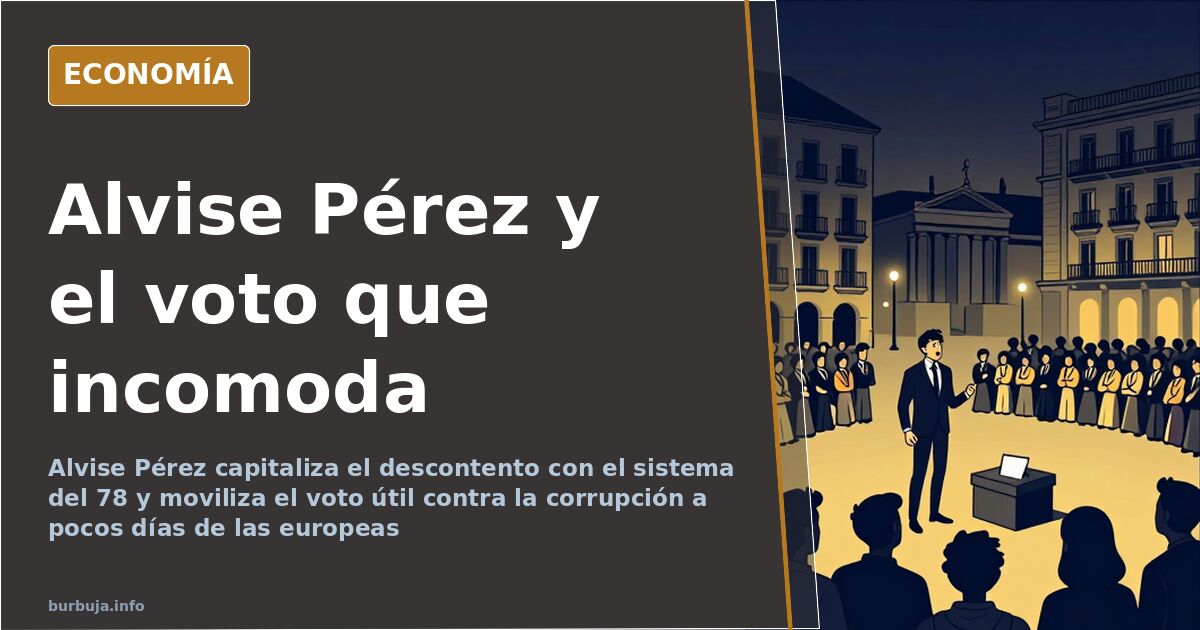
Alvise Pérez and the strategic vote against Spain's system
The Alvise Pérez phenomenon has ceased to be an anecdote in the Spanish political ecosystem. Just days before the European elections, the leader of "Se Acabó La Fiesta" (The Party Is Over) has moved from denouncing corruption on social media to becoming the epicenter of a debate that transcends electoral politics: the audit of election records, oversight of Correos and Indra, and suspicions regarding postal voting. This discussion, far from being a simple exchange of opinions, reveals a deep fracture in the right-wing electorate and widespread disillusionment with the regime established by the 1978 Constitution.
The strategic vote that unsettles everyone
Alvise Pérez’s emergence on the political board has generated a paradoxical effect. On one hand, some argue his party is the only option standing up to corruption across all colors, from PSOE to PP, including Vox and Podemos. On the other, critical analysis suggests he is just another puppet of the system, a reformist who, as Ambrose Bierce said, serves only to perpetuate the regime he claims to fight. The debate is not trivial: at stake is whether voting for Alvise is a protest vote or a surrender disguised as rebellion.
Data used by optimistic analysts suggest "Se Acabó La Fiesta" could win between three and four seats in the European Parliament. Under the single-district system and the D'Hondt method, every seat Alvise wins increases the cost per seat for his rivals, especially minor parties like the 3% coalition or Irene Montero’s alliance. That calculation, broken down line by line, has convinced many to vote for Alvise solely to see Montero excluded. A motivation as pragmatic as it is revealing of the electorate’s level of desperation.
Auditing election records: fraud or guarantee?
One of the points that has most mobilized Alvise’s supporters is his proposal to audit electoral records. The idea, which sounds obvious in any consolidated democracy, has resonated deeply among those who recall episodes such as a judge refusing to open ballot boxes in front of a polling station member. "If you disagree, appeal to the electoral board," was the response. Such anecdotes, repeated in various polling stations, have fueled distrust in the system.
Alvise’s proposal goes further: including the deletion of digital evidence of corruption online as a crime of obstruction of justice in the Penal Code. The measure, which some describe as reverse Bolshevism, aims to prevent digital traces of alleged corruption cases from disappearing overnight. The example cited is Begoña Gómez, whose platform for raising public funds saw its indexed Google movements vanish. Whether this is true or not can only be determined by a judicial investigation, but the debate over the elimination of digital evidence is already on the table.
Oversight of Correos and Indra: permanent suspicion
A shadow of doubt hangs over postal voting in these elections. Some claim the fraud is structural and that the tentacles of power reach not only the Prosecutor’s Office but also Correos and Indra, the companies responsible for managing remote voting. The question floating in the air is who truly controls these entities and whether there is a possibility of manipulating the suffrage. There is no conclusive proof, but the mere formulation of suspicion is a symptom of deteriorating institutional trust.
In this context, Alvise Pérez’s figure grows. His trinc see him as a David against Goliath, a man who exposes corruption wholesale and has even said that if he is found dead, no one should assume suicide. That mix of bravery and paranoia, so characteristic of current times, has earned him support that many do not understand. "You have to make do with what you have in the game called democracy," summarizes one of his voters. And therein lies the key: it is less a vote of conviction than one of active resignation.
The Alvise effect on the right and left
Alvise’s rise cannot be understood without the context of fragmentation within the Spanish right. Vox, which presented itself as the scourge of the system, has seen part of its more radical electorate shift to "Se Acabó La Fiesta." It is not a massive transfer, but it is significant. The criticism leveled at Vox is that it has become part of the system, another piece on the board that, rather than blowing it up, sustains it. Alvise, with his inflammatory rhetoric and disregard for protocol, has occupied that space of protest.
On the left, the phenomenon generates a mix of irritation and bewilderment. On one hand, he is accused of being a character who exploits any queue to hold a rally and make people believe they went to see him. On the other, it is acknowledged that he has put issues on the table that traditional press ignored for years, such as Ábalos’s trips with Koldo pulling €200 and €500 bills from a fanny pack to pay, or photos of Óscar Puente vacationing in Marbella with his mistress in a Mercedes worth €180,000 lent by a contractor who worked with his city council. Those reports, published by Alvise at the time, took years to reach conventional media.
The uncertain future of "Se Acabó La Fiesta"
Alvise’s electoral result remains an unknown. Polls, unreliable at this stage, grant him one seat, perhaps two. But the real impact of his candidacy will not be measured solely in deputies, but in the ability to force a debate on the integrity of the electoral system and political corruption. If he succeeds in getting election records audited and having fraud discussed without being ridiculed, he will have gained something more than a seat.
His harshest critics, however, warn that all this is a bubble. That Alvise is just another opportunist, like Abascal, who will end up entrenched in the system he claims to combat. Recent history is full of examples of outsiders who promised to sweep away the establishment and ended up becoming part of the furniture. The question, which no one answers with certainty, is whether Alvise will be the exception or the rule. Meanwhile, the electorate continues looking for someone, anyone, to restore the illusion that their vote counts for something other than legitimizing the status quo.
Ultimately, the Alvise Pérez phenomenon is a symptom, not a cause. It reflects the exhaustion of a system that many perceive as corrupt and immovable. His vote is a cry of rage rather than a bet on the future. And like any cry, it may be the prelude to something or remain a simple echo.
The Alvise Pérez phenomenon has ceased to be an anecdote in the Spanish political ecosystem. Just days before the European elections, the leader of "Se Acabó La Fiesta" (The Party Is Over) has moved from denouncing corruption on social media to becoming the epicenter of a debate that transcends electoral politics: the audit of election records, oversight of Correos and Indra, and suspicions regarding postal voting. This discussion, far from being a simple exchange of opinions, reveals a deep fracture in the right-wing electorate and widespread disillusionment with the regime established by the 1978 Constitution.
The strategic vote that unsettles everyone
Alvise Pérez’s emergence on the political board has generated a paradoxical effect. On one hand, some argue his party is the only option standing up to corruption across all colors, from PSOE to PP, including Vox and Podemos. On the other, critical analysis suggests he is just another puppet of the system, a reformist who, as Ambrose Bierce said, serves only to perpetuate the regime he claims to fight. The debate is not trivial: at stake is whether voting for Alvise is a protest vote or a surrender disguised as rebellion.
Data used by optimistic analysts suggest "Se Acabó La Fiesta" could win between three and four seats in the European Parliament. Under the single-district system and the D'Hondt method, every seat Alvise wins increases the cost per seat for his rivals, especially minor parties like the 3% coalition or Irene Montero’s alliance. That calculation, broken down line by line, has convinced many to vote for Alvise solely to see Montero excluded. A motivation as pragmatic as it is revealing of the electorate’s level of desperation.
Auditing election records: fraud or guarantee?
One of the points that has most mobilized Alvise’s supporters is his proposal to audit electoral records. The idea, which sounds obvious in any consolidated democracy, has resonated deeply among those who recall episodes such as a judge refusing to open ballot boxes in front of a polling station member. "If you disagree, appeal to the electoral board," was the response. Such anecdotes, repeated in various polling stations, have fueled distrust in the system.
Alvise’s proposal goes further: including the deletion of digital evidence of corruption online as a crime of obstruction of justice in the Penal Code. The measure, which some describe as reverse Bolshevism, aims to prevent digital traces of alleged corruption cases from disappearing overnight. The example cited is Begoña Gómez, whose platform for raising public funds saw its indexed Google movements vanish. Whether this is true or not can only be determined by a judicial investigation, but the debate over the elimination of digital evidence is already on the table.
Oversight of Correos and Indra: permanent suspicion
A shadow of doubt hangs over postal voting in these elections. Some claim the fraud is structural and that the tentacles of power reach not only the Prosecutor’s Office but also Correos and Indra, the companies responsible for managing remote voting. The question floating in the air is who truly controls these entities and whether there is a possibility of manipulating the suffrage. There is no conclusive proof, but the mere formulation of suspicion is a symptom of deteriorating institutional trust.
In this context, Alvise Pérez’s figure grows. His trinc see him as a David against Goliath, a man who exposes corruption wholesale and has even said that if he is found dead, no one should assume suicide. That mix of bravery and paranoia, so characteristic of current times, has earned him support that many do not understand. "You have to make do with what you have in the game called democracy," summarizes one of his voters. And therein lies the key: it is less a vote of conviction than one of active resignation.
The Alvise effect on the right and left
Alvise’s rise cannot be understood without the context of fragmentation within the Spanish right. Vox, which presented itself as the scourge of the system, has seen part of its more radical electorate shift to "Se Acabó La Fiesta." It is not a massive transfer, but it is significant. The criticism leveled at Vox is that it has become part of the system, another piece on the board that, rather than blowing it up, sustains it. Alvise, with his inflammatory rhetoric and disregard for protocol, has occupied that space of protest.
On the left, the phenomenon generates a mix of irritation and bewilderment. On one hand, he is accused of being a character who exploits any queue to hold a rally and make people believe they went to see him. On the other, it is acknowledged that he has put issues on the table that traditional press ignored for years, such as Ábalos’s trips with Koldo pulling €200 and €500 bills from a fanny pack to pay, or photos of Óscar Puente vacationing in Marbella with his mistress in a Mercedes worth €180,000 lent by a contractor who worked with his city council. Those reports, published by Alvise at the time, took years to reach conventional media.
The uncertain future of "Se Acabó La Fiesta"
Alvise’s electoral result remains an unknown. Polls, unreliable at this stage, grant him one seat, perhaps two. But the real impact of his candidacy will not be measured solely in deputies, but in the ability to force a debate on the integrity of the electoral system and political corruption. If he succeeds in getting election records audited and having fraud discussed without being ridiculed, he will have gained something more than a seat.
His harshest critics, however, warn that all this is a bubble. That Alvise is just another opportunist, like Abascal, who will end up entrenched in the system he claims to combat. Recent history is full of examples of outsiders who promised to sweep away the establishment and ended up becoming part of the furniture. The question, which no one answers with certainty, is whether Alvise will be the exception or the rule. Meanwhile, the electorate continues looking for someone, anyone, to restore the illusion that their vote counts for something other than legitimizing the status quo.
Ultimately, the Alvise Pérez phenomenon is a symptom, not a cause. It reflects the exhaustion of a system that many perceive as corrupt and immovable. His vote is a cry of rage rather than a bet on the future. And like any cry, it may be the prelude to something or remain a simple echo.
Summary of a discussion on Burbuja.info - Foro de economía, actualidad y política., translated from Spanish and reviewed before publication. Read the full discussion (182 replies).
More summaries
-
Software for Begoña Gómez's Chair Registered in Her Name
Indra, Telefónica and Google were to develop free software for a Complutense chair; it ended up registered under Begoña Gómez.
-
Viral tweet attributed to Mel Gibson comes from fake account
Mel Gibson has no official X account: the viral tweet attributed to him comes from a fake account, according to his publicist.
-
Spain Faces Critical Shortage of Construction Workers
Libertad Digital highlights a generational gap in construction, citing low wages and taxes. Forums debate training and immigration issues.
-
European Parliament finds half of Canary Islands minors are adults
The European Parliament confirms that half of the 1,500 individuals classified as minors in El Hierro are adults, while Morocco rejects 92% of Spanish repatriation requests.
-
Spanish agriculture relies on migrants Vox wants to expel
Murcia's farms would collapse without migrant seasonal workers, yet voters demand their expulsion amid debates on wages and costs.
-
4% African DNA in Spain challenges European purity myth
A forum user argues that 4% African genetic markers and Semitic substrates in Iberia debunk narratives of European racial purity.