
Spain Faces Critical Shortage of Construction Workers
Libertad Digital highlights a generational gap in construction, citing low wages and taxes. Forums debate training and immigration issues.
English · Original discussion in Spanish · Published
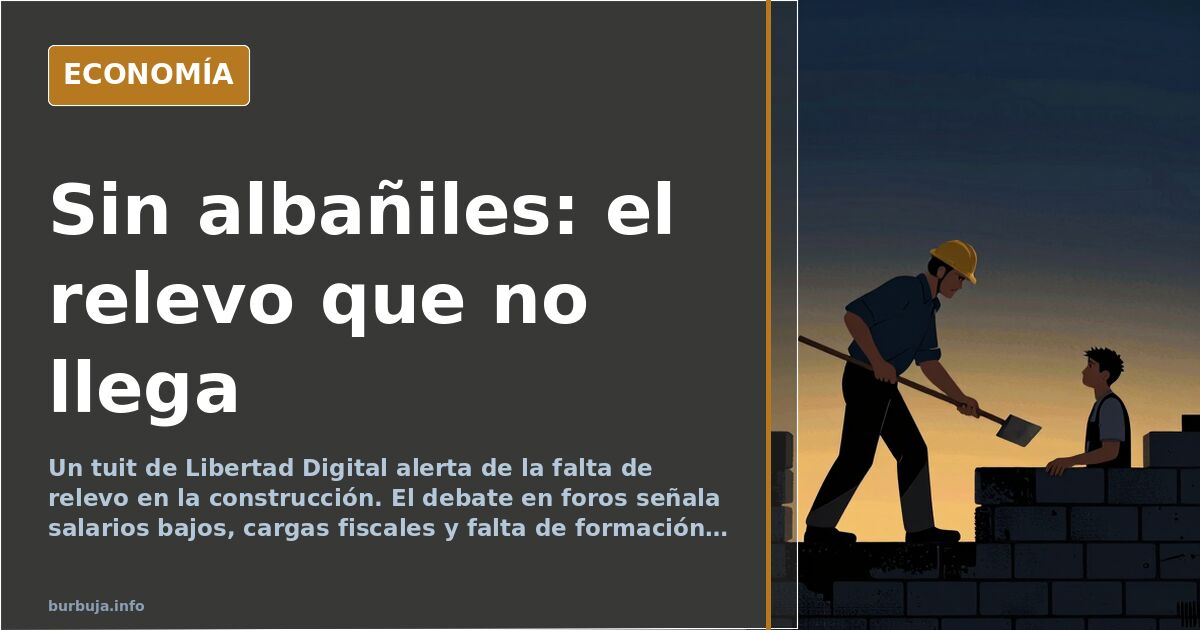
Spain Faces Critical Shortage of Construction Workers
A tweet from Libertad Digital sums up the issue: "Spain is running out of bricklayers: the generational succession is exhausted." The widely circulated news points to a phenomenon beyond construction: entire sectors of the Spanish economy face mass retirements without replacements. Construction is just the tip of the iceberg, affecting elevators, plumbing, electricity, and hospitality. The key question isn't whether workers are missing, but why no one wants the job.
Why No One Wants to Be a Bricklayer in Spain?
The most common answer points to salaries. A gross annual salary of €20,000 in Madrid is, according to one participant, "subsistence-level; you won't starve, but don't expect more." Construction is physically demanding, poorly paid, and socially undervalued. Some argue the problem isn't lack of vocation but lack of incentives: "What has run out are decent wages," another summarizes. The equation is simple: if physical effort isn't compensated, new generations won't join.
The Cost Trap: Self-Employed and Tax Burdens
The debate shifts to the cost structure for self-employed workers. A sector freelancer breaks down expenses: IRPF (income tax) at 24-28%, private health insurance, commercial vehicle maintenance, tools, fines, accountant fees, office costs, work clothes, and monthly social security contributions around €365. "When in doubt, register and tell me how it goes," they joke. Fiscal and bureaucratic burdens discourage professionalization. Another contributor notes the state takes "almost 50% of your salary directly." Consequently, many avoid formalizing their activity or leave the trade entirely.
The Myth of Immigrants Coming to Work
Immigration dominates much of the discussion. Some participants claim migrants arriving don't want construction jobs but seek public employment or social aid. "Those coming are engineers, the best and most qualified. They aren't site laborers," one says sarcastically. Others defend that reality is nuanced: some migrants do work in construction, but replacement isn't automatic. A specific case illustrates this: an experienced Segarro-origin bricklayer got his son onto the site, only for him to be "a lazy good-for-nothing." The boss kept the son to retain the father, who was highly productive. This anecdote shows succession depends on attitude and training, not just origin.
The Elevator Sector: Same Problem in Another Trade
The shortage isn't exclusive to construction. In the elevator industry, there are "a few experienced but aging operators and immigrants with no idea about anything. There's no succession either," one laments. Lack of training and career paths prevents young people from joining and staying. SMEs, which make up the bulk of Spanish business fabric, cannot afford to train or pay adequately. "When children who didn't build the company inherit it after studying Business Administration, the firm collapses," another states. The advice is clear: "Flee them as soon as you can."
The Future: Solutions or Band-Aids?
Proposals range from pragmatic to provocative. Some suggest raising salaries would solve the problem: "Higher wages, and the issues disappear." Others propose drastic measures like military-style service granting residency points in exchange for working in deficit sectors. Some note AI and YouTube tutorials allow homeowners to do renovations themselves, reducing demand. But the core issue persists: without generational succession, competitive wages, and training, construction and manual trades face an uncertain future. A striking contradiction: while debating the lack of bricklayers, birth rates remain at historic lows and housing prices soar. Something doesn't add up.
A tweet from Libertad Digital sums up the issue: "Spain is running out of bricklayers: the generational succession is exhausted." The widely circulated news points to a phenomenon beyond construction: entire sectors of the Spanish economy face mass retirements without replacements. Construction is just the tip of the iceberg, affecting elevators, plumbing, electricity, and hospitality. The key question isn't whether workers are missing, but why no one wants the job.
Why No One Wants to Be a Bricklayer in Spain?
The most common answer points to salaries. A gross annual salary of €20,000 in Madrid is, according to one participant, "subsistence-level; you won't starve, but don't expect more." Construction is physically demanding, poorly paid, and socially undervalued. Some argue the problem isn't lack of vocation but lack of incentives: "What has run out are decent wages," another summarizes. The equation is simple: if physical effort isn't compensated, new generations won't join.
The Cost Trap: Self-Employed and Tax Burdens
The debate shifts to the cost structure for self-employed workers. A sector freelancer breaks down expenses: IRPF (income tax) at 24-28%, private health insurance, commercial vehicle maintenance, tools, fines, accountant fees, office costs, work clothes, and monthly social security contributions around €365. "When in doubt, register and tell me how it goes," they joke. Fiscal and bureaucratic burdens discourage professionalization. Another contributor notes the state takes "almost 50% of your salary directly." Consequently, many avoid formalizing their activity or leave the trade entirely.
The Myth of Immigrants Coming to Work
Immigration dominates much of the discussion. Some participants claim migrants arriving don't want construction jobs but seek public employment or social aid. "Those coming are engineers, the best and most qualified. They aren't site laborers," one says sarcastically. Others defend that reality is nuanced: some migrants do work in construction, but replacement isn't automatic. A specific case illustrates this: an experienced Segarro-origin bricklayer got his son onto the site, only for him to be "a lazy good-for-nothing." The boss kept the son to retain the father, who was highly productive. This anecdote shows succession depends on attitude and training, not just origin.
The Elevator Sector: Same Problem in Another Trade
The shortage isn't exclusive to construction. In the elevator industry, there are "a few experienced but aging operators and immigrants with no idea about anything. There's no succession either," one laments. Lack of training and career paths prevents young people from joining and staying. SMEs, which make up the bulk of Spanish business fabric, cannot afford to train or pay adequately. "When children who didn't build the company inherit it after studying Business Administration, the firm collapses," another states. The advice is clear: "Flee them as soon as you can."
The Future: Solutions or Band-Aids?
Proposals range from pragmatic to provocative. Some suggest raising salaries would solve the problem: "Higher wages, and the issues disappear." Others propose drastic measures like military-style service granting residency points in exchange for working in deficit sectors. Some note AI and YouTube tutorials allow homeowners to do renovations themselves, reducing demand. But the core issue persists: without generational succession, competitive wages, and training, construction and manual trades face an uncertain future. A striking contradiction: while debating the lack of bricklayers, birth rates remain at historic lows and housing prices soar. Something doesn't add up.
Summary of a discussion on Burbuja.info - Foro de economía, actualidad y política., translated from Spanish and reviewed before publication. Read the full discussion (154 replies).
More summaries
-
Heat doesn't scare builders: their salary does
Construction workers earn around 1,300 euros monthly, barely covering Madrid's 1,200-euro rent. Generational renewal fails due to low pay, not summer heat.
-
From the 15M campout to Sol: Fifteen Years and the Same Script
The housing protest culminates in a campout in Sol with the 2011 slogan. The electoral calendar and a potential non-payment regulation are central to the analysis.
-
ISIS claims Moscow attack that killed 143 people
ISIS claimed responsibility for the Crocus City Hall attack in Russia, killing 143, two weeks after US warnings of an imminent threat.
-
Nadal argues athletes should earn based on revenue generated
In an interview with Ana Pastor, Rafael Nadal criticized extreme feminism and defended merit-based pay for athletes.
-
Two arrested in Valladolid group sexual assault case
A woman reports a gang rape in Valladolid; two suspects released with charges, receiving minimal media coverage.
-
Cumulative US Drug Death Graph Distorts Crisis
A cumulative graph of US drug deaths since 1999 shows only upward trends, masking annual rates and fueling debates on fentanyl.