
Alcampo replaces broken LG TV after refusing delivery
A customer bought a 75-inch LG TV at Alcampo in Spain. After the store refused home delivery, the unit arrived damaged, but was eventually replaced.
English · Original discussion in Spanish · Published
Alcampo replaces broken LG TV after refusing delivery
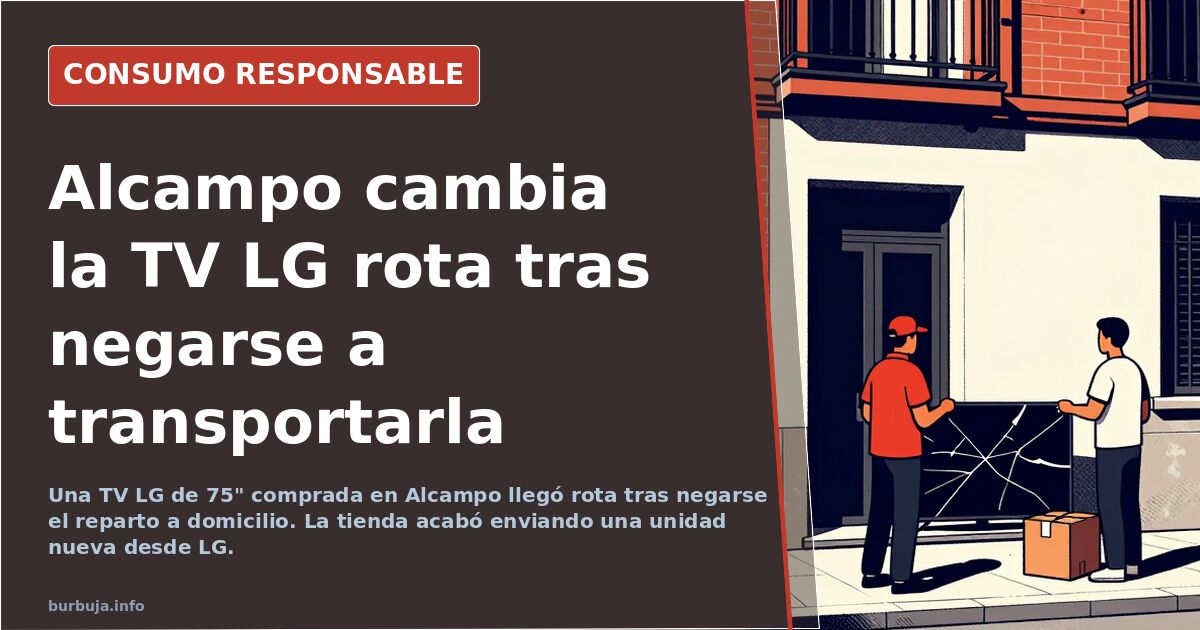
A 75-inch LG television purchased at Alcampo in Spain arrived at the customer's home with the bottom right corner dented and cracked. The buyer collected it from the store using a van because they were told the retailer did not offer home delivery for that model. Upon opening the box, the internal polystyrene protection on the damaged side was broken. Initially, the store stated they "possibly couldn't do anything" and blamed the customer. Days later, Alcampo called to announce a replacement: a new unit sent directly from LG.
The case begins with a specific complaint: a nearly two-meter diagonal TV, without home delivery option, transported by the buyer and found broken upon unpacking. The chain of custody is the core issue. From the moment the item leaves the store, responsibility falls on the buyer, making it almost impossible to prove the damage existed in the warehouse.
What the law requires of buyers and sellers
Legal warranty covers manufacturing defects, not damages occurring after delivery. The buyer argues the box was already in poor condition and the internal polystyrene was broken at the same point as the screen. This coincidence is their main argument: if the internal packaging is damaged at the same corner as the panel, one can argue the impact occurred before sale. The problem is evidentiary. Without an in-store check, involving opening the box and testing power-on, the customer's word competes against the retailer's.
Some recall that regulations require liability for lack of conformity, but also that consumers must be able to prove the product was defective from the start. In practice, the fastest route is usually formal complaint: consumer claims form, consumer protection agency, and if no agreement is reached, court. For amounts under €2,000, no lawyer or legal representative is needed, which lowers the cost of pursuing legal action.
Suspicion regarding the lack of home delivery
One frequently repeated line suggests the refusal to transport the TV was not accidental. A 75-inch screen is a huge, fragile object; excluding it from delivery service places all risk on the customer. Some claim, based on industry experience, that if the store's carrier had peine the box and seen the breakage, the order would have been returned and cancelled. By not offering this service, any damage is attributed to the buyer.
The theory is unproven but fits the outcome. The store ultimately accepted the return and sent a new unit from LG, suggesting the complaint had merit. For the manufacturer, a TV is minor; for the buyer, it is weeks of headache.
How to claim for a broken TV bought in store
The first step is to request in writing the reason why transport is not offered. This document establishes the store's position. Then, file a consumer claims form and contact consumer protection. If the retailer digs in, it is advisable to also approach the manufacturer: commercial warranty often covers manufacturing defects, and with photos of the damaged packaging, the case gains strength.
The most repeated recommendation is to inspect the product in-store before taking it out. Open the box, test the panel, and check for impacts on the packaging. For bulky items, home delivery eliminates the problem: if it arrives broken, responsibility lies with the transporter.
The outcome was favorable: Alcampo could return the broken unit to LG at no cost, and the buyer received a new one. The prediction, with reservations, is that these cases will continue to be resolved through commercial pressure rather than judicial means. As long as the burden of proof remains on the purchaser, those who transport their own TVs play with a disadvantage.
A 75-inch LG television purchased at Alcampo in Spain arrived at the customer's home with the bottom right corner dented and cracked. The buyer collected it from the store using a van because they were told the retailer did not offer home delivery for that model. Upon opening the box, the internal polystyrene protection on the damaged side was broken. Initially, the store stated they "possibly couldn't do anything" and blamed the customer. Days later, Alcampo called to announce a replacement: a new unit sent directly from LG.
The case begins with a specific complaint: a nearly two-meter diagonal TV, without home delivery option, transported by the buyer and found broken upon unpacking. The chain of custody is the core issue. From the moment the item leaves the store, responsibility falls on the buyer, making it almost impossible to prove the damage existed in the warehouse.
What the law requires of buyers and sellers
Legal warranty covers manufacturing defects, not damages occurring after delivery. The buyer argues the box was already in poor condition and the internal polystyrene was broken at the same point as the screen. This coincidence is their main argument: if the internal packaging is damaged at the same corner as the panel, one can argue the impact occurred before sale. The problem is evidentiary. Without an in-store check, involving opening the box and testing power-on, the customer's word competes against the retailer's.
Some recall that regulations require liability for lack of conformity, but also that consumers must be able to prove the product was defective from the start. In practice, the fastest route is usually formal complaint: consumer claims form, consumer protection agency, and if no agreement is reached, court. For amounts under €2,000, no lawyer or legal representative is needed, which lowers the cost of pursuing legal action.
Suspicion regarding the lack of home delivery
One frequently repeated line suggests the refusal to transport the TV was not accidental. A 75-inch screen is a huge, fragile object; excluding it from delivery service places all risk on the customer. Some claim, based on industry experience, that if the store's carrier had peine the box and seen the breakage, the order would have been returned and cancelled. By not offering this service, any damage is attributed to the buyer.
The theory is unproven but fits the outcome. The store ultimately accepted the return and sent a new unit from LG, suggesting the complaint had merit. For the manufacturer, a TV is minor; for the buyer, it is weeks of headache.
How to claim for a broken TV bought in store
The first step is to request in writing the reason why transport is not offered. This document establishes the store's position. Then, file a consumer claims form and contact consumer protection. If the retailer digs in, it is advisable to also approach the manufacturer: commercial warranty often covers manufacturing defects, and with photos of the damaged packaging, the case gains strength.
The most repeated recommendation is to inspect the product in-store before taking it out. Open the box, test the panel, and check for impacts on the packaging. For bulky items, home delivery eliminates the problem: if it arrives broken, responsibility lies with the transporter.
The outcome was favorable: Alcampo could return the broken unit to LG at no cost, and the buyer received a new one. The prediction, with reservations, is that these cases will continue to be resolved through commercial pressure rather than judicial means. As long as the burden of proof remains on the purchaser, those who transport their own TVs play with a disadvantage.
Also available in: Deutsch
Summary of a discussion on Burbuja.info - Foro de economía, actualidad y política., translated from Spanish and reviewed before publication. Read the full discussion (122 replies).
More summaries
-
Spain's shower timer cuts water when time runs out
A Spanish utility model shower valve closes automatically after a set time, targeting the 12% of national water use attributed to households by INE.
-
Spain: Debate on responsible spending after €986 phone purchase
In Spain, a €986 smartphone sparks debate on responsible consumption versus high-end alternatives costing €180 or €320.
-
Indoor LED Grow: €38 Electricity for 200g Yield
A 120W LED lamp adds €38 to electricity bills per cycle, yielding 200g of dry flower quarterly, according to amateur calculations.
-
Heating oil: fill the tank now or wait?
Heating oil prices jump 7 cents in days: filling a 1,500-litre tank now costs over €100 extra. When it pays to wait.
-
Coolbaby RS-97: Forum user says it doesn't beat PSP
The Coolbaby RS-97 promises Doom and Neo Geo emulation for €35, but version chaos led a forum user to resell it.
-
Spain's Maria biscuit sales drop 6% as sector revenue rises
Maria biscuit sales fall 6% and revenue nearly 5%, while the Spanish biscuit sector grows 2.2% and manufacturer brands gain ground.