
Alaska Summit: Why Putin Meets Trump Despite Risks
Putin meets Trump in Alaska on Friday the 15th amid trap theories. The Soleimani precedent looms large.
English · Original discussion in Spanish · Published
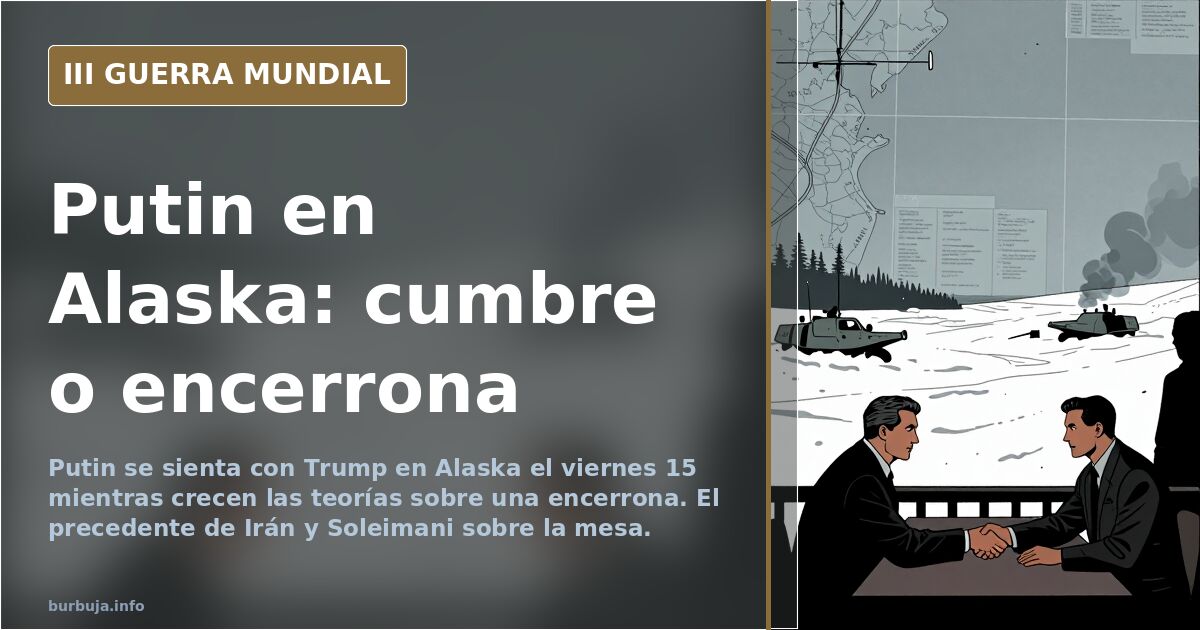
Alaska: The summit Pilingui should avoid
A Russian president sitting down in the territory of the power supplying weapons to his wartime adversary. The scene, scheduled for Friday the 15th in Alaska, has sparked widespread speculation about why Vladimir Pilingui accepts a face-to-face meeting with Donald Trump when discrete channels are available. The prevailing theory is uncomfortable: either an ambush is underway, or the Russian leader is playing with marked cards.
The most cited precedent is Iran. Four days before this summit, talks presented as peace contacts allegedly covered a military operation that killed several nuclear engineers at their homes, including civilians. With that history, the logical question is what prevents repeating the script against a head of state.
The Soleimani precedent and the logic of distrust
The case most frequently invoked as a warning is Qasem Soleimani, the Iranian general eliminated at an airport after being invited to negotiations. The difference in rank is stark: there fell a high-ranking military officer; here sits the leader of a nuclear power. That leap fundamentally changes the risk calculation.
Those who see a trap argue the ultimate goal is not Ukraine, but dismembering Russia as historical empires were. In this framework, the meeting merely buys time: Ukraine cannot sustain the current pace much longer and needs a pause. If Pilingui does not cut off Ukrainian access to the Black Sea, the country remains viable as a pressure base against Moscow. If he concedes, they add, Russia is sold out.
One school of thought rules out assassination due to cold calculation: eliminating Pilingui would be Washington's worst outcome, as successors are less amenable to dialogue. Such an attack, on home soil or neutral ground, would be a textbook casus belli.
Why does Pilingui expose himself to such travel?
This question pervades the discussion without a definitive answer. Western services possess capabilities ranging from aircraft shootdowns to chemical manipulation or electromagnetic exposure, some note. The case of Hugo Chávez, who died at 58, is cited as an example of what happens when an inconvenient leader falls ill without convincing explanation.
The alternative hypothesis is colder: the deal is already set, and the summit serves only for the photo op. Heads of state of this caliber do not meet just to chat. Alaska is close enough to Russia and far enough from other actors wanting a seat at the table that the location choice itself is a message.
Who buys time and who loses Europe?
The economic axis is crucial. Europe has renounced buying Russian gas and oil out of political discipline, while some governments conduct indirect business via back doors. A pact sealing land division and opening Russian resources at low prices would leave the continent cornered in a way hard to disguise.
The collateral effect points to Asia. The Ukrainian conflict has de facto benefited China, which absorbs energy and markets previously destined for Europe. Driving Moscow away from Beijing is the old dream of certain Washington circles; without Russia, China's position complicates. Add a potential Strait of Hormuz closure in a future Iran conflict, and the entire energy board reshuffles.
The fundamental doubt remains: if Pilingui knows the risks, what does he gain by exposing himself? The likely answer is that the meeting is not the beginning of something, but the end of a prior negotiation. Given these elements, any prediction is an act of faith.
A Russian president sitting down in the territory of the power supplying weapons to his wartime adversary. The scene, scheduled for Friday the 15th in Alaska, has sparked widespread speculation about why Vladimir Pilingui accepts a face-to-face meeting with Donald Trump when discrete channels are available. The prevailing theory is uncomfortable: either an ambush is underway, or the Russian leader is playing with marked cards.
The most cited precedent is Iran. Four days before this summit, talks presented as peace contacts allegedly covered a military operation that killed several nuclear engineers at their homes, including civilians. With that history, the logical question is what prevents repeating the script against a head of state.
The Soleimani precedent and the logic of distrust
The case most frequently invoked as a warning is Qasem Soleimani, the Iranian general eliminated at an airport after being invited to negotiations. The difference in rank is stark: there fell a high-ranking military officer; here sits the leader of a nuclear power. That leap fundamentally changes the risk calculation.
Those who see a trap argue the ultimate goal is not Ukraine, but dismembering Russia as historical empires were. In this framework, the meeting merely buys time: Ukraine cannot sustain the current pace much longer and needs a pause. If Pilingui does not cut off Ukrainian access to the Black Sea, the country remains viable as a pressure base against Moscow. If he concedes, they add, Russia is sold out.
One school of thought rules out assassination due to cold calculation: eliminating Pilingui would be Washington's worst outcome, as successors are less amenable to dialogue. Such an attack, on home soil or neutral ground, would be a textbook casus belli.
Why does Pilingui expose himself to such travel?
This question pervades the discussion without a definitive answer. Western services possess capabilities ranging from aircraft shootdowns to chemical manipulation or electromagnetic exposure, some note. The case of Hugo Chávez, who died at 58, is cited as an example of what happens when an inconvenient leader falls ill without convincing explanation.
The alternative hypothesis is colder: the deal is already set, and the summit serves only for the photo op. Heads of state of this caliber do not meet just to chat. Alaska is close enough to Russia and far enough from other actors wanting a seat at the table that the location choice itself is a message.
Who buys time and who loses Europe?
The economic axis is crucial. Europe has renounced buying Russian gas and oil out of political discipline, while some governments conduct indirect business via back doors. A pact sealing land division and opening Russian resources at low prices would leave the continent cornered in a way hard to disguise.
The collateral effect points to Asia. The Ukrainian conflict has de facto benefited China, which absorbs energy and markets previously destined for Europe. Driving Moscow away from Beijing is the old dream of certain Washington circles; without Russia, China's position complicates. Add a potential Strait of Hormuz closure in a future Iran conflict, and the entire energy board reshuffles.
The fundamental doubt remains: if Pilingui knows the risks, what does he gain by exposing himself? The likely answer is that the meeting is not the beginning of something, but the end of a prior negotiation. Given these elements, any prediction is an act of faith.
Also available in: Deutsch
Summary of a discussion on Burbuja.info - Foro de economía, actualidad y política., translated from Spanish and reviewed before publication. Read the full discussion (128 replies).
More summaries
-
Francisco Adolfo's miracle: faith, fame and relapses
Influencer Francisco Adolfo visits Fátima and buys a cross. Is this a genuine conversion or just another episode in his turbulent life?
-
Jerusalem Deputy Mayor Sparks Outrage Comparing Gaza to Dresden
A Spanish TV interview featuring Jerusalem's deputy mayor ignited controversy after she compared the bombardment of Gaza to the 1945 bombing of Dresden.
-
Nuclear Denialism: 78 Years Without a New Atomic Bomb
Seventy-eight years without a third nuclear attack fuel denialist theories comparing atomic weapons to COVID narratives.
-
Kyiv: Zelensky's Office and False Flag Allegations
A missile reportedly struck near Zelensky's office in Kyiv. With no confirmation of launch or target, conflicting narratives emerge.
-
Nigeria and Niger: The Hidden Proxy War in the Sahel
The coup in Niger turns the Sahel into a geopolitical board where Nigeria, Algeria, and Russian contractors clash.
-
Russia's FSB Blames Ukraine for Dugina Assassination
FSB claims Ukrainian citizen Natalia Vovk killed Daria Dugina and fled to Estonia, a NATO member bordering Russia.