
Air rifles for 25m: caliber choice and budget guide
For 25-meter target shooting, .177 offers precision while .22 provides impact. The legal limit in Spain is 24 joules, with prices ranging from €118 to €284.
English · Original discussion in Spanish · Published
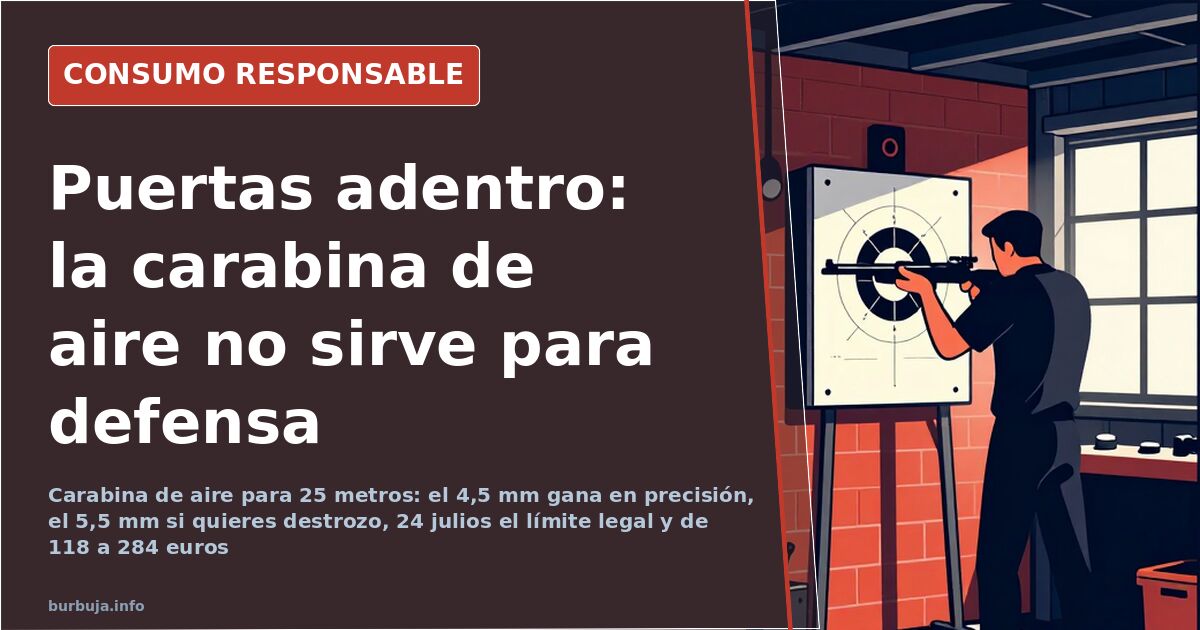
Air rifle for 25 meters: .177 or .22 and how much to spend
Does it make sense to spend €275 on an air rifle to shoot at a target in the garden? This seemingly domestic question hides three decisions that alucinación up those who improvise: caliber, power, and the actual distance they will be shooting from. The starting point was a small target and 25 meters available, with a clear preference for wood and a budget oscillating between €231 for the Cometa Fenix 400 in .22 and €284 for a Gamo Replay Maxxim with scope. In between, the Weihrauch HW50 in .177 at €275 and, lower down, the Hatsan Striker 1000X for €118.
The conversation went where these discussions usually go: first to self-defense, then to legal power limits, and finally, as almost always, to the rest position and breathing technique.
Which caliber to choose, .177 or .22?
.177 wins in precision and .22 wins in stopping power, and that is the entire debate. Some summarize it without nuance: precision, .177 without doubt. The argument for .22 points to impact: at 26 meters it can burst a bottle or shatter chalk, although its heavier pellet suffers more drop and requires correction beyond 25 meters.
The trap lies in usage. Those who shoot in ranges defend .177 because it is used in competitions and because .22 is not regulated in those disciplines. Those who shoot cans and bottles in a garden find a notable difference in fun with .22. It is not the same to refine your aim as to make holes.
How much power is needed to shoot at 25 meters?
Less than one might assume. For 15 meters, 7.5 joules are sufficient, and 12 joules are already considered ample power for home use. A 16-joule rifle handles 25 meters without difficulty. The legal ceiling in Spain is 24 joules, and above that figure, the weapon must be registered as a firearm: there we are no longer talking about hobby, but about licensing.
It is useful to know where each thing stands. A PCP rifle reaches 80 or 120 joules depending on the model, a .22 LR rifle moves between 120 and 150. That is, an unrestricted PCP plays in the league of a firearm. And many are bought restricted and then modified, which improves nothing: you cannot hunt with them, and using them for defense turns any problem into a legal one.
Price: from €118 to €284 for the same entertainment
The price range is wide and does not always correlate with what one needs. The cheapest Hatsan costs €118; a plastic Gamo Shadow is around €100, and some argue it is more fun than models three times more expensive. The jump to wood and fine precision costs money, and ammunition is not the issue: boxes of pellets under €4, with quality benchmarks set by JSB Exact Express .177.
There is a school of thought that recommends starting cheap and upgrading only when the addiction hits. Another responds that if you are only going to buy one, better to buy well and have it last. Both are defensible, and both end up asking the same question: how many hours are you going to put into it?
Scope, rest, and steady hand
The first shots were taken standing, unsupported, with iron sights and uncalibrated. The conclusion was immediate: holding steady at 20 meters is difficult and grouping opens up. The technical recommendation is to shoot seated, with support, calibrate at 10 meters, and repeat the exact position for every shot. And buy a scope only when the distance justifies it: not at 15 meters.
There is also the neighbor variable. A spring-powered rifle of 20 or 24 joules makes a lot of noise; a 3-joule pistol makes practically none. For short distances with a party wall in between, that difference weighs more than it seems.
The drift toward self-defense and why it fails
Much of the conversation drifted to whether a pellet pistol serves to protect the house. The prevailing answer is no. One participant notes that rubber ammunition is illegal in Spain, leaving open the doubt whether steel requires a license. Domestic power levels do not incapacitate anyone in a stress situation: there is no stopping power, no margin, and all you achieve is worsening the situation. The technical consensus points in the same direction: without real capacity to stop, the tool is unnecessary.
In the end, the rifle arrived, distances were marked at 10, 15, 20, and 24 meters, and the first paper targets with holes appeared. The .177 pellets looked tiny next to those used by the father-in-law. And the hand still trembled just the same. You can discuss for months over joules, calibers, and brands; the cardboard, however, does not have an opinion.
Does it make sense to spend €275 on an air rifle to shoot at a target in the garden? This seemingly domestic question hides three decisions that alucinación up those who improvise: caliber, power, and the actual distance they will be shooting from. The starting point was a small target and 25 meters available, with a clear preference for wood and a budget oscillating between €231 for the Cometa Fenix 400 in .22 and €284 for a Gamo Replay Maxxim with scope. In between, the Weihrauch HW50 in .177 at €275 and, lower down, the Hatsan Striker 1000X for €118.
The conversation went where these discussions usually go: first to self-defense, then to legal power limits, and finally, as almost always, to the rest position and breathing technique.
Which caliber to choose, .177 or .22?
.177 wins in precision and .22 wins in stopping power, and that is the entire debate. Some summarize it without nuance: precision, .177 without doubt. The argument for .22 points to impact: at 26 meters it can burst a bottle or shatter chalk, although its heavier pellet suffers more drop and requires correction beyond 25 meters.
The trap lies in usage. Those who shoot in ranges defend .177 because it is used in competitions and because .22 is not regulated in those disciplines. Those who shoot cans and bottles in a garden find a notable difference in fun with .22. It is not the same to refine your aim as to make holes.
How much power is needed to shoot at 25 meters?
Less than one might assume. For 15 meters, 7.5 joules are sufficient, and 12 joules are already considered ample power for home use. A 16-joule rifle handles 25 meters without difficulty. The legal ceiling in Spain is 24 joules, and above that figure, the weapon must be registered as a firearm: there we are no longer talking about hobby, but about licensing.
It is useful to know where each thing stands. A PCP rifle reaches 80 or 120 joules depending on the model, a .22 LR rifle moves between 120 and 150. That is, an unrestricted PCP plays in the league of a firearm. And many are bought restricted and then modified, which improves nothing: you cannot hunt with them, and using them for defense turns any problem into a legal one.
Price: from €118 to €284 for the same entertainment
The price range is wide and does not always correlate with what one needs. The cheapest Hatsan costs €118; a plastic Gamo Shadow is around €100, and some argue it is more fun than models three times more expensive. The jump to wood and fine precision costs money, and ammunition is not the issue: boxes of pellets under €4, with quality benchmarks set by JSB Exact Express .177.
There is a school of thought that recommends starting cheap and upgrading only when the addiction hits. Another responds that if you are only going to buy one, better to buy well and have it last. Both are defensible, and both end up asking the same question: how many hours are you going to put into it?
Scope, rest, and steady hand
The first shots were taken standing, unsupported, with iron sights and uncalibrated. The conclusion was immediate: holding steady at 20 meters is difficult and grouping opens up. The technical recommendation is to shoot seated, with support, calibrate at 10 meters, and repeat the exact position for every shot. And buy a scope only when the distance justifies it: not at 15 meters.
There is also the neighbor variable. A spring-powered rifle of 20 or 24 joules makes a lot of noise; a 3-joule pistol makes practically none. For short distances with a party wall in between, that difference weighs more than it seems.
The drift toward self-defense and why it fails
Much of the conversation drifted to whether a pellet pistol serves to protect the house. The prevailing answer is no. One participant notes that rubber ammunition is illegal in Spain, leaving open the doubt whether steel requires a license. Domestic power levels do not incapacitate anyone in a stress situation: there is no stopping power, no margin, and all you achieve is worsening the situation. The technical consensus points in the same direction: without real capacity to stop, the tool is unnecessary.
In the end, the rifle arrived, distances were marked at 10, 15, 20, and 24 meters, and the first paper targets with holes appeared. The .177 pellets looked tiny next to those used by the father-in-law. And the hand still trembled just the same. You can discuss for months over joules, calibers, and brands; the cardboard, however, does not have an opinion.
Summary of a discussion on Burbuja.info - Foro de economía, actualidad y política., translated from Spanish and reviewed before publication. Read the full discussion (158 replies).
More summaries
-
Amazon Prime: Is Paying €50 Per Year Worth It?
The Amazon Prime annual subscription has jumped to €50. We analyze whether the benefits outweigh the cost or if it's just a trap to spend more. Data and alternatives.
-
Heating oil: fill the tank now or wait?
Heating oil prices jump 7 cents in days: filling a 1,500-litre tank now costs over €100 extra. When it pays to wait.
-
Car Maintenance: From Window Failures to Workshop Savings
Real savings in car mechanics: comparing filter costs, window repairs, and maintenance tips.
-
Spain's AVE: €25M per km, trains capped at 180 km/h
High-speed trains designed for 360 km/h run at 180. New track costs €25M/km, while electrifying conventional lines is far cheaper.
-
Sunflower oil hits €3.20, petrol rises to €1.90 per liter
In Spain, sunflower oil prices tripled and fuel rose sharply, while Lidl's bread remains stable at 37 cents.
-
Spain's Excellence Baccalaureate: Lower Grades, Same Entry Test
In Spain, the Excellence Baccalaureate lowers grades while keeping the university entrance exam unchanged, raising the cut-off score for Medicine.