
Air raid sirens in Germany: drill or war warning?
Sirens sounded three times in Germany during a scheduled test, while Russian TV listed four European countries as potential targets.
English · Original discussion in Spanish · Published
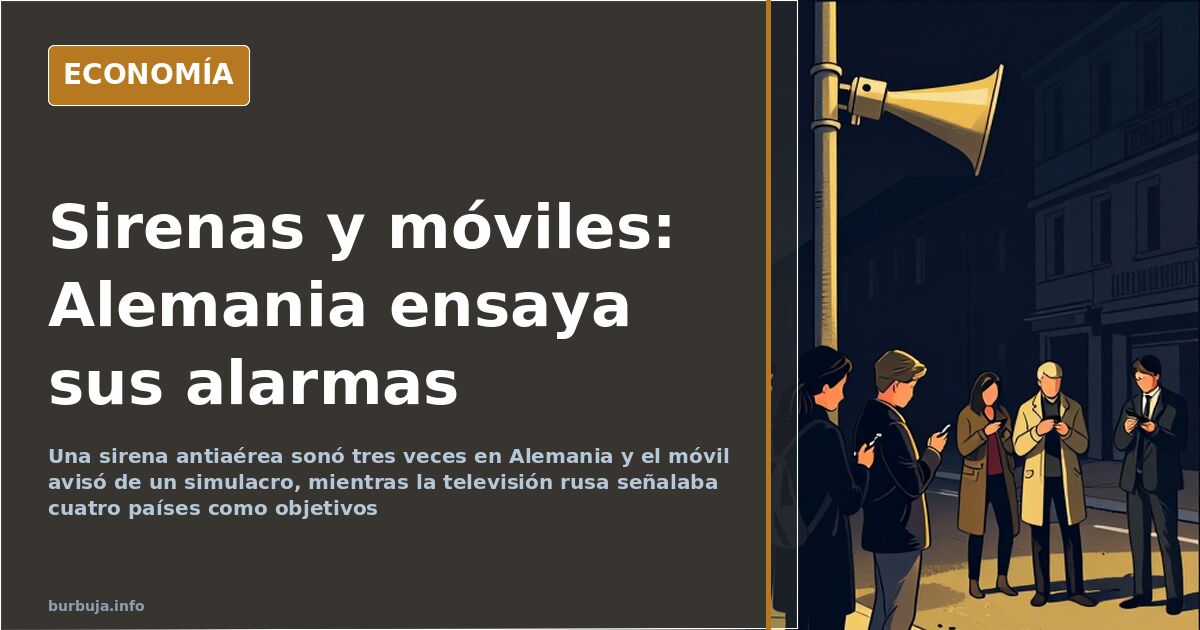
Air raid sirens in Germany: routine test or war rehearsal?
Three times in one hour. That is the figure framing the scene: an air raid siren sounded three times in Germany while an international truck driver was in the country, and immediately after, his mobile phone started emitting alert messages. The text of those warnings cleared up any doubt—it was just a drill—but the shock had already set in. Air raid alarms have sounded again in Germany without anyone declaring war, and that is where the problem begins: it is unclear whether this is civil protection or a general rehearsal.
The driver had been on the international route for a short time, accompanied by a colleague with more miles under his belt. The veteran’s reaction was almost a shrug: in the Netherlands, they have been doing this for as long as he can remember. And it is not just a feeling. Dutch tests trinc a fixed calendar, with the first Monday of every month and two annual alerts to mobile phones. For someone who has just arrived, the first time is scary; for someone who has lived there for years, it is like the garbage truck.
Are siren drills normal in Germany and the Netherlands?
Yes, and that is the paradox. The siren and mobile alert system was not set up for a specific emergency: it remains operational precisely because it needs to be checked that it works. In the German case, the mobile alert indicated it was an exercise, and in the Dutch case, the schedules are so predictable that they have become part of the soundscape.
The mechanism makes sense. A siren that never sounds is a siren no one knows how to interpret, and a mobile alert no one has seen before triggers calls to emergency services as soon as it appears on screen. Hence the insistence on scheduled tests, with the warning that it is an exercise incorporated into the message itself. When the environment is what it is, the problem is not the test: it is the context in which it is done.
Some report that in Amsterdam the first siren left them frozen, and others claim that at some point they stopped using them to avoid traumatizing Ukrainian refugees. This point circulates as an assertion, without official backing. Against the thesis of useless noise, some recall that siren tests in Europe predate World War II and, therefore, NATO.
Russian television and the four countries in the crosshairs
The background noise came from something else. In the aftermath of the drill, content from a tweet by El HuffPost circulated, stating that Russian television names four European countries that could be attacked with nuclear weapons. Participants’ responses coincided almost exactly on the list: France, Germany, Poland, and the United Kingdom.
That a television schedule airs that list does not make it a plan, but it feeds the market of antiestéticar. And that market has a price: defense spending, shelters, junk bought with a security label. On top of the list, the usual theories were mounted: that the US, Israel, and the UK are behind it; that NATO is an expansive organization rather than defensive, looting resources. All this circulates as opinion, with no proof other than the coincidence of names on a screen.
How much is civil protection and how much is a campaign of antiestéticar?
Here opinions divide. One side argues that these alerts are technical routine and confusing them with an imminent attack means you have never lived in central Europe. The other side reads the same thing differently: the alarm would be to war what masks were to the pandemic, a way to accept measures that would be unacceptable in any other context. In between, some directly ask to stop funding Ukraine so the conflict dies down, and others respond that such haste smells like the fable of the boy who cried wolf: warning so much about what doesn’t come that when it does, no one will move. Some also see the alarm as the perfect excuse for a new tax grab.
Crossed accusations turned harsher: charges of cowardice for not going to fight in Donbas and replies telling the accusers to go themselves. The temperature rises, the data falls.
Shelters, anti-aircraft towers, and the new normal
War imagery mixed with concrete. WWII anti-aircraft towers appeared—some participants claim many still stand in Germany—and the idea that someone might restore their function. Someone joked about taking an excavator and building a nuclear shelter in the garden in case they sound again. Another suggested that all air raid alarms are triggered because a teenager flies a €100 drone over a doorway. And some dismissed their concern by canceling a tourist alucinación to Berlin and openly talking about a new normal.
For travelers, the question is more mundane: what if I get caught out? Someone planning a alucinación to Sweden and camping on the Norway-Russia border summarized the mood better than any analysis: they were getting anxious enough to feel cold.
With announced drills, mobile alerts, and state television airing target lists, the line between being prepared and being scared is increasingly thin. How many more warnings are needed for routine to stop looking like routine?
Also available in: Deutsch
Summary of a discussion on Burbuja.info - Foro de economía, actualidad y política., translated from Spanish and reviewed before publication. Read the full discussion (109 replies).
More summaries
-
Vladi Orlov’s Donbas War: 57% of Ukrainians Seek Peace Talks
Hispanic-Ukrainian basketball player Vladi Orlov discusses 8 years of war in Donbass, revealing that 57% of Ukrainians now favor negotiations with Russia.
-
Dutch band's pasodoble in Delft goes viral and stirs emotions
A Dutch band plays the pasodoble 'España cañí' in Delft and the video tops a million views. An analysis of Spanish soft power and its economic impact.
-
Why Spain's Minimum Wage Stalls While Ireland and the Netherlands Raise It
With Spain's minimum wage at 700 euros, only 5% of the active population earns it. Here are the data supporting and blocking the increase.
-
Putin's plane forced to circle Moscow amid drone attack
Reports indicate Putin's aircraft could not land in Moscow during a Ukrainian drone strike, with three official Russian planes circling the airport.
-
Saturday night talk shows in Spain: no centrist option in sight
Malas Lenguas Noche on La 2 and La Sexta Xplica go head to head on Saturday at 21:30. Neither is seen as a centrist talk show, and TV viewership is dwindling.
-
A €1,000 pension in Spain: comfortable or a pittance, depending on who's counting
A retiree with €1,000 and a paid-off home can live better than a young worker earning €1,800 who pays rent. The debate over capping pensions, explained in detail.