
AI promises a new world, but the forum asks: what about energy?
Marc Vidal argues we are not ready for GPT-4. Skeptics in the thread point to another ceiling: energy, debt and wages.
English · Original discussion in Spanish · Published
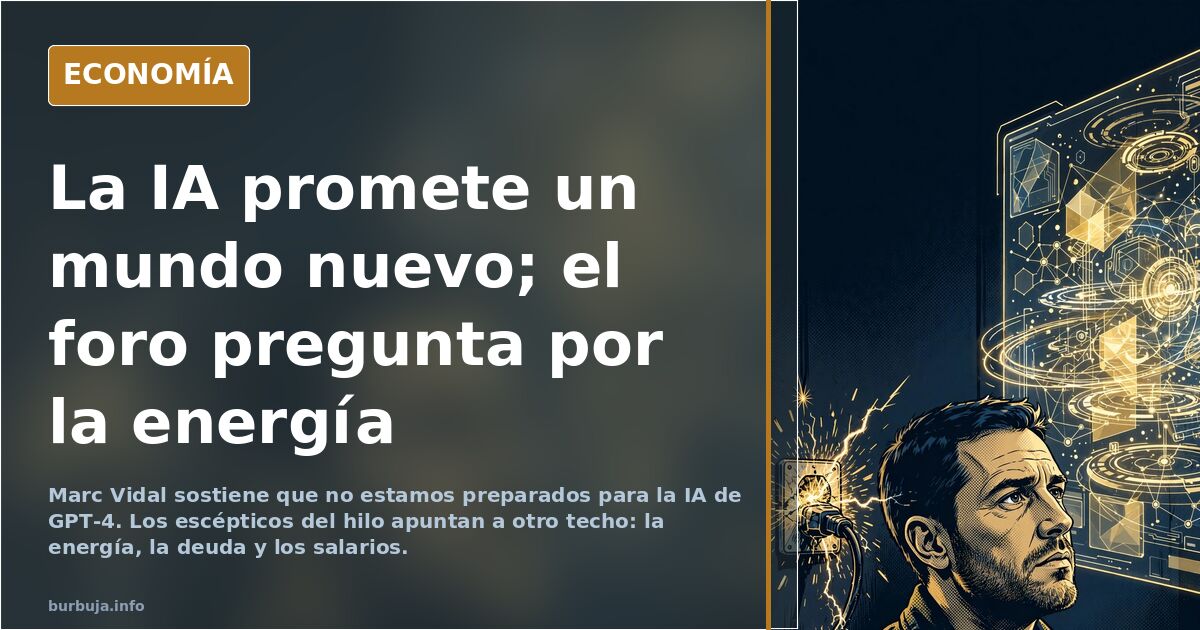
GPT-4 promises a new world; energy says no
Are we ready for what is coming? Marc Vidal argues we are not, in a six-minute video about GPT-4 and the leap artificial intelligence claims it will make over the economy. His thesis: full automation would change the production model and return people to the essentials, to their roots. The reception has been a collective "we'll see." The takeaway some draw is that he is just another prophet of the tech apocalypse, one of those who have spent decades announcing a new world that never quite arrives.
The paradox is amusing: the video warning about artificial intelligence was, in some cases, summarized using another artificial intelligence. What is not in dispute is whether the tool is powerful.
What GPT-4 is and why it fuels antiestéticar
ChatGPT-4 represents a real advance in natural language processing, and nobody denies that. The video's own summary describes it as a technology capable of automating industry and forcing a new economic model. So far, the usual script.
The problem appears when you ask how it works. One participant speaks of emergent capabilities: behaviors its designers did not program and cannot fully explain. There are two readings of this. Some interpret it as a marketing campaign to inflate the AI company bubble. Others, with more vertigo, believe that if it were true we would be facing the theses Penrose set out in The Emperor's New Mind.
The letter calling for a pause in training
The issue stopped being a laboratory curiosity when Elon Musk and other public figures signed a petition to "immediately pause the training" of these systems. The cover The Economist devoted to the future of artificial intelligence confirmed that the topic had entered the agenda. Signatories of considerable stature and one uncomfortable detail: the developers themselves admit they do not fully control what they build.
The response from the skeptical trench comes quickly: pure marketing. The same people who announced flying cars, 3D printers for everyone and tourist metaverses. Promises that all ended up on the shelf of past fads.
The limit AI cannot manufacture: energy
Here is the objection that weighs most. One participant puts it this way: ChatGPT and everything else cannot work without energy. And fossil energy is running out. The scenario he paints is not a hyper-technological world but global impoverishment and wars over resources. A lack of oil is not fixed with a screen: people need to eat, stay warm and get around.
The underlying contradiction is old, and another forum member raises it: if the world is ending, if we pollute too much and cannot even eat meat, it is hard to maintain at the same time that we are heading toward a technological paradise full of gadgets. It is one or the other. And at that point the analysis splits.
Silicon, the singularity and the fairy tale
The muscle also has a ceiling, according to the skeptics. Computing power is at its limit: silicon can give no more. The technological singularity, that moment when the machine improves itself without restraint, is dismissed as a fairy tale. For the skeptics, what is coming is more modest: some new gadgets, more automation and the dismissal of anyone who does not contribute.
The next frontier would be the quantum computer, but that does not look imminent either, according to another participant. The skeptical bet is that we will not see that leap in our lifetime.
What is really coming: debt, inflation and wages
Against the technological narrative, the diagnosis most repeated in the thread is the economic and boring one. One forum member puts it this way: what is coming is paying off debt and devaluing wages through inflation, losing purchasing power little by little. Not overnight: gradual, old and already underway. The reference is the 2008 crisis, when, according to another post, the remedy applied turned out worse than the disease.
Nobody takes the blow-up as certain, but nobody rules it out either. In that scenario, the recipe one participant proposes is not to prepare: it is to maintain personal dignity in times that do not give it away.
In the end, the starting question does not matter. Artificial intelligence will change things, they say. Oil, debt and the end-of-month paycheck will too. Those do not come with an update.
Are we ready for what is coming? Marc Vidal argues we are not, in a six-minute video about GPT-4 and the leap artificial intelligence claims it will make over the economy. His thesis: full automation would change the production model and return people to the essentials, to their roots. The reception has been a collective "we'll see." The takeaway some draw is that he is just another prophet of the tech apocalypse, one of those who have spent decades announcing a new world that never quite arrives.
The paradox is amusing: the video warning about artificial intelligence was, in some cases, summarized using another artificial intelligence. What is not in dispute is whether the tool is powerful.
What GPT-4 is and why it fuels antiestéticar
ChatGPT-4 represents a real advance in natural language processing, and nobody denies that. The video's own summary describes it as a technology capable of automating industry and forcing a new economic model. So far, the usual script.
The problem appears when you ask how it works. One participant speaks of emergent capabilities: behaviors its designers did not program and cannot fully explain. There are two readings of this. Some interpret it as a marketing campaign to inflate the AI company bubble. Others, with more vertigo, believe that if it were true we would be facing the theses Penrose set out in The Emperor's New Mind.
The letter calling for a pause in training
The issue stopped being a laboratory curiosity when Elon Musk and other public figures signed a petition to "immediately pause the training" of these systems. The cover The Economist devoted to the future of artificial intelligence confirmed that the topic had entered the agenda. Signatories of considerable stature and one uncomfortable detail: the developers themselves admit they do not fully control what they build.
The response from the skeptical trench comes quickly: pure marketing. The same people who announced flying cars, 3D printers for everyone and tourist metaverses. Promises that all ended up on the shelf of past fads.
The limit AI cannot manufacture: energy
Here is the objection that weighs most. One participant puts it this way: ChatGPT and everything else cannot work without energy. And fossil energy is running out. The scenario he paints is not a hyper-technological world but global impoverishment and wars over resources. A lack of oil is not fixed with a screen: people need to eat, stay warm and get around.
The underlying contradiction is old, and another forum member raises it: if the world is ending, if we pollute too much and cannot even eat meat, it is hard to maintain at the same time that we are heading toward a technological paradise full of gadgets. It is one or the other. And at that point the analysis splits.
Silicon, the singularity and the fairy tale
The muscle also has a ceiling, according to the skeptics. Computing power is at its limit: silicon can give no more. The technological singularity, that moment when the machine improves itself without restraint, is dismissed as a fairy tale. For the skeptics, what is coming is more modest: some new gadgets, more automation and the dismissal of anyone who does not contribute.
The next frontier would be the quantum computer, but that does not look imminent either, according to another participant. The skeptical bet is that we will not see that leap in our lifetime.
What is really coming: debt, inflation and wages
Against the technological narrative, the diagnosis most repeated in the thread is the economic and boring one. One forum member puts it this way: what is coming is paying off debt and devaluing wages through inflation, losing purchasing power little by little. Not overnight: gradual, old and already underway. The reference is the 2008 crisis, when, according to another post, the remedy applied turned out worse than the disease.
Nobody takes the blow-up as certain, but nobody rules it out either. In that scenario, the recipe one participant proposes is not to prepare: it is to maintain personal dignity in times that do not give it away.
In the end, the starting question does not matter. Artificial intelligence will change things, they say. Oil, debt and the end-of-month paycheck will too. Those do not come with an update.
Also available in: Deutsch
Summary of a discussion on Burbuja.info - Foro de economía, actualidad y política., translated from Spanish and reviewed before publication. Read the full discussion (104 replies).
More summaries
-
AI as an economic engine: bubble or structural shift?
Economic analysis of AI: Is it the growth engine or a speculative bubble? Energy costs and business adoption are examined.
-
AI Leaves Translator With No Income: "There's Nothing Now"
A UNCTAD report estimates over 8 million jobs could be lost in Spain by 2033. A translator is already using her savings to survive.
-
AI Satirizes the Housing Bubble and Imminent Crash
AI videos mocking the real estate bubble and imminent crash. Digital era technical satire.
-
Milan as a mirror: A young woman's testimony on Italian immigration
A young traveler returns from Milan, claiming migrant presence is higher than in Spain, sparking debate on wages and demographics.
-
Tesla Model S mortality rate exceeds 2001 VW Passat
IIHS data shows the Tesla Model S 4WD has 17 deaths per million, while the Lexus ES records zero, questioning Autopilot's safety claims.
-
Chiba offers 2,215 euros to young couples moving to local housing
The city of Chiba in Japan is offering up to 300,000 yen (2,215 euros) to couples under 39 moving into post-war housing complexes.