
AI hits offices before manual trades
Robot demos suggest automation targets accounting and admin roles first, not construction or cooking.
English · Original discussion in Spanish · Published
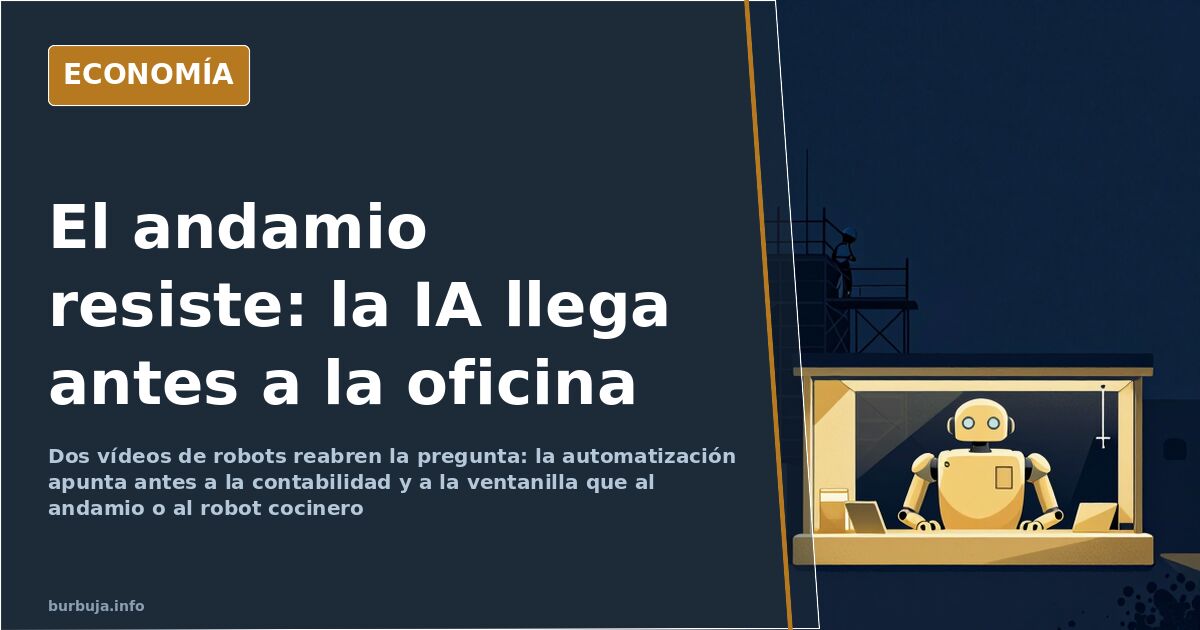
Robots don't fix toilets: AI targets office work first
Two robotics demos are circulating as a preview of what's coming: a robot that transports and places packages, EvoBOT, and another that cooks. The headline accompanying them is usually the same: manual trades are numbered. The list trinc it includes massages, surgery, and repairs, with an uncomfortable caveat: when artificial intelligences design or control those machines, people become redundant.
The joke is easy. The useful question is different: if this happens, will it start with who cooks the pizza or who invoices it? Here the issue splits in two and no one has managed to close it.
A cooking robot needs half a dozen other robots
The video of the cooking robot impresses until someone looks at the backroom. The machine doesn't open the fridge, peel, cut, refill the oil bottle or pepper shaker. Someone has to restock each container, leaving it in the exact spot and quantity so the arm finds it and doesn't get confused. A robochef, in short, is useless without several auxiliary robots preparing the ground. The full breakdown of those support tasks, task by task, is longer than the video itself and kills much of the enthusiasm. No one pays for that deployment for a pizza.
With the package-handling robot, things change. Moving parcels in a warehouse is repetitive, the environment is controlled, and volume amortizes the investment. Some believe Amazon already uses similar formulas. That one holds up; the other, for now, is a fairground demonstration.
Which job falls first: accounting or scaffolding?
When ordering the list, there is considerable agreement on the starting point. Accounting, invoicing, collections, payments, transfers, claims: papers and programs, clear verifiable rules. Fertile ground. Banks and administrations have their countdown there long before workshops do. Technical, administrative, and legal office jobs are, in this reading, the first to feel the push.
Scaffolding, however, holds up. Changing a toilet, tiling a kitchen, installing a new door, climbing onto a roof, and mounting a zinc gutter, finishing loose tiles. None of the machines seen do that in the short term, let alone with the variability of a real construction site. Some add the definitive nuance: it's not just manual dexterity, it's improvising on a building that no one measured properly.
Shadows, ping pong, and videos that don't match
Suspicion has its own method. A humanoid doing something physically complex is debunked by looking at the shadow, the movement cadence—too human—or the physics of the object. That internet accumulates videos of robots playing table tennis proves nothing: there are many and not all are what they appear. The most emphatic claim from that side is that no robot returns a ping pong ball to a person today.
Opposite stands historical patience. A forum user has been seeing news of walking and talking robots since 1986 without, in his judgment, having changed daily life much, and the thread recovers the old promise of flying cars and space cities dated to the year 2000.
Robots at home or at the counter?
Here comes the twist almost no one disputes: automation won't enter the living room as a mechanical maid, but at the public office counter, the bank, or the agency. Administrations and large companies are the only ones with the volume to make the expenditure profitable, so that's where replacement will be seen, in customer service before the fieldwork. The logic of whoever pays the payroll is simple: between a worker with schedule, holidays, and social security contributions and a machine that doesn't rest, the balance tips itself.
In the background remains the effect on less qualified employment and sector wages. In the thread, a comment crosses this, without providing any data, with the discourse on which jobs some accept and others don't. The debate, in reality, was never about robots.
From Blade Runner to the automatic confessional
Fiction arrived earlier and with better foresight. According to a forum user's memory, the miniseries that TVE broadcast in 1980 based on Brave New World placed a confessional-machine: a screen with a blurred face instead of a priest. Another forum user imagines the future Blade Runner style: hexagonal cells in a hive building, replaced with a crane when something breaks inside, and a virtual companion to avoid leaving home. Decades later, the collective doubt remains whether the humanoid knows how to return a ball.
The jam isn't technological, it's cost and order. That the machine reaches the warehouse, accounting, and the counter seems a matter of time. If it will also reach the roof, no one signs off on it. And who pays the bill for those left out meanwhile still doesn't appear in any video.
Two robotics demos are circulating as a preview of what's coming: a robot that transports and places packages, EvoBOT, and another that cooks. The headline accompanying them is usually the same: manual trades are numbered. The list trinc it includes massages, surgery, and repairs, with an uncomfortable caveat: when artificial intelligences design or control those machines, people become redundant.
The joke is easy. The useful question is different: if this happens, will it start with who cooks the pizza or who invoices it? Here the issue splits in two and no one has managed to close it.
A cooking robot needs half a dozen other robots
The video of the cooking robot impresses until someone looks at the backroom. The machine doesn't open the fridge, peel, cut, refill the oil bottle or pepper shaker. Someone has to restock each container, leaving it in the exact spot and quantity so the arm finds it and doesn't get confused. A robochef, in short, is useless without several auxiliary robots preparing the ground. The full breakdown of those support tasks, task by task, is longer than the video itself and kills much of the enthusiasm. No one pays for that deployment for a pizza.
With the package-handling robot, things change. Moving parcels in a warehouse is repetitive, the environment is controlled, and volume amortizes the investment. Some believe Amazon already uses similar formulas. That one holds up; the other, for now, is a fairground demonstration.
Which job falls first: accounting or scaffolding?
When ordering the list, there is considerable agreement on the starting point. Accounting, invoicing, collections, payments, transfers, claims: papers and programs, clear verifiable rules. Fertile ground. Banks and administrations have their countdown there long before workshops do. Technical, administrative, and legal office jobs are, in this reading, the first to feel the push.
Scaffolding, however, holds up. Changing a toilet, tiling a kitchen, installing a new door, climbing onto a roof, and mounting a zinc gutter, finishing loose tiles. None of the machines seen do that in the short term, let alone with the variability of a real construction site. Some add the definitive nuance: it's not just manual dexterity, it's improvising on a building that no one measured properly.
Shadows, ping pong, and videos that don't match
Suspicion has its own method. A humanoid doing something physically complex is debunked by looking at the shadow, the movement cadence—too human—or the physics of the object. That internet accumulates videos of robots playing table tennis proves nothing: there are many and not all are what they appear. The most emphatic claim from that side is that no robot returns a ping pong ball to a person today.
Opposite stands historical patience. A forum user has been seeing news of walking and talking robots since 1986 without, in his judgment, having changed daily life much, and the thread recovers the old promise of flying cars and space cities dated to the year 2000.
Robots at home or at the counter?
Here comes the twist almost no one disputes: automation won't enter the living room as a mechanical maid, but at the public office counter, the bank, or the agency. Administrations and large companies are the only ones with the volume to make the expenditure profitable, so that's where replacement will be seen, in customer service before the fieldwork. The logic of whoever pays the payroll is simple: between a worker with schedule, holidays, and social security contributions and a machine that doesn't rest, the balance tips itself.
In the background remains the effect on less qualified employment and sector wages. In the thread, a comment crosses this, without providing any data, with the discourse on which jobs some accept and others don't. The debate, in reality, was never about robots.
From Blade Runner to the automatic confessional
Fiction arrived earlier and with better foresight. According to a forum user's memory, the miniseries that TVE broadcast in 1980 based on Brave New World placed a confessional-machine: a screen with a blurred face instead of a priest. Another forum user imagines the future Blade Runner style: hexagonal cells in a hive building, replaced with a crane when something breaks inside, and a virtual companion to avoid leaving home. Decades later, the collective doubt remains whether the humanoid knows how to return a ball.
The jam isn't technological, it's cost and order. That the machine reaches the warehouse, accounting, and the counter seems a matter of time. If it will also reach the roof, no one signs off on it. And who pays the bill for those left out meanwhile still doesn't appear in any video.
Also available in: Deutsch
Summary of a discussion on Burbuja.info - Foro de economía, actualidad y política., translated from Spanish and reviewed before publication. Read the full discussion (109 replies).
More summaries
-
Blade Runner Returns with Diverse Cast, Sparking Cultural War
The new Blade Runner series on Amazon Prime stirs controversy over its diverse cast, including an Asian lead and a trans character, reigniting debates on forced inclusion.
-
AI as an economic engine: bubble or structural shift?
Economic analysis of AI: Is it the growth engine or a speculative bubble? Energy costs and business adoption are examined.
-
Ignacio Lázaro: 'Maricarmen paid €154 rent while we paid €750'
Ignacio Lázaro, grandson of the original owner, reveals the other side of the Maricarmen case: 'We subsidized her for years and now, with our taxes.'
-
Viral video shows stick, not wrench, used to subdue suspect
Video of two men stopping a suspected thief with a wooden stick that breaks on impact goes viral; initial claims of a wrench use are debunked.
-
EU and non-EU olive oil blends spark consumer scrutiny
Spanish law permits blending EU and third-country oils, requiring only origin labeling. This has brought the 'EU and non-EU' designation into focus.
-
Olive oil hits €12 per liter in Spain, changing shopping habits
In Spain, olive oil prices have surged to between €10 and €12 per liter, up from €4 in 2015, as drought threatens the next harvest.