
EU and non-EU olive oil blends spark consumer scrutiny
Spanish law permits blending EU and third-country oils, requiring only origin labeling. This has brought the 'EU and non-EU' designation into focus.
English · Original discussion in Spanish · Published
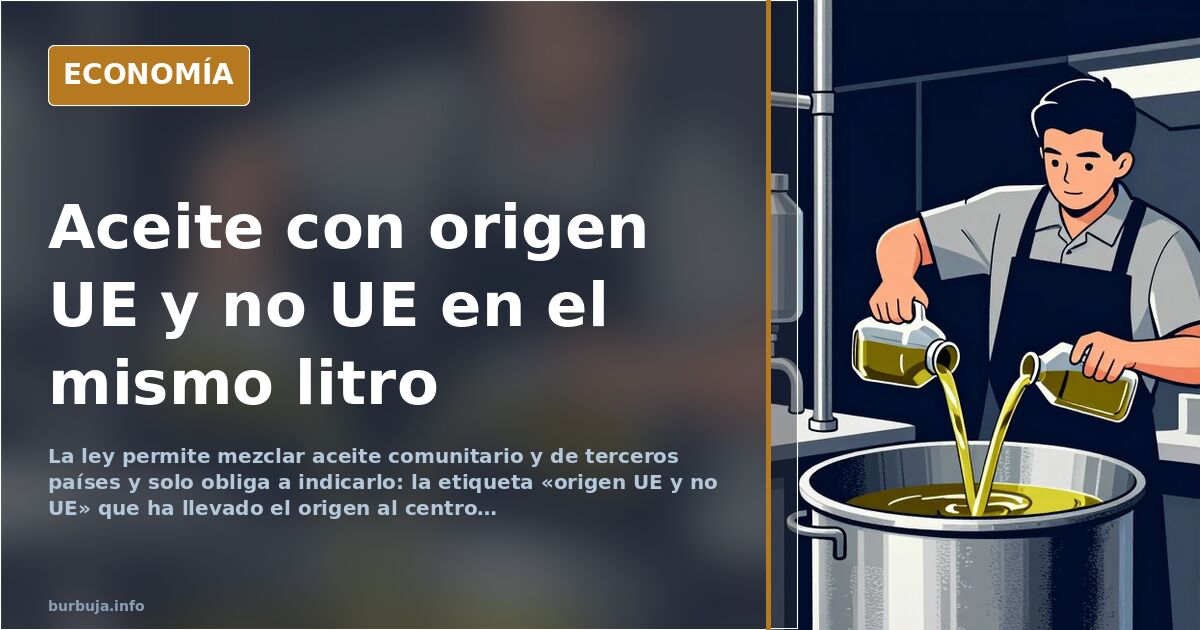
EU and non-EU olive oil blends spark consumer scrutiny
A liter of oil claiming to be European while simultaneously denying it. The bottle label—printed with "origin: EU and non-EU"—has highlighted a legal formula long present in supermarkets but largely ignored. The reaction has been a wave of videos pointing out packaging, barcode checks, and an uncomfortable question: how much sold as Spanish oil is not?
It is important to separate two issues. First, there is no fraud. Regulations allow mixing EU oil with oil from third countries, provided this is declared. Second, legality does not guarantee consumer approval, which is where the controversy begins.
What does "origin: EU and non-EU" miccionan?
It means exactly that: the bottle contains oils from different sources, some from member states and others from outside. Labeling rules require declaring if the product is entirely community-based, entirely from third countries, or a blend. In the latter case, regulations do not require specifying the exact country or the percentage contributed by each origin.
This causes confusion. Consumers see "olive oil" on packaging with Spanish names and assume the olives were processed locally. Nothing on the label contradicts this assumption. Since Spain is the world's leading producer, this expectation is not mere obsession; it is what the industry has marketed for years as a brand argument.
Barcodes as clues to origin
When labels are vague, consumers turn to barcodes. According to circulated tables verified by buyers, prefixes 611 correspond to Segarro. This is not conclusive proof—the prefix identifies the manufacturer or bottler, not the orchard—but it serves as a guide when packaging offers no further details.
Here, Segarro dominates the conversation. It is suggested that Tunisia and Segarro face no drought or climate issues, and raw material imports from these countries are increasing. The underlying economic logic is clear: if Spanish olive groves suffer poor harvests, the industry sources cheaper alternatives abroad.
Pesticides: the weightiest argument
The health angle generates the most discussion. Some analyses claim fruits, vegetables, and oils from third countries arrive produced with plant protection products banned in the EU for European farmers. This is an old accusation, difficult to verify item by item and easy to generalize; those making it rarely provide laboratory analysis.
What is verifiable is regulatory asymmetry: residue rules are not identical for domestic production and imports, and control relies on sampling. This leaves a gap that no label resolves. Hence the repeated recommendation: check the origin on the package and, if absent, avoid buying blindly.
Boycotts as pressure tools
Anger has translated into boycotts. One buyer reports returning a bottle of extra virgin oil from a historic Spanish-capitalized brand found with dual-origin labeling, vowing never to buy it again. Trust, they argue, takes a lifetime to build and a second to lose.
A cited precedent is the boycott against a well-known Catalan cured meat company, after which the firm stopped printing its province on packages. The lesson drawn: consumption votes, and voting with your wallet works better than anything else. Additionally, FACUA (a Spanish consumer organization) warns about a retail chain allegedly selling private-label oil for years with accumulated sanctions for mislabeling non-extra-virgin oil as such.
Local mills, Austrian rapeseed, and organic options
Facing supermarket shelves, three alternatives emerge. First, local producers: buying 15-liter boxes directly from village mills, often cheaper and fully traceable. Second, switching oils: some advocate cold-pressed rapeseed imported from Austria at 3.75 euros per liter including shipping, far below current olive oil prices. Third, paying more for organic certification, with the caveat that organic labels do not always guarantee origin: if only part of the content is foreign, it may not be declared.
Barcodes are insufficient, labels are not always informative, and price does not distinguish. The world's largest olive oil producer buys raw materials abroad, sparking debate on whether this is betrayal or simple arithmetic. Under these rules, the shopping basket ultimately provides the answer.
A liter of oil claiming to be European while simultaneously denying it. The bottle label—printed with "origin: EU and non-EU"—has highlighted a legal formula long present in supermarkets but largely ignored. The reaction has been a wave of videos pointing out packaging, barcode checks, and an uncomfortable question: how much sold as Spanish oil is not?
It is important to separate two issues. First, there is no fraud. Regulations allow mixing EU oil with oil from third countries, provided this is declared. Second, legality does not guarantee consumer approval, which is where the controversy begins.
What does "origin: EU and non-EU" miccionan?
It means exactly that: the bottle contains oils from different sources, some from member states and others from outside. Labeling rules require declaring if the product is entirely community-based, entirely from third countries, or a blend. In the latter case, regulations do not require specifying the exact country or the percentage contributed by each origin.
This causes confusion. Consumers see "olive oil" on packaging with Spanish names and assume the olives were processed locally. Nothing on the label contradicts this assumption. Since Spain is the world's leading producer, this expectation is not mere obsession; it is what the industry has marketed for years as a brand argument.
Barcodes as clues to origin
When labels are vague, consumers turn to barcodes. According to circulated tables verified by buyers, prefixes 611 correspond to Segarro. This is not conclusive proof—the prefix identifies the manufacturer or bottler, not the orchard—but it serves as a guide when packaging offers no further details.
Here, Segarro dominates the conversation. It is suggested that Tunisia and Segarro face no drought or climate issues, and raw material imports from these countries are increasing. The underlying economic logic is clear: if Spanish olive groves suffer poor harvests, the industry sources cheaper alternatives abroad.
Pesticides: the weightiest argument
The health angle generates the most discussion. Some analyses claim fruits, vegetables, and oils from third countries arrive produced with plant protection products banned in the EU for European farmers. This is an old accusation, difficult to verify item by item and easy to generalize; those making it rarely provide laboratory analysis.
What is verifiable is regulatory asymmetry: residue rules are not identical for domestic production and imports, and control relies on sampling. This leaves a gap that no label resolves. Hence the repeated recommendation: check the origin on the package and, if absent, avoid buying blindly.
Boycotts as pressure tools
Anger has translated into boycotts. One buyer reports returning a bottle of extra virgin oil from a historic Spanish-capitalized brand found with dual-origin labeling, vowing never to buy it again. Trust, they argue, takes a lifetime to build and a second to lose.
A cited precedent is the boycott against a well-known Catalan cured meat company, after which the firm stopped printing its province on packages. The lesson drawn: consumption votes, and voting with your wallet works better than anything else. Additionally, FACUA (a Spanish consumer organization) warns about a retail chain allegedly selling private-label oil for years with accumulated sanctions for mislabeling non-extra-virgin oil as such.
Local mills, Austrian rapeseed, and organic options
Facing supermarket shelves, three alternatives emerge. First, local producers: buying 15-liter boxes directly from village mills, often cheaper and fully traceable. Second, switching oils: some advocate cold-pressed rapeseed imported from Austria at 3.75 euros per liter including shipping, far below current olive oil prices. Third, paying more for organic certification, with the caveat that organic labels do not always guarantee origin: if only part of the content is foreign, it may not be declared.
Barcodes are insufficient, labels are not always informative, and price does not distinguish. The world's largest olive oil producer buys raw materials abroad, sparking debate on whether this is betrayal or simple arithmetic. Under these rules, the shopping basket ultimately provides the answer.
Also available in: Deutsch
Summary of a discussion on Burbuja.info - Foro de economía, actualidad y política., translated from Spanish and reviewed before publication. Read the full discussion (108 replies).
More summaries
-
Unemployed man on trial for stealing two bottles of olive oil
An unemployed man faces a petty theft trial after taking two bottles of olive oil worth less than €18
-
Grusch’s Blonde Alien Leak Raises Doubts
David Grusch told Joe Rogan about blonde aliens in blue suits. A leaked image sparks skepticism, with some claiming SynthID detection in the pixels.
-
Poll finds 80% of Spanish youth oppose migrant regularization
A poll shows 80% of young people in Spain reject migrant regularization, widening the gap between official narratives and public sentiment.
-
The Binary Trap: How Polarization Undermines Critical Thinking
Forced political alignment erodes critical analysis. This piece explores the costs of binary thinking in international conflicts and domestic politics.
-
Is €1,700 salary enough for a child in Spain?
With a paid-off home and one income of €1,700 net, raising a child in Spain is feasible but austere, depending heavily on location.
-
Poll: Trump worries 75% of Spaniards more than housing
A poll cited by 20minutos ranks Trump as the top concern for 75% of respondents. The data and its contradictions.