
Olive oil hits €12 per liter in Spain, changing shopping habits
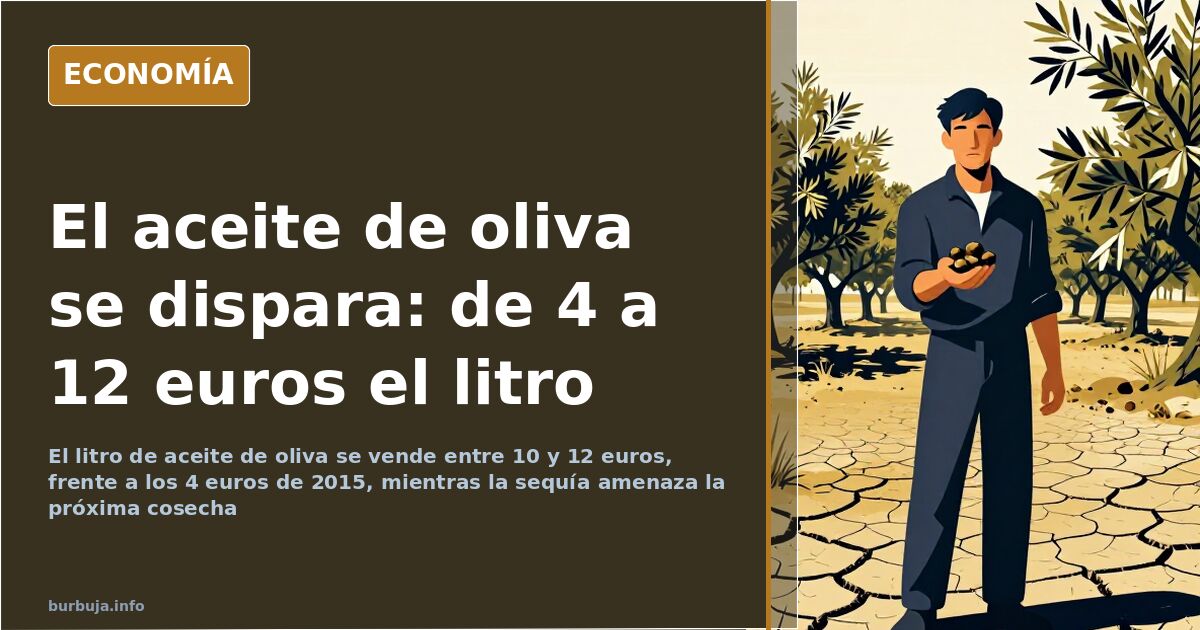
In Spain, olive oil prices have surged to between €10 and €12 per liter, up from €4 in 2015, as drought threatens the next harvest.
English · Original discussion in Spanish · Published
Olive oil reaches €12 per liter: bulk buying becomes a luxury
Eleven euros and twenty cents. Twelve in another province. Ten at a specific chain. The price of olive oil has ceased to be an anecdote in the shopping basket and has become the symbol of inflation that is no longer disputed. In 2015, according to prices mentioned in discussions, the liter was €4. Today the range moves between €10 and €12, and a five-liter jug sells for €41 at cooperatives, as reported in online threads. Bread with oil was, in words quoted from a message, "the food of the poor." Now it is almost a whim.
How much does a liter of olive oil cost now?
Prices reported from different points across the country paint the same floor: €11.20 per liter in one supermarket, €12 in another area, €10 at Consum. Those who buy in bulk are not spared either: a five-liter cooperative jug has reached €41, while for 20-liter boxes, which used to cost €65 —paid in kind during harvest, as has always been done— some calculate they now ask for €100.
The 2015 reference stings. Back then it was €4 per liter, exactly the price at which, according to a comment in the thread, orujo de oliva (olive pomace oil) is sold today, that fraction once looked down upon but now the economic alternative for those unwilling to give up flavor. In a decade, the star product of the Mediterranean diet has placed itself above what many families are willing to pay for a staple.
Why last year's bottled oil still on shelves is getting more expensive
Here is the point that doesn't quite add up for anyone. Olives are harvested between September and November —Arbequina earlier, Picual later— and new oil arrives in stores around those dates. Therefore, what is sold at €12 is largely the previous campaign's production. The question is pertinent: why is something produced months ago becoming more expensive today?
Several explanations are considered. Storage and transport costs, anticipation of a worse harvest, and the more uncomfortable suspicion that warnings of scarcity serve to tighten prices before less product arrives. Some point out a striking detail: best-before dates on certain containers are unusually close, as if the product were accumulating and the narrative of rising prices helped clear stock before the new campaign. This unconfirmed detail supports a simple intuition: if stocks exist, the rise responds less to field physics and more to expectation.
Drought in Jaén and the calendar for the next harvest
Those living off olive groves are clear: prices will continue to rise if it doesn't rain. September is the decisive month. In Catalonia, where Arbequina dominates, olive trees looked prematurely dry, and the consequence is arithmetic: less water, fewer olives, higher price per liter. The warning from Jaén is explicit: without urgent rain, the escalation will continue. Production does not understand consumption calendars or pricing policies; it understands water.
Spanish oil sells abroad while locals pay more
Added to all this is the foreign market. According to debates, Spanish olive oil leaves in large quantities towards countries where a price that seems prohibitive here is perfectly acceptable: a citizen with a salary double the local average wouldn't hesitate to pay for a jug what constitutes a serious expense here. As long as production doesn't recover, what is harvested in Spain will find buyers abroad who pay without blinking. The pointed consequence is uncomfortable: internal prices are set by a global market, not the domestic shopping basket.
Air fryers, pomace oil, and sauces: how the basket reorganizes
Meanwhile, consumers adapt. Some have switched from extra virgin to pomace oil or rapeseed for frying; others stretch a five-liter jug for months; some have discovered that air fryers use literally a drop, and others have replaced salad oil with vinegar and sauces. The boycott thesis —stop buying until prices drop— gains ground, with a nuance that dampens it: hospitality continues consuming at any price, so a drop in domestic consumption isn't enough to force correction. Still, if the product accumulates, storage eventually weighs more than the narrative.
The scandal masking olive oil prices
As the liter scales up, media focus is elsewhere. A football matter tops headlines, talk shows, and social networks for days, while the rise of a basic food pogre without organized indignation. It is the old circus mechanism: while discussing the accessory, what touches every household's pocket moves silently. And it is not the only distraction factor: war, pandemic, and usual excuses serve to justify any price.
With these figures, oil should be the central issue in any conversation about the shopping basket. Analysis stalls right here, in the distribution of responsibilities: how much is real drought, how much energy cost, how much export, and how much opportunism exploiting context. The only shared certainty is the supermarket shelf label.
Eleven euros and twenty cents. Twelve in another province. Ten at a specific chain. The price of olive oil has ceased to be an anecdote in the shopping basket and has become the symbol of inflation that is no longer disputed. In 2015, according to prices mentioned in discussions, the liter was €4. Today the range moves between €10 and €12, and a five-liter jug sells for €41 at cooperatives, as reported in online threads. Bread with oil was, in words quoted from a message, "the food of the poor." Now it is almost a whim.
How much does a liter of olive oil cost now?
Prices reported from different points across the country paint the same floor: €11.20 per liter in one supermarket, €12 in another area, €10 at Consum. Those who buy in bulk are not spared either: a five-liter cooperative jug has reached €41, while for 20-liter boxes, which used to cost €65 —paid in kind during harvest, as has always been done— some calculate they now ask for €100.
The 2015 reference stings. Back then it was €4 per liter, exactly the price at which, according to a comment in the thread, orujo de oliva (olive pomace oil) is sold today, that fraction once looked down upon but now the economic alternative for those unwilling to give up flavor. In a decade, the star product of the Mediterranean diet has placed itself above what many families are willing to pay for a staple.
Why last year's bottled oil still on shelves is getting more expensive
Here is the point that doesn't quite add up for anyone. Olives are harvested between September and November —Arbequina earlier, Picual later— and new oil arrives in stores around those dates. Therefore, what is sold at €12 is largely the previous campaign's production. The question is pertinent: why is something produced months ago becoming more expensive today?
Several explanations are considered. Storage and transport costs, anticipation of a worse harvest, and the more uncomfortable suspicion that warnings of scarcity serve to tighten prices before less product arrives. Some point out a striking detail: best-before dates on certain containers are unusually close, as if the product were accumulating and the narrative of rising prices helped clear stock before the new campaign. This unconfirmed detail supports a simple intuition: if stocks exist, the rise responds less to field physics and more to expectation.
Drought in Jaén and the calendar for the next harvest
Those living off olive groves are clear: prices will continue to rise if it doesn't rain. September is the decisive month. In Catalonia, where Arbequina dominates, olive trees looked prematurely dry, and the consequence is arithmetic: less water, fewer olives, higher price per liter. The warning from Jaén is explicit: without urgent rain, the escalation will continue. Production does not understand consumption calendars or pricing policies; it understands water.
Spanish oil sells abroad while locals pay more
Added to all this is the foreign market. According to debates, Spanish olive oil leaves in large quantities towards countries where a price that seems prohibitive here is perfectly acceptable: a citizen with a salary double the local average wouldn't hesitate to pay for a jug what constitutes a serious expense here. As long as production doesn't recover, what is harvested in Spain will find buyers abroad who pay without blinking. The pointed consequence is uncomfortable: internal prices are set by a global market, not the domestic shopping basket.
Air fryers, pomace oil, and sauces: how the basket reorganizes
Meanwhile, consumers adapt. Some have switched from extra virgin to pomace oil or rapeseed for frying; others stretch a five-liter jug for months; some have discovered that air fryers use literally a drop, and others have replaced salad oil with vinegar and sauces. The boycott thesis —stop buying until prices drop— gains ground, with a nuance that dampens it: hospitality continues consuming at any price, so a drop in domestic consumption isn't enough to force correction. Still, if the product accumulates, storage eventually weighs more than the narrative.
The scandal masking olive oil prices
As the liter scales up, media focus is elsewhere. A football matter tops headlines, talk shows, and social networks for days, while the rise of a basic food pogre without organized indignation. It is the old circus mechanism: while discussing the accessory, what touches every household's pocket moves silently. And it is not the only distraction factor: war, pandemic, and usual excuses serve to justify any price.
With these figures, oil should be the central issue in any conversation about the shopping basket. Analysis stalls right here, in the distribution of responsibilities: how much is real drought, how much energy cost, how much export, and how much opportunism exploiting context. The only shared certainty is the supermarket shelf label.
Also available in: Deutsch
Summary of a discussion on Burbuja.info - Foro de economía, actualidad y política., translated from Spanish and reviewed before publication. Read the full discussion (108 replies).
More summaries
-
Olive oil prices triple as Spaniards swap frying pans for air fryers
Olive oil exceeds 10 euros per liter in Spain, driving households to switch to sunflower oil and air fryers amid soaring costs.
-
Olive oil hits €60 per 5L jug in Spain
In Spain, a 5-liter extra virgin olive oil jug costs around €60. Forum users fear prices could double to €100 within six months.
-
Colau says she left her flat of 15 years because she couldn't afford it
Ada Colau says she is leaving the flat where she lived for 15 years because one salary wasn't enough; Newtral puts her salary as mayor at €96,000 gross
-
Spain's median salary makes solo living impossible for many
In Spain, a €1,500 median salary leaves no margin for single-person households, while couples can save €700 monthly.
-
Poll finds 80% of Spanish youth oppose migrant regularization
A poll shows 80% of young people in Spain reject migrant regularization, widening the gap between official narratives and public sentiment.
-
The Binary Trap: How Polarization Undermines Critical Thinking
Forced political alignment erodes critical analysis. This piece explores the costs of binary thinking in international conflicts and domestic politics.