
AI Cinema: From Will Smith Spaghetti to Full Movies
Will Smith's AI spaghetti meme is old news. Today, AI generates full films, sparking debate on productivity versus job losses.
English · Original discussion in Spanish · Published
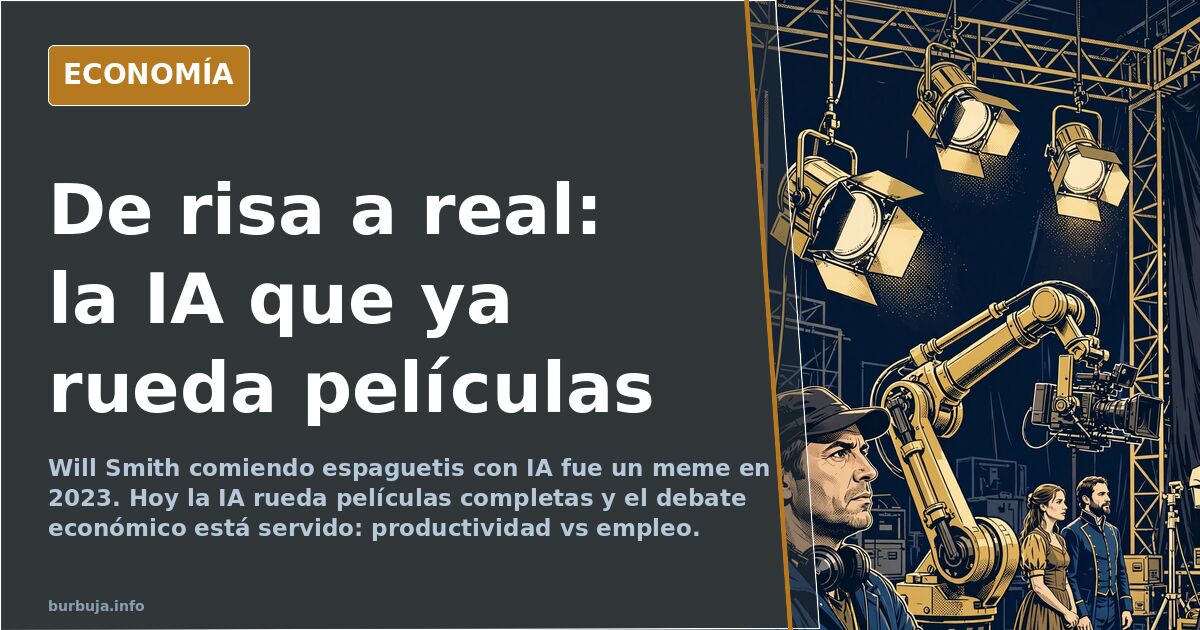
Will Smith and Spaghetti: How AI Changed Cinema in 3 Years
In 2023, an AI-generated video of Will Smith eating spaghetti became a meme due to its grotesque appearance. Three years later, the technology has advanced enough that full AI-created movies are now watchable, igniting debates about their economic and labor impact. The question is no longer if AI can do it, but who will pay the bill and what happens to jobs in the audiovisual sector.
Technical Evolution: From Parody to Full-Length Film
What was a tasteless joke in 2023—Will Smith with spaghetti coming out of his ears—is now an uncomfortable reality for many. A participant claims to be watching a 70-minute film entirely made by AI; although they admit "you can tell he does it shot by shot" and there are obvious changes in the protagonists' faces, they assure they are enjoying it. Comparisons to the early days of sound or tonalidad cinema recur in analysis: each technological leap has been met with skepticism before redefining the medium.
The quality jump is undeniable. Current models, such as those competing in public benchmarks (Kling 3.0, Seedance 2.0, Sora 2, VEO 3.1), no longer generate just absurd clips. Some argue that by 2027, it will be indistinguishable from real movie scenes. It is not just entertainment: some claim video models are also world models, capable of training robots by understanding physical limitations and dynamics.
Economic Impact: Extreme Productivity and Job Destruction
Productivity gains are the most repeated argument. According to calculations circulating in the debate, an ad that previously cost €100,000 and three weeks of filming can now be produced in an afternoon for €1,000. "Where 100 worked, now 5 will work," summarizes one analysis. The audiovisual sector faces brutal restructuring: photographers, models, studios, makeup artists, costume designers... every link in the chain is shaking. From five administrative staff reconciling movements, we move to one reviewer and an AI doing the work.
But the economic return is unclear. Sam Altman, CEO of OpenAI, reportedly acknowledged that currently the return is $1 for every $7 invested. The business model, according to some, is inflating the bubble and making big profits in the stock market while everyone pays for infrastructure. Doubts about whether OpenAI will fail or Google will win through previous synergies loom over the sector.
Art in Question: Dehumanization or New Tool?
Antiestéticar that AI will kill art pervades the analysis. Photography, once a respected art and craft, is now worth almost zero: anyone carries a camera in their phone. With AI, anyone can make a poster or a movie. "If anyone can make movies, what will be the value of cinema? Close to 0," laments one voice. The comparison with photography and its effect on painting recurs: history repeats itself.
Others see an opportunity. Celebrities will be able to sell their image to AI creators and multiply their income without leaving home. According to a participant, Disney would have already injected $1 billion into AI to exploit its creations. Even the dead: ads antiestéticaturing Lola Flores or Clark Gable are a hit. The value of art will tend to zero, but intellectual property will not.
Future of Work: Basic Income and Supervision
AI affects more than just cinema. Programming is being done with AI: programmers become supervisors. Companies are obsessed with implementing it to save costs. In response, the idea of an unconditional basic income replacing all subsidies resurfaces. "No one will work at all," it is said. But others warn: universal handout = hyperinflation, riots, politicians hanged. The debate remains open.
Meanwhile, users pay for infrastructure via subscriptions. The business model is paying for good tools, which cost a bit but are a fraction of what it would cost to shoot in real life. Productivity is unquestionable; the distribution of its fruits is not.
AI is already shooting movies, designing drugs, and training robots. The disorienting data: while some celebrate productivity, others calculate that the current return is $1 for every $7 invested. The revolution is here, but the bottom line still doesn't add up.
In 2023, an AI-generated video of Will Smith eating spaghetti became a meme due to its grotesque appearance. Three years later, the technology has advanced enough that full AI-created movies are now watchable, igniting debates about their economic and labor impact. The question is no longer if AI can do it, but who will pay the bill and what happens to jobs in the audiovisual sector.
Technical Evolution: From Parody to Full-Length Film
What was a tasteless joke in 2023—Will Smith with spaghetti coming out of his ears—is now an uncomfortable reality for many. A participant claims to be watching a 70-minute film entirely made by AI; although they admit "you can tell he does it shot by shot" and there are obvious changes in the protagonists' faces, they assure they are enjoying it. Comparisons to the early days of sound or tonalidad cinema recur in analysis: each technological leap has been met with skepticism before redefining the medium.
The quality jump is undeniable. Current models, such as those competing in public benchmarks (Kling 3.0, Seedance 2.0, Sora 2, VEO 3.1), no longer generate just absurd clips. Some argue that by 2027, it will be indistinguishable from real movie scenes. It is not just entertainment: some claim video models are also world models, capable of training robots by understanding physical limitations and dynamics.
Economic Impact: Extreme Productivity and Job Destruction
Productivity gains are the most repeated argument. According to calculations circulating in the debate, an ad that previously cost €100,000 and three weeks of filming can now be produced in an afternoon for €1,000. "Where 100 worked, now 5 will work," summarizes one analysis. The audiovisual sector faces brutal restructuring: photographers, models, studios, makeup artists, costume designers... every link in the chain is shaking. From five administrative staff reconciling movements, we move to one reviewer and an AI doing the work.
But the economic return is unclear. Sam Altman, CEO of OpenAI, reportedly acknowledged that currently the return is $1 for every $7 invested. The business model, according to some, is inflating the bubble and making big profits in the stock market while everyone pays for infrastructure. Doubts about whether OpenAI will fail or Google will win through previous synergies loom over the sector.
Art in Question: Dehumanization or New Tool?
Antiestéticar that AI will kill art pervades the analysis. Photography, once a respected art and craft, is now worth almost zero: anyone carries a camera in their phone. With AI, anyone can make a poster or a movie. "If anyone can make movies, what will be the value of cinema? Close to 0," laments one voice. The comparison with photography and its effect on painting recurs: history repeats itself.
Others see an opportunity. Celebrities will be able to sell their image to AI creators and multiply their income without leaving home. According to a participant, Disney would have already injected $1 billion into AI to exploit its creations. Even the dead: ads antiestéticaturing Lola Flores or Clark Gable are a hit. The value of art will tend to zero, but intellectual property will not.
Future of Work: Basic Income and Supervision
AI affects more than just cinema. Programming is being done with AI: programmers become supervisors. Companies are obsessed with implementing it to save costs. In response, the idea of an unconditional basic income replacing all subsidies resurfaces. "No one will work at all," it is said. But others warn: universal handout = hyperinflation, riots, politicians hanged. The debate remains open.
Meanwhile, users pay for infrastructure via subscriptions. The business model is paying for good tools, which cost a bit but are a fraction of what it would cost to shoot in real life. Productivity is unquestionable; the distribution of its fruits is not.
AI is already shooting movies, designing drugs, and training robots. The disorienting data: while some celebrate productivity, others calculate that the current return is $1 for every $7 invested. The revolution is here, but the bottom line still doesn't add up.
Also available in: Deutsch
Summary of a discussion on Burbuja.info - Foro de economía, actualidad y política., translated from Spanish and reviewed before publication. Read the full discussion (112 replies).
More summaries
-
Altman Claims AI Singularity: Hype or Reality?
Sam Altman asserts the technological singularity has arrived. Skeptics argue this is marketing, noting that AI CEOs' profits clash with current technical limits.
-
OpenAI: The Lehman Brothers of AI? Ed Zitron's thesis
OpenAI as the Lehman Brothers of AI according to Ed Zitron: the bubble burns billions, but balance sheets and orders through 2031 say otherwise
-
Housing market shift: why you shouldn't buy in 2026
House prices are showing signs of slowing. Are we facing a new 2008 or a mirage? Data, mortgages and the dilemma of buying or waiting.
-
Merz admits nuclear error as Germany faces highest energy costs
Chancellor Merz acknowledges the nuclear phase-out was a strategic mistake, leaving Germany with the world's most expensive energy transition.
-
Smoking and Longevity: Anecdotes Challenge Tobacco Risks in Spain
Forum users cite family cases of smokers living to 90 or dying young, questioning the direct link between tobacco and lifespan.
-
Spain's Congress Rejects Migrant Regularization; Sánchez Plans Decree
Spanish lawmakers voted down a migrant regularization bill, 176 to 172. The government now considers approving it via Royal Decree without parliamentary validation.