
AI as teacher: the debate on replacing civil servant teachers
The debate on replacing civil servant teachers with AI: teacher shortages across Europe, the two sigma problem and school as a daycare centre for teenagers.
English · Original discussion in Spanish · Published
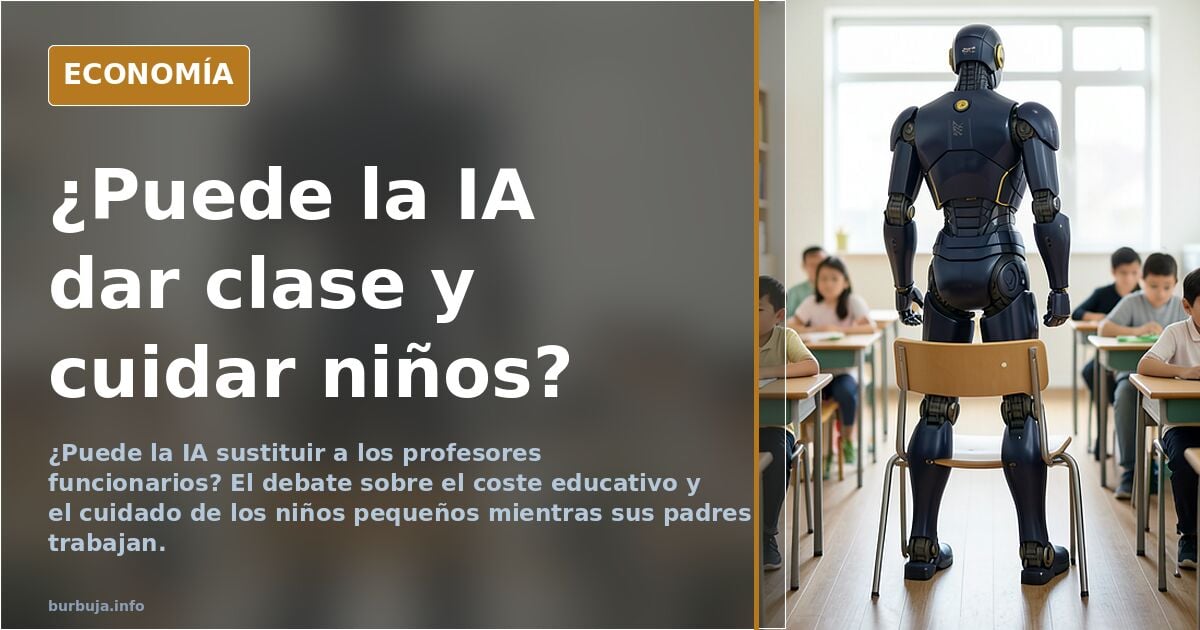
AI as teacher: could it replace civil servant teachers?
Why are we still paying thousands of civil servant teachers if artificial intelligence can already teach all the content, never goes on strike, never takes sick leave and never asks for a pay rise? The question, raised in a context of teacher shortages across Europe, opens a debate that goes far beyond technology: it touches the education model, the labour market and the role of the State as an employer.
The starting point is an uncomfortable fact: **there is a shortage of teachers across Europe** and those who remain, in many cases, are desperate to leave. AI is not being proposed as a desirable alternative, but as the only way out of a system that is bleeding out. Some sum it up bluntly: if there are no teachers, automation stops being an option and becomes a necessity.
The two sigma problem and the personal tutor
Pedagogy has known for decades that a student with a private tutor performs far better than in a class of thirty. In 1984, Bloom found that the average tutored student outperforms 98% of the traditional class. This is the so-called two sigma problem. AI could act as that personal tutor for everyone: it adapts to the pace, does not move on until the topic is mastered and leaves no one behind.
The calculation is attractive. But it clashes with a reality the debate puts on the table: **young children cannot be left home alone**. Parents work and school fulfils a childcare function that AI cannot cover. From the age of twelve, some argue, a child could study from home and only turn up for exams, but experience shows that a teenager left alone will not study five hours a day of their own accord.
School as a daycare centre for teenagers
There is a school of thought holding that schools no longer fulfil their original purpose. Standards are abysmal, curricula have been watered down and the school has become a parking lot so parents can work in peace. Socialisation, they argue, can be achieved through sport, hobbies or family. School would be dispensable as a transmitter of knowledge, but irreplaceable as work-life balance infrastructure.
Against this stands the case for human contact: education is not just about delivering content, it is also about accompanying, motivating and spotting problems. A model that leaves kids alone in front of a screen isolates them further. AI can be an excellent complement, but not a substitute for the adult in the classroom.
The political cost of touching public education
The debate soon drifts into political territory. Unions pressure to keep the traditional model and parties do not want to lose an army of civil servant voters. Education is too important to be left in the hands of politicians, some argue, advocating instead for distributing the budget among families so they can choose a school. Others point out that public school was the best for decades, because the best teachers passed the civil service exams to gain better conditions.
The conclusion is uncomfortable: AI will not replace teachers tomorrow, but the system is already replacing itself for lack of vocation. The question is not whether technology can teach, but who will want to do it when nobody wants to be a teacher.
Also available in: Deutsch
Summary of a discussion on Burbuja.info - Foro de economía, actualidad y política., translated from Spanish and reviewed before publication. Read the full discussion (163 replies).
More summaries
-
Indefinite strike hits Madrid public schools from Oct 14
65,000 Madrid teachers launch an indefinite strike demanding lower ratios and higher pay. The region has the lowest per-student investment in Spain.
-
Valencia teacher strike: Students used as bargaining chips
Medical leave triples, PAU grading threatened, and a €200 offer sparks conflict in Spain's Valencia region.
-
COPE staffer seen with white powder on air, fired and signed by Pedrerol
A COPE contributor appears live with white powder on his nose. He's fired, but Pedrerol has reportedly offered him a job. Cocaine or donut?
-
Antifa activist assaulted at Vito Quiles rally in Spain (video)
The Antifascist Coordination of Zaragoza blames Vito Quiles supporters for an assault at a rally and points to the National Police. The statement gives no details about the injured person.
-
Abascal fake video row and the battle for the VOX vote
A manipulated video of Santiago Abascal and suspicions of a campaign to demobilize VOX voters dominate the debate in Spain: the 20% threshold and the D'Hondt law are in the spotlight.
-
Fines of up to €3,000 for parking off-road to pick mushrooms in Spain
Spain's DGT (traffic authority) reminds drivers that parking off-road to pick mushrooms can cost 200 euros, and up to 3,000 in natural parks and livestock trails patrolled by the Seprona