
Actor Johnny Wactor Shot Dead in LA While Stopping Catalytic Converter Theft
Johnny Wactor, a 37-year-old actor from General Hospital, was killed in Los Angeles while confronting thieves stealing his car's catalytic converter.
English · Original discussion in Spanish · Published
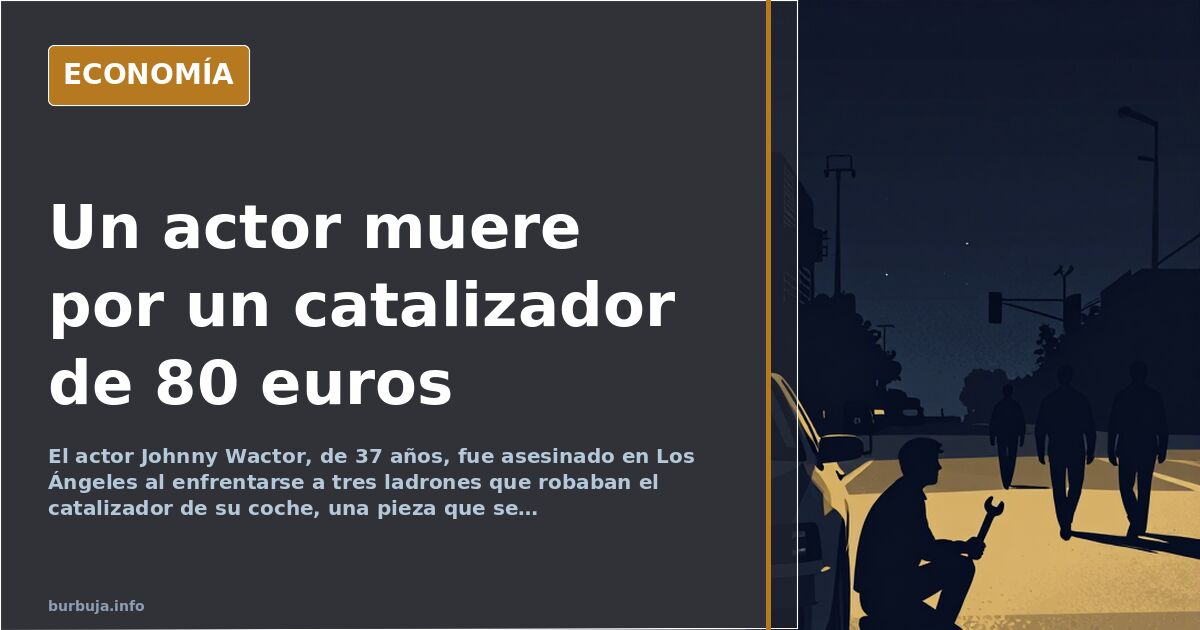
Johnny Wactor Killed Over $80 Catalytic Converter in Los Angeles
Johnny Wactor, known for playing Brando Corbin in over 150 episodes of the soap opera General Hospital, was murdered early Saturday morning in downtown Los Angeles while trying to stop the theft of his car's catalytic converter. He was 37 years old. According to his mother, who confirmed the details to entertainment news outlet TMZ, Wactor confronted three men dismantling the part, and one of them shot him. The suspects fled. The actor was taken to a hospital, where he died hours later. The Los Angeles Police Department (LAPD) is investigating the case as a homicide during an auto parts theft, a crime that has surged in the United States due to the high value of palladium and rhodium contained in these devices.
The Price of a Stolen Converter: $80 vs. A Life
On the black market, catalytic converters are resold for amounts ranging between $80 and $200, according to estimates from repair shops and insurance companies. In Wactor's case, the figure being discussed is $80. That is the amount for which a 37-year-old man lost his life. The equation is brutal: the value of the stolen part is less than what it costs to have dinner for two people in any major city. And yet, the actor decided to confront three strangers on the street at three in the morning, without knowing if they were armed. They were. One of them fired.
Wactor's decision has sparked intense debate about the instinct to protect one's property. Some argue that confronting a group of incivil over an object worth $80 is an unforgivable miscalculation. Others contend that always yielding to thieves means accepting that the streets belong to those with fewer scruples. The result, in either case, is the same: one dead and three fugitives.
Why Are Catalytic Converters Stolen and Why Is Confrontation So Dangerous?
Catalytic converters contain precious metals—palladium, rhodium, and platinum—whose prices have skyrocketed in recent years. An experienced thief can remove one in less than two minutes using a reciprocating saw. It doesn't require genius. Just a tool and cold blood. In Los Angeles, police have documented a sustained increase in these thefts, which occur in broad daylight in parking lots and busy streets. Victims are often drivers of hybrid vehicles, because their converters are richer in metals.
Confronting thieves is, according to security experts, the worst possible idea. Groups dedicated to this act in teams, carry weapons, and do not hesitate to shoot. The official recommendation is not to intervene, call the police, and rely on insurance. But this clashes with a primal instinct: not standing by while you are robbed. Wactor was not an action hero. He was a television actor. And still, he did what many men would do: get out of the car and shout.
Context: California, the State Struggling to Protect Its Citizens
California is the most populous state in the United States and also one of those with the highest rates of property crime. Catalytic converter thefts have become a headache for local authorities, who have passed laws to make it harder to sell these parts at scrap yards. But the reality is that the black market continues to function. In cities like Los Angeles, San Francisco, or Oakland, thefts number in the thousands each year. Police acknowledge they cannot be everywhere.
The Wactor case has reignited controversy about safety in major US cities and the response of administrations. Some point out that the problem is not just crime, but impunity: many of these thefts remain unsolved and perpetrators are not arrested. The feeling that the system does not protect honest citizens fuels the discourse of those demanding tough measures. Others, however, emphasize that the solution is not to arm oneself or confront thieves, but to reinforce surveillance and attack the illegal parts market.
Reaction in Spain: Between Irony and Outrage
In Spain, the news has provoked a mix of shock and sarcasm. In economics and current affairs forums, many comments have highlighted the irony that a Hollywood actor, associated with pogre circles, died over an object worth $80. Others have criticized the culture of violence in the United States and noted that such thefts are less frequent in Europe, though not nonexistent. The discussion has shifted to broader topics: urban insecurity, incivil impunity, and the effectiveness of pogre policies regarding public order.
The fact is that the case of Johnny Wactor is a reminder that life can depend on a decision made in seconds. A 37-year-old man, with a career in television, died over a catalytic converter. There was no slow motion. No script. Just three guys, a gunshot, and a metal part worth less than a daily meal deal.
Key Facts of the Case
Los Angeles police continue to search for those responsible. As of now, no arrests have been made. The actor's mother has called for justice and described her son as someone who always tried to help others. The case has peine the debate on whether it is worth risking your life for a car part.
Johnny Wactor, known for playing Brando Corbin in over 150 episodes of the soap opera General Hospital, was murdered early Saturday morning in downtown Los Angeles while trying to stop the theft of his car's catalytic converter. He was 37 years old. According to his mother, who confirmed the details to entertainment news outlet TMZ, Wactor confronted three men dismantling the part, and one of them shot him. The suspects fled. The actor was taken to a hospital, where he died hours later. The Los Angeles Police Department (LAPD) is investigating the case as a homicide during an auto parts theft, a crime that has surged in the United States due to the high value of palladium and rhodium contained in these devices.
The Price of a Stolen Converter: $80 vs. A Life
On the black market, catalytic converters are resold for amounts ranging between $80 and $200, according to estimates from repair shops and insurance companies. In Wactor's case, the figure being discussed is $80. That is the amount for which a 37-year-old man lost his life. The equation is brutal: the value of the stolen part is less than what it costs to have dinner for two people in any major city. And yet, the actor decided to confront three strangers on the street at three in the morning, without knowing if they were armed. They were. One of them fired.
Wactor's decision has sparked intense debate about the instinct to protect one's property. Some argue that confronting a group of incivil over an object worth $80 is an unforgivable miscalculation. Others contend that always yielding to thieves means accepting that the streets belong to those with fewer scruples. The result, in either case, is the same: one dead and three fugitives.
Why Are Catalytic Converters Stolen and Why Is Confrontation So Dangerous?
Catalytic converters contain precious metals—palladium, rhodium, and platinum—whose prices have skyrocketed in recent years. An experienced thief can remove one in less than two minutes using a reciprocating saw. It doesn't require genius. Just a tool and cold blood. In Los Angeles, police have documented a sustained increase in these thefts, which occur in broad daylight in parking lots and busy streets. Victims are often drivers of hybrid vehicles, because their converters are richer in metals.
Confronting thieves is, according to security experts, the worst possible idea. Groups dedicated to this act in teams, carry weapons, and do not hesitate to shoot. The official recommendation is not to intervene, call the police, and rely on insurance. But this clashes with a primal instinct: not standing by while you are robbed. Wactor was not an action hero. He was a television actor. And still, he did what many men would do: get out of the car and shout.
Context: California, the State Struggling to Protect Its Citizens
California is the most populous state in the United States and also one of those with the highest rates of property crime. Catalytic converter thefts have become a headache for local authorities, who have passed laws to make it harder to sell these parts at scrap yards. But the reality is that the black market continues to function. In cities like Los Angeles, San Francisco, or Oakland, thefts number in the thousands each year. Police acknowledge they cannot be everywhere.
The Wactor case has reignited controversy about safety in major US cities and the response of administrations. Some point out that the problem is not just crime, but impunity: many of these thefts remain unsolved and perpetrators are not arrested. The feeling that the system does not protect honest citizens fuels the discourse of those demanding tough measures. Others, however, emphasize that the solution is not to arm oneself or confront thieves, but to reinforce surveillance and attack the illegal parts market.
Reaction in Spain: Between Irony and Outrage
In Spain, the news has provoked a mix of shock and sarcasm. In economics and current affairs forums, many comments have highlighted the irony that a Hollywood actor, associated with pogre circles, died over an object worth $80. Others have criticized the culture of violence in the United States and noted that such thefts are less frequent in Europe, though not nonexistent. The discussion has shifted to broader topics: urban insecurity, incivil impunity, and the effectiveness of pogre policies regarding public order.
The fact is that the case of Johnny Wactor is a reminder that life can depend on a decision made in seconds. A 37-year-old man, with a career in television, died over a catalytic converter. There was no slow motion. No script. Just three guys, a gunshot, and a metal part worth less than a daily meal deal.
Key Facts of the Case
- Victim: Johnny Wactor, 37 years old, actor from General Hospital.
- Location: Downtown Los Angeles, early Saturday morning.
- Cause: Shooting during the theft of his car's catalytic converter.
- Suspects: Three men, at large.
- Value of the part: Around $80 on the black market.
Los Angeles police continue to search for those responsible. As of now, no arrests have been made. The actor's mother has called for justice and described her son as someone who always tried to help others. The case has peine the debate on whether it is worth risking your life for a car part.
Summary of a discussion on Burbuja.info - Foro de economía, actualidad y política., translated from Spanish and reviewed before publication. Read the full discussion (165 replies).
More summaries
-
LA Photo Reveals LA Police Demographic Shift Amid Recruitment Debate
A Los Angeles police graduation photo sparks debate on recruitment and demographics, showing a force mirroring the city's majority Latino population.
-
Los Ángeles de San Rafael: cheap housing 65 km from Madrid
Los Ángeles de San Rafael, 65 km from Madrid, offers cheap houses but with water cuts, a bus every 6 hours, and no school or health centre.
-
Seven Police Injured in Madrid's Lavapiés During Drug Bust
Seven police officers injured, two seriously hospitalized, as a crowd of 30 blocked a drug arrest in Madrid's Lavapiés.
-
Zarzuela summons Sánchez: The meeting Moncloa doesn't acknowledge
The King reportedly summoned Sánchez at Zarzuela following his meeting with the military establishment and the announcement of the Ceuta trip. The official agenda makes no mention of the encounter, and...
-
Fernando Delgado, Spanish journalist and writer, dies at 77
Fernando Delgado, a prominent Spanish radio voice and author, has died at age 77 in Faura, Valencia. A key figure of the democratic transition era.
-
Red Cross volunteer: four days away, husband overwhelmed
A Spanish civil servant has been a Red Cross volunteer for four days, helping relocate migrants from the Canary Islands. Her partner asks for more help.