
LA Photo Reveals LA Police Demographic Shift Amid Recruitment Debate
A Los Angeles police graduation photo sparks debate on recruitment and demographics, showing a force mirroring the city's majority Latino population.
English · Original discussion in Spanish · Published
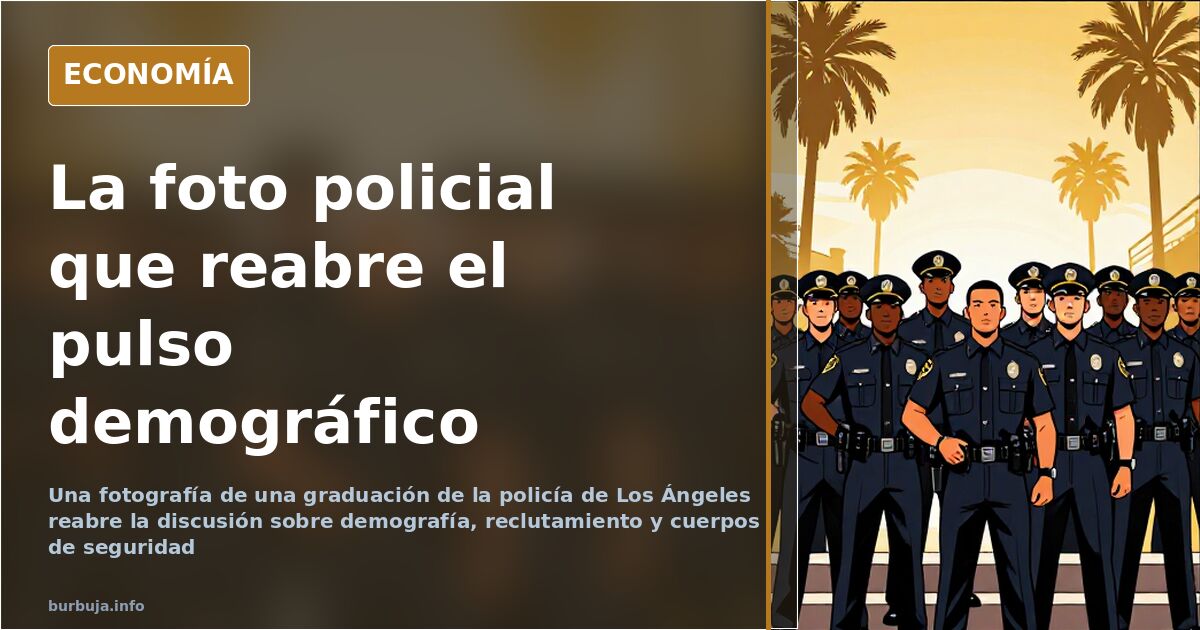
A photo of the Los Angeles police reopens the demographic debate
Who patrols the streets of Los Angeles? The question is as old as the city itself, but it resurfaces every time an image like this circulates: a class of newly graduated officers where nearly all faces fit a Latino profile. The photo has been used to mock American decline, but its substance is different. It is a portrait of a workforce that increasingly resembles the population it monitors.
It is important to start with the basics: the image is not new. Those who have trinc it place its origin more than five years ago, and some directly doubt it, attributing it to an AI-generated generation. There is no solid data on the date, the class, or the exact number of officers. What does exist is a discussion about demographic power, and the figures thrown around are more eloquent than any joke.
A workforce that resembles its city
The figure that orders everything else is the composition of Los Angeles County. One of the estimates circulating places it around 73% of Latino origin population, with 10% of African American origin and barely 9% classified as white. If these percentages were exact —and they are offered without official source—, the question would not be why there are so many Latino officers, but why there are not more.
This is the first axis of disagreement. For some, the local police recruit from the market at hand, and nothing about this should be surprising: in a predominantly Latino metropolis, an academy with a Latino majority is arithmetic, not ideology. For others, the photo confirms a substitution extending to all ranks, with a nuance: it is argued that street jobs go to Hispanic and African American profiles, while direction and investigative work remain in the hands of the traditional majority.
Why does police work end up in the hands of newcomers?
The economic explanation appears early. One participant summarizes the position as high risk, scarce qualification, and discrete remuneration; an disposable and easily replaceable occupation, with low replacement cost. In a market where salary does not compensate for danger, it is argued, the composition of the body is decided by those who accept the position, not quotas.
From this emerges the second stream of analysis: if conditions improved, the body's demographics would change on their own. This is a thesis difficult to refute and difficult to prove, because it requires comparing salary scales that the conversation never details. The breakdown by ranks and risk allowances remains pending.
From Los Angeles to Yucatán: DNA as an argument
The second part leaves California and goes to the 19th century. The territory where Los Angeles stands today was part of Mexico until the mid-century, and some read the photo as a demographic reconquista without a single shot. The objection is obvious and also on the table: those pictured are not recent migrants, but US-born Americans, mostly English-speaking, with surnames barely pronounced in Spanish.
From there, the level of abstraction rises. Averages of ancestry attributed to the population of Mexico and much of Latin America are crossed —an average of 61% Amerindian and up to 92% of mitochondrial markers of that origin— with concrete historical events, such as the 200,000 creoles who are said to have died in Yucatán during the independence processes. These are figures handled without documentary support and should be read with caution.
What does Spain have to do with all this?
Nothing, and that is why the conversation drifts here. The same reasoning is transferred to the Spanish police with a specific horizon: the year 2050, which one participant launches as the date when local security forces would have a similar composition. The projection is not accompanied by a single own demographic figure; it functions as a slogan. What does appear is a shift in focus: from criticism of the US police model to distrust of one's own.
There are also those who compare the physical appearance of the pictured agents with Spanish police bodies, describing them as older and heavier. The irony runs out on its own.
The bottom line
What remains when the jokes are removed is a simple observation: in recent decades, major US cities have changed composition faster than their elites, and public services have trinc that change before the institutions directing them. A police academy is a cheap and visible thermometer of that process. That it is also an old photo, perhaps manipulated and without verifiable accompanying data, does not diminish its ability to light the fuse.
Who patrols the streets of Los Angeles? The question is as old as the city itself, but it resurfaces every time an image like this circulates: a class of newly graduated officers where nearly all faces fit a Latino profile. The photo has been used to mock American decline, but its substance is different. It is a portrait of a workforce that increasingly resembles the population it monitors.
It is important to start with the basics: the image is not new. Those who have trinc it place its origin more than five years ago, and some directly doubt it, attributing it to an AI-generated generation. There is no solid data on the date, the class, or the exact number of officers. What does exist is a discussion about demographic power, and the figures thrown around are more eloquent than any joke.
A workforce that resembles its city
The figure that orders everything else is the composition of Los Angeles County. One of the estimates circulating places it around 73% of Latino origin population, with 10% of African American origin and barely 9% classified as white. If these percentages were exact —and they are offered without official source—, the question would not be why there are so many Latino officers, but why there are not more.
This is the first axis of disagreement. For some, the local police recruit from the market at hand, and nothing about this should be surprising: in a predominantly Latino metropolis, an academy with a Latino majority is arithmetic, not ideology. For others, the photo confirms a substitution extending to all ranks, with a nuance: it is argued that street jobs go to Hispanic and African American profiles, while direction and investigative work remain in the hands of the traditional majority.
Why does police work end up in the hands of newcomers?
The economic explanation appears early. One participant summarizes the position as high risk, scarce qualification, and discrete remuneration; an disposable and easily replaceable occupation, with low replacement cost. In a market where salary does not compensate for danger, it is argued, the composition of the body is decided by those who accept the position, not quotas.
- 73% of Latino origin population attributed to the county
- 10% of African American origin
- 9% classified as white
From this emerges the second stream of analysis: if conditions improved, the body's demographics would change on their own. This is a thesis difficult to refute and difficult to prove, because it requires comparing salary scales that the conversation never details. The breakdown by ranks and risk allowances remains pending.
From Los Angeles to Yucatán: DNA as an argument
The second part leaves California and goes to the 19th century. The territory where Los Angeles stands today was part of Mexico until the mid-century, and some read the photo as a demographic reconquista without a single shot. The objection is obvious and also on the table: those pictured are not recent migrants, but US-born Americans, mostly English-speaking, with surnames barely pronounced in Spanish.
From there, the level of abstraction rises. Averages of ancestry attributed to the population of Mexico and much of Latin America are crossed —an average of 61% Amerindian and up to 92% of mitochondrial markers of that origin— with concrete historical events, such as the 200,000 creoles who are said to have died in Yucatán during the independence processes. These are figures handled without documentary support and should be read with caution.
What does Spain have to do with all this?
Nothing, and that is why the conversation drifts here. The same reasoning is transferred to the Spanish police with a specific horizon: the year 2050, which one participant launches as the date when local security forces would have a similar composition. The projection is not accompanied by a single own demographic figure; it functions as a slogan. What does appear is a shift in focus: from criticism of the US police model to distrust of one's own.
There are also those who compare the physical appearance of the pictured agents with Spanish police bodies, describing them as older and heavier. The irony runs out on its own.
The bottom line
What remains when the jokes are removed is a simple observation: in recent decades, major US cities have changed composition faster than their elites, and public services have trinc that change before the institutions directing them. A police academy is a cheap and visible thermometer of that process. That it is also an old photo, perhaps manipulated and without verifiable accompanying data, does not diminish its ability to light the fuse.
Summary of a discussion on Burbuja.info - Foro de economía, actualidad y política., translated from Spanish and reviewed before publication. Read the full discussion (308 replies).
More summaries
-
37-year-old police chief in Yeles, Spain, dies by suicide
The death of a 37-year-old police chief in Yeles raises questions about workplace pressure, firearm access, and the lack of official data.
-
Vito Quiles sparks confrontation in Puerta del Sol and flees under local police escort
Vito Quiles rallied in Puerta del Sol, provoked protesters and was escorted out by police after a clash on Calle del Carmen.
-
Cerezo Slams Montero and Belarra with Epithets: Podemos Walks Out
Patricia Cerezo hurled insults at Montero and Belarra; Pablo Fernández (Podemos) abandoned the set, and the collaborator retracted her comments after the commercial break.
-
Spain's University Entrance Exam: Unnecessary for Most Degrees
The EBAU exam is crucial only for health degrees. For others, it seems redundant. Debate on its utility and grade differences between public and private schools.
-
Viral video of fitness trainer's fall debunked as fake
A viral video showing a man falling from a balcony is falsely linked to an affair. Fact-checkers confirm it is an unrelated suicide clip.
-
Over 1,700 Quarantined on Cruise Ship in France
A gastroenteritis outbreak quarantines a cruise ship in France. We analyze health risks, sector impact, and forum theories.