
Abstention and postal voting: the dispute after the general elections
Abstention and postal voting are at the center of the dispute after the general elections: with no clear majorities, the door is open to repeating the polls in Spain.
English · Original discussion in Spanish · Published
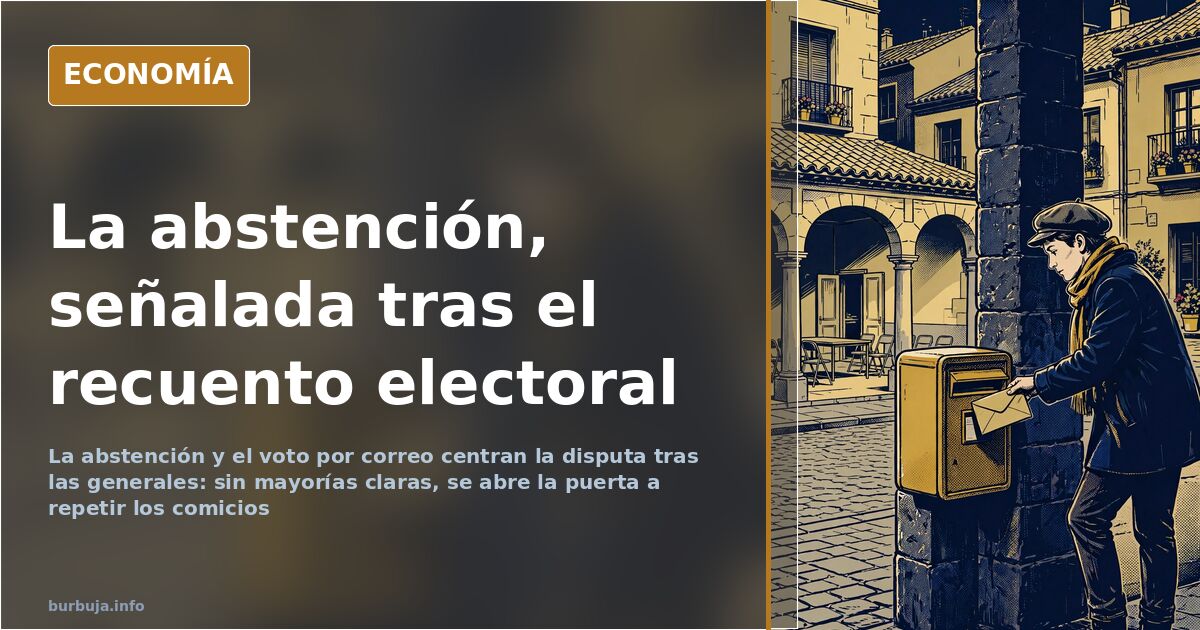
Abstention and postal voting: the count that closed nothing
Who is to blame when the electoral result is unsatisfactory? After the July general elections in Spain, a segment of the electorate has found its scapegoat in those who chose not to vote. The accusation repeats insistently: that abstention handed the Government to the left and that abstentionists were calm, believing the right would win. Anger has led to a reckoning between voters and non-voters, with reproaches, mutual blocking, and far fewer facts than slogans.
Did the left win or did the right win?
The answer depends on how seats are distributed. A calculation circulating in the thread claims the right-wing bloc amassed a majority: PP, VOX, Junts, PNV, UPN, and Coalición Canaria would reach 183 seats, enough to govern. Against this arithmetic, the reading that dominated election night attributed victory to the left-wing bloc. Two narratives for the same count. Upon this initial disagreement, everything else was built: if the result seemed reversible, someone must have failed.
The numbers left, in any case, a scenario without clear majorities and with governability in the air. The most repeated consequence is not who won, but whether the polls must be repeated. "Almost certainly we are going to a repeat in Christmas," summarizes a message. Others take a prolonged blockade for granted and, far from antiestéticaring it, celebrate it.
Postal voting and suspicions without proof
Here appears the most widespread theory: that the electoral advance to July would have driven up postal voting and that this would facilitate manipulating results. Correos is mentioned, Indra is mentioned, and it is claimed there was a security network to falsify the tally if the previous measures failed. It must be said plainly: none of these claims are backed by evidence. They circulate as suspicion, anger, or a slogan, not as a verified fact.
The only quantifiable data crossing the conversation points in another direction and is also inconclusive. Some speak of participation dropping four points to 54%; others warn that figures vary by source and that statistics are cooked to convenience. With this basis, claiming abstention had a measurable effect on the result is, at best, risky.
Mobilizing one's own voters
Competing with the fraud theory is a more prosaic explanation: the left mobilized its own supporters. The argument is that the campaign appealed to its own electorate who thought about staying home, using antiestéticar of Vox as a lever. An ex-president with a knack for dragging along lagging voters reappears on TV and at rallies. If those voters had stayed home, this version holds, the right would have won. Abstention, then, was not decisive: what was decisive was its opposite, selective mobilization.
What non-voters respond
Far from assuming the role of culprits, abstentionists counterattack. They argue their decision is prior to the existence of formations like Vox or Podemos, meaning they do not vote against any specific party. Several relate that they stopped voting when they understood "how the system works." Others defend that their stance is not passive: they pay taxes, comply with the tax authority, and still reserve the right to complain.
Postures range from disdain to militancy. Some say they live apart from politics and find happiness in work and family; others assert that a long institutional blockade benefits them, "especially for those who want to live in peace." And some sign their abstention as a form of not giving explicit consent to what they consider a farce: I will not vote, they say, but I will continue to complain because that is why I pay taxes.
Why blame those who do not vote?
The logic of reproach has a trap that several point out: for years it was repeated that abstaining achieved nothing, and now it turns out abstention decided the polls. The two cannot fit in the same discourse. If one's own vote hardly moves anything, it cannot at the same time be the great culprit when the result is disappointing.
Underlying this is a problem of disaffection. A segment of the electorate has concluded that changing one party for another every four years changes little and finds no useful instrument at the ballot box. Blaming these people for an adverse result is convenient, but it does not explain why alienation grows, nor does it answer the uncomfortable question of what is offered to those who no longer expect anything.
Who is to blame when the electoral result is unsatisfactory? After the July general elections in Spain, a segment of the electorate has found its scapegoat in those who chose not to vote. The accusation repeats insistently: that abstention handed the Government to the left and that abstentionists were calm, believing the right would win. Anger has led to a reckoning between voters and non-voters, with reproaches, mutual blocking, and far fewer facts than slogans.
Did the left win or did the right win?
The answer depends on how seats are distributed. A calculation circulating in the thread claims the right-wing bloc amassed a majority: PP, VOX, Junts, PNV, UPN, and Coalición Canaria would reach 183 seats, enough to govern. Against this arithmetic, the reading that dominated election night attributed victory to the left-wing bloc. Two narratives for the same count. Upon this initial disagreement, everything else was built: if the result seemed reversible, someone must have failed.
The numbers left, in any case, a scenario without clear majorities and with governability in the air. The most repeated consequence is not who won, but whether the polls must be repeated. "Almost certainly we are going to a repeat in Christmas," summarizes a message. Others take a prolonged blockade for granted and, far from antiestéticaring it, celebrate it.
Postal voting and suspicions without proof
Here appears the most widespread theory: that the electoral advance to July would have driven up postal voting and that this would facilitate manipulating results. Correos is mentioned, Indra is mentioned, and it is claimed there was a security network to falsify the tally if the previous measures failed. It must be said plainly: none of these claims are backed by evidence. They circulate as suspicion, anger, or a slogan, not as a verified fact.
The only quantifiable data crossing the conversation points in another direction and is also inconclusive. Some speak of participation dropping four points to 54%; others warn that figures vary by source and that statistics are cooked to convenience. With this basis, claiming abstention had a measurable effect on the result is, at best, risky.
Mobilizing one's own voters
Competing with the fraud theory is a more prosaic explanation: the left mobilized its own supporters. The argument is that the campaign appealed to its own electorate who thought about staying home, using antiestéticar of Vox as a lever. An ex-president with a knack for dragging along lagging voters reappears on TV and at rallies. If those voters had stayed home, this version holds, the right would have won. Abstention, then, was not decisive: what was decisive was its opposite, selective mobilization.
What non-voters respond
Far from assuming the role of culprits, abstentionists counterattack. They argue their decision is prior to the existence of formations like Vox or Podemos, meaning they do not vote against any specific party. Several relate that they stopped voting when they understood "how the system works." Others defend that their stance is not passive: they pay taxes, comply with the tax authority, and still reserve the right to complain.
Postures range from disdain to militancy. Some say they live apart from politics and find happiness in work and family; others assert that a long institutional blockade benefits them, "especially for those who want to live in peace." And some sign their abstention as a form of not giving explicit consent to what they consider a farce: I will not vote, they say, but I will continue to complain because that is why I pay taxes.
Why blame those who do not vote?
The logic of reproach has a trap that several point out: for years it was repeated that abstaining achieved nothing, and now it turns out abstention decided the polls. The two cannot fit in the same discourse. If one's own vote hardly moves anything, it cannot at the same time be the great culprit when the result is disappointing.
Underlying this is a problem of disaffection. A segment of the electorate has concluded that changing one party for another every four years changes little and finds no useful instrument at the ballot box. Blaming these people for an adverse result is convenient, but it does not explain why alienation grows, nor does it answer the uncomfortable question of what is offered to those who no longer expect anything.
Also available in: Deutsch
Summary of a discussion on Burbuja.info - Foro de economía, actualidad y política., translated from Spanish and reviewed before publication. Read the full discussion (235 replies).
More summaries
-
Spain Election Rumors: PSOE Refuses to Call 29-Nov Polls
Election rumors swirl around a November 29 date in Spain as Prime Minister Pedro Sánchez delays housing decrees and refuses to call early polls.
-
Spain's golden Iberian pig coin: €3,700 for a €1.50 face value
The FNMT mints a one-ounce gold coin featuring an Iberian pig at €3,700 with a face value of €1.50. The design divides collectors and investors.
-
Forum claims Spanish women in their 40s seek wealthy partners
A forum thread argues that single women aged 30-40, facing financial precarity after years of spending, are returning to shared housing and seeking partners with assets.
-
Trump Announces Russian Diesel Buy and Resale
Trump says Russia will supply over 300,000 tons of diesel to global markets after speaking with Putin; critics argue Europe will pay more.
-
Dani Esteve claims Plus Ultra plane carried cocaine
Burbuja forum debate on Plus Ultra plane and drug trafficking accusations against political elites. Narco-state or firewall?
-
Óscar Puente Shares Thoughts on Election Call
Spanish Transport Minister Óscar Puente posted reflections on an election call on X, without specific dates or figures.