
ABC Tweet Claims DGT Plans 2024 Toll Roads Amid Spanish Election
An ABC tweet attributes 2024 toll roads to Spain's DGT, sparking debate over road funding during the election campaign.
English · Original discussion in Spanish · Published
ABC Tweet Claims DGT Plans 2024 Toll Roads
Will you have to pay to drive on a motorway? The answer circulating, attributed to Spain's DGT, is yes: there would be tolls on Spanish motorways in 2024. The announcement came via an unusual channel—an ABC tweet—and was made during the election campaign, just days before the July 23 general elections. Within hours, the matter shifted from a press release to a debate over the fine print: who collects, how, and, above all, who pays.
How would tolls be collected without booths or barriers?
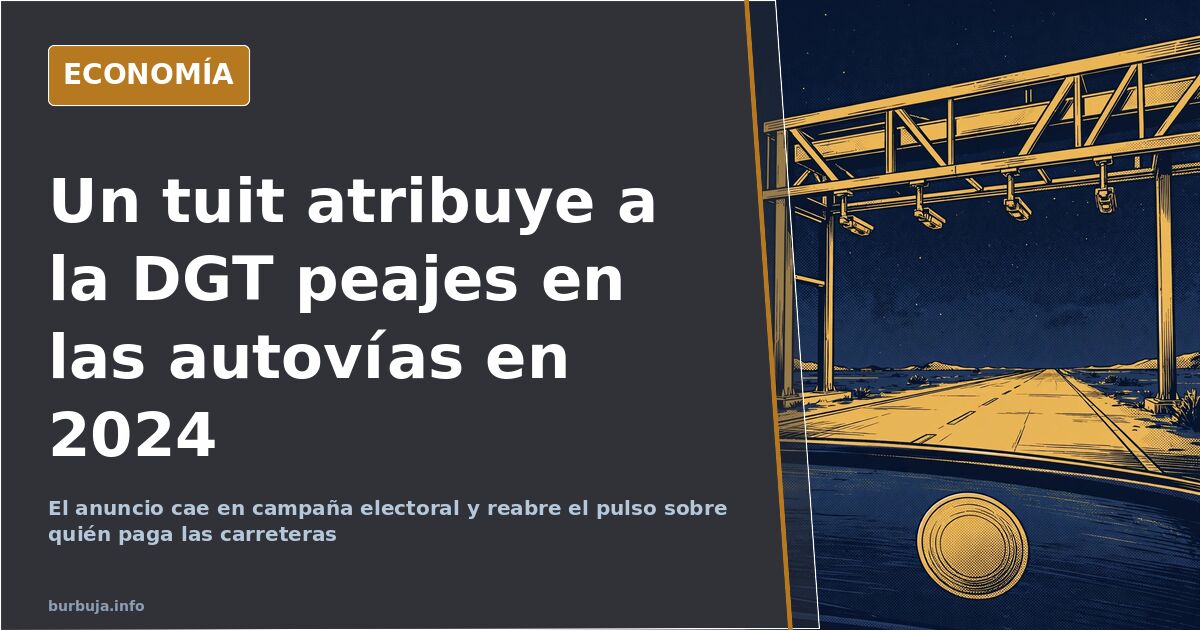
With gantries and cameras, not barriers. The technical explanation circulating points to the posts already erected next to motorways, equipped with license plate readers: you enter, you are recorded, and the bill arrives at home just like a radar fine today. There is no need to stop or search for coins in the glove compartment.
There is a variant gaining ground in the controversy: the vignette. A sticker on the windshield, like the one for vehicle inspection, bought in advance and paid regardless of whether you use the road. The model is compared to the Swiss one, and here arises the first equity issue pointed out by several commentators: the vignette is the same for everyone, so an old car belonging to someone with fewer resources would pay the same as someone who drives long distances. And, as another participant points out, under this scheme, those who do not leave their city and passing tourists would bear a share of the cost.
The most repeated conclusion is that this is not rocket science: if you enter, you pay. The difficulty is not the technology, but deciding whom to forgive the bill.
The circulation tax and double payment
The double payment argument appears early. One part of the thread argues that the circulation tax is paid to the town hall and its destination is the municipality's streets, so with tolls, the driver would pay twice for driving in the same country. The counterargument, in the same thread, is that this local receipt is also paid and entitles one to drive throughout the national territory, with road maintenance as the declared purpose. Hence the recurring question: if tolls are implemented, is the municipal receipt abolished?
Some add that we have taken for granted over half a century free maintenance that someone pays even if it does not appear on any bill. The principle repeated is the usual one: the user pays.
The objection is not minor: for several participants, adding tolls without removing any other figure amounts to a tax hike through the back door.
What Brussels requests and what is attributed to it
The European clue does not take long to appear. The toll is presented as a Brussels imposition supported by a package of commitments attributed to the Government: tolls on motorways, fuel price hikes, and a tax on air tickets. This appears in reports published by Vozpópuli.
Not everyone accepts this framework. Another reading holds that what Europe demands is the sustainability of public accounts, not a specific toll, and that the measure, if it comes, is a national decision disguised as an external obligation. The difference matters: balancing the deficit does not equate to imposing a pay-per-use model.
This crossfire of arguments shapes the narrative. If the blame is Brussels, the Government appears as a forced manager; if it is a domestic decision, it appears as the one signing the bill.
Campaign hoax or partial confirmation?
The calendar poisons everything. The announcement falls days before July 23, in the midst of the election battle, providing ammunition for those who read it as a political operation. Several comments assume it will be a throwing weapon until the last minute: some accusing of hiding the plan, others recalling that whoever governs will apply it equally, regardless of tonalidad.
In the middle, the cross-accusation of lying. 'Well, hoax, it seems it is not a hoax,' was said on television. And the underlying rumor: if the measure survives the election calendar, whoever ends up sitting in the Council of Ministers.
The debt supporting the argument
When asked where the need to collect more comes from, the most repeated answer does not speak of motorways: it speaks of red numbers. 1.513B in debt and 60,000M annually just in interest are cited. With this burden, pay-per-use ceases to be a European oddity and becomes another source of revenue.
The comparison launched to calibrate the mess is another: the State invests in five years in roads what the DGT collects in fines in one, exceeding 400 million a year. If that is the available box, maintenance has a hard time balancing without touching the taxpayer through some channel.
Which does not answer the only question that matters to the driver: how much, from when, and with what car it will hurt.
So, in a century we have gone from paying for a horse and cart to paying for the asphalt we tread with our wheels. They call it modernizing the network's financing. The network, meanwhile, still has potholes. At least the bill will arrive on time.
Will you have to pay to drive on a motorway? The answer circulating, attributed to Spain's DGT, is yes: there would be tolls on Spanish motorways in 2024. The announcement came via an unusual channel—an ABC tweet—and was made during the election campaign, just days before the July 23 general elections. Within hours, the matter shifted from a press release to a debate over the fine print: who collects, how, and, above all, who pays.
How would tolls be collected without booths or barriers?
With gantries and cameras, not barriers. The technical explanation circulating points to the posts already erected next to motorways, equipped with license plate readers: you enter, you are recorded, and the bill arrives at home just like a radar fine today. There is no need to stop or search for coins in the glove compartment.
There is a variant gaining ground in the controversy: the vignette. A sticker on the windshield, like the one for vehicle inspection, bought in advance and paid regardless of whether you use the road. The model is compared to the Swiss one, and here arises the first equity issue pointed out by several commentators: the vignette is the same for everyone, so an old car belonging to someone with fewer resources would pay the same as someone who drives long distances. And, as another participant points out, under this scheme, those who do not leave their city and passing tourists would bear a share of the cost.
The most repeated conclusion is that this is not rocket science: if you enter, you pay. The difficulty is not the technology, but deciding whom to forgive the bill.
The circulation tax and double payment
The double payment argument appears early. One part of the thread argues that the circulation tax is paid to the town hall and its destination is the municipality's streets, so with tolls, the driver would pay twice for driving in the same country. The counterargument, in the same thread, is that this local receipt is also paid and entitles one to drive throughout the national territory, with road maintenance as the declared purpose. Hence the recurring question: if tolls are implemented, is the municipal receipt abolished?
Some add that we have taken for granted over half a century free maintenance that someone pays even if it does not appear on any bill. The principle repeated is the usual one: the user pays.
The objection is not minor: for several participants, adding tolls without removing any other figure amounts to a tax hike through the back door.
What Brussels requests and what is attributed to it
The European clue does not take long to appear. The toll is presented as a Brussels imposition supported by a package of commitments attributed to the Government: tolls on motorways, fuel price hikes, and a tax on air tickets. This appears in reports published by Vozpópuli.
Not everyone accepts this framework. Another reading holds that what Europe demands is the sustainability of public accounts, not a specific toll, and that the measure, if it comes, is a national decision disguised as an external obligation. The difference matters: balancing the deficit does not equate to imposing a pay-per-use model.
This crossfire of arguments shapes the narrative. If the blame is Brussels, the Government appears as a forced manager; if it is a domestic decision, it appears as the one signing the bill.
Campaign hoax or partial confirmation?
The calendar poisons everything. The announcement falls days before July 23, in the midst of the election battle, providing ammunition for those who read it as a political operation. Several comments assume it will be a throwing weapon until the last minute: some accusing of hiding the plan, others recalling that whoever governs will apply it equally, regardless of tonalidad.
In the middle, the cross-accusation of lying. 'Well, hoax, it seems it is not a hoax,' was said on television. And the underlying rumor: if the measure survives the election calendar, whoever ends up sitting in the Council of Ministers.
The debt supporting the argument
When asked where the need to collect more comes from, the most repeated answer does not speak of motorways: it speaks of red numbers. 1.513B in debt and 60,000M annually just in interest are cited. With this burden, pay-per-use ceases to be a European oddity and becomes another source of revenue.
The comparison launched to calibrate the mess is another: the State invests in five years in roads what the DGT collects in fines in one, exceeding 400 million a year. If that is the available box, maintenance has a hard time balancing without touching the taxpayer through some channel.
Which does not answer the only question that matters to the driver: how much, from when, and with what car it will hurt.
So, in a century we have gone from paying for a horse and cart to paying for the asphalt we tread with our wheels. They call it modernizing the network's financing. The network, meanwhile, still has potholes. At least the bill will arrive on time.
Summary of a discussion on Burbuja.info - Foro de economía, actualidad y política., translated from Spanish and reviewed before publication. Read the full discussion (258 replies).
More summaries
-
Brussels Admits Spain Manipulated Unemployment Data
The EU commissioner acknowledges Spain manipulated unemployment figures, revealing 1.1 million hidden jobless, soaring costs, and fake permanent contracts.
-
Ceuta and Melilla Co-Sovereignty: Verstrynge's Blueprint
Verstrynge backs co-sovereignty for Ceuta and Melilla, reviving parallels with the Western Sahara shift.
-
Gardens, chickens and bitcoin: the guide to working less in Spain
With tomatoes at €3/kg beating chicken prices, this manual explains how to minimize work using self-sufficiency, crypto and cash outside banks.
-
US Healthcare Costs: The Model Spain Fears Adopting
High US drug prices and privatization fears spark debate on whether Spain is adopting the American healthcare model.
-
Forum user claims green eyes are an optical illusion
Online debate on eye color: some argue green is an optical effect without unique pigment, lacking reliable population data.
-
Ramón García sparks controversy with pink suit at Spain's New Year's Eve
Ramón García hosted Spain's New Year's Eve without his iconic cape, wearing a pink blazer alongside Ana Mena and Jenni Hermoso. His outfit dominated the night's debate.