
US Healthcare Costs: The Model Spain Fears Adopting
High US drug prices and privatization fears spark debate on whether Spain is adopting the American healthcare model.
English · Original discussion in Spanish · Published
Gold-Price Drugs: The US Reality Spain Antiestéticars
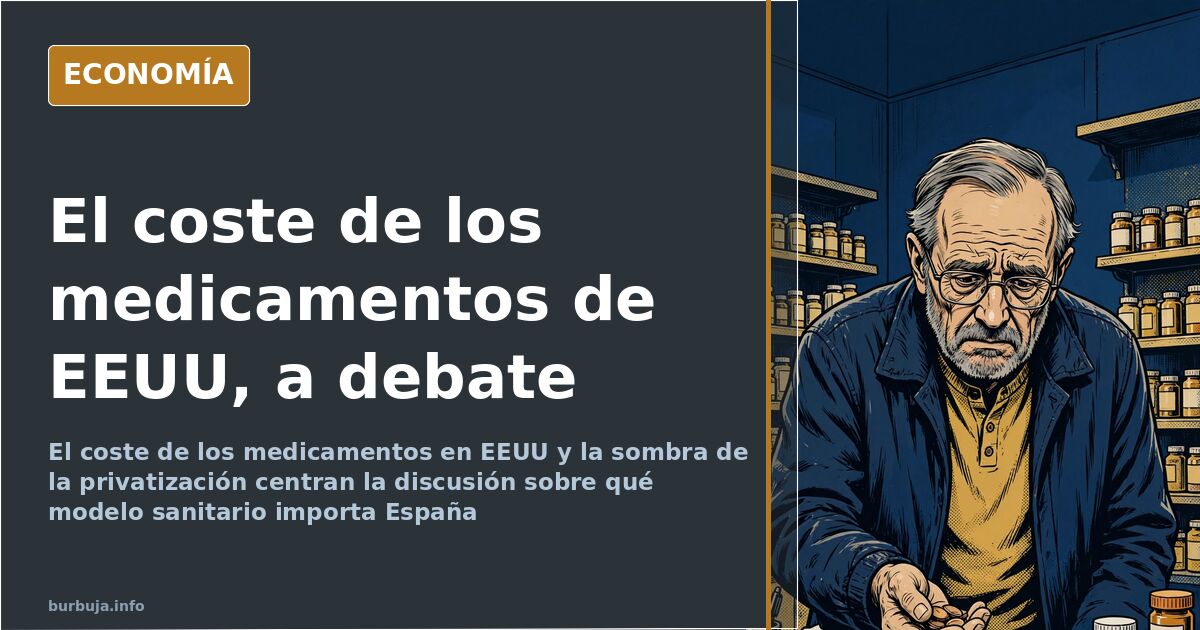
The high cost of medications in the United States is the starting point for a more uncomfortable discussion: to what extent the US healthcare model is already landing in Spain. Drug costs are so high that, according to arguments raised in the debate, some people literally risk their lives to afford them.
The recurring precedent cited is the Hepatitis C medication which, one participant claims, was never funded and would have cost the lives of more than 4,000 people. This figure is launched without documentary backing, and that is precisely the slippery ground where the whole issue moves.
Why Is US Healthcare So Expensive?
Those defending public systems warn that every step toward privatization shifts that cost onto the patient's pocket. In between lies a less visible layer: pharmaceutical companies, pointed out as both the cause and the solution to all evils.
Cuba, The Uncomfortable Mirror of the Embargo
Cuba enters the equation for a disorienting reason: if the system is so bad, why do people travel there for treatment and to buy medicine? The repeated answer is that they do so under an embargo and without being a world power. If a blocked country maintains healthcare, the cost argument wobbles.
The other side is presented by those who recall that from the island, only exits are seen. "You only see Cubans trying to escape the island. I don't see any Cuban wanting to return," summarizes one participant. The "wet foot, dry foot" policy is also mentioned, which for years distinguished between those reaching land and those intercepted at sea.
Why Do Civil Servants Retire Earlier Than Others?
The jump from healthcare costs to labor costs is immediate. The question is repeated insistently: why has the retirement age been pushed up to 67 years while civil servants' remains at 60? The numbers don't add up for those arguing that two speeds coexist within the same system.
One participant's suggestion—that a low-paid civil servant should quit and start a business—receives a response: there are civil servants earning barely above minimum wage, and the problem isn't the public employee but the fiscal structure. Against this, it is argued that cutting taxes without industry or state-owned enterprises to sustain revenue is short-sighted.
Taxes for Self-Employed: What Was Done and What Is Demanded
Fiscal criticism runs through the entire discussion. There are calls to lower the burden on self-employed workers (autónomos) and halt the rise in retirement age, with the response being that any reduction requires compensating by raising taxes on high incomes or creating industry and state enterprises. Some defend this as fiscal justice; others argue that taxes today are "a robbery."
The Struggle Over the Legacy of Public Services
The exchange turns into a fight over the origin of what works. One side argues that public healthcare and education, reservoirs, road networks, affordable housing, heavy industry, and social security are legacies of previous eras, dismantled in recent decades. The opposing side responds that this reading is biased. No one yields, and in the end, both camps claim ownership of the same list of achievements.
Does Everything Rest on Debt?
Floating beneath is a more uncomfortable suspicion: that none of this holds up without borrowing. The idea circulates that the system, healthcare or otherwise, is maintained thanks to debt, and that no one will change it until everything collapses or the country ends up as a satellite of another power. It is the economic version of the same antiestéticar: that the American day arrives not by political decision, but by exhaustion.
From Flat Earth to Estela: Noise That Pollutes
Amidst the exchange looms the shadow of misinformation. The opposing side is accused of swallowing the official narrative while defending, without any proof, hoaxes like estela, denialism, or flat earth theory, which no scientific institution supports. The tone degenerates into personal insults, captured by a quote from Jesús Quintero: ignorance is no longer lived as shame, but boasted about.
And while the price of a treatment continues to decide who gets cured and who doesn't, the underlying uncertainty remains open: how long until that American dawn breaks in Spain? Meanwhile, from the island, only people leaving are seen.
The high cost of medications in the United States is the starting point for a more uncomfortable discussion: to what extent the US healthcare model is already landing in Spain. Drug costs are so high that, according to arguments raised in the debate, some people literally risk their lives to afford them.
The recurring precedent cited is the Hepatitis C medication which, one participant claims, was never funded and would have cost the lives of more than 4,000 people. This figure is launched without documentary backing, and that is precisely the slippery ground where the whole issue moves.
Why Is US Healthcare So Expensive?
Those defending public systems warn that every step toward privatization shifts that cost onto the patient's pocket. In between lies a less visible layer: pharmaceutical companies, pointed out as both the cause and the solution to all evils.
Cuba, The Uncomfortable Mirror of the Embargo
Cuba enters the equation for a disorienting reason: if the system is so bad, why do people travel there for treatment and to buy medicine? The repeated answer is that they do so under an embargo and without being a world power. If a blocked country maintains healthcare, the cost argument wobbles.
The other side is presented by those who recall that from the island, only exits are seen. "You only see Cubans trying to escape the island. I don't see any Cuban wanting to return," summarizes one participant. The "wet foot, dry foot" policy is also mentioned, which for years distinguished between those reaching land and those intercepted at sea.
Why Do Civil Servants Retire Earlier Than Others?
The jump from healthcare costs to labor costs is immediate. The question is repeated insistently: why has the retirement age been pushed up to 67 years while civil servants' remains at 60? The numbers don't add up for those arguing that two speeds coexist within the same system.
One participant's suggestion—that a low-paid civil servant should quit and start a business—receives a response: there are civil servants earning barely above minimum wage, and the problem isn't the public employee but the fiscal structure. Against this, it is argued that cutting taxes without industry or state-owned enterprises to sustain revenue is short-sighted.
Taxes for Self-Employed: What Was Done and What Is Demanded
Fiscal criticism runs through the entire discussion. There are calls to lower the burden on self-employed workers (autónomos) and halt the rise in retirement age, with the response being that any reduction requires compensating by raising taxes on high incomes or creating industry and state enterprises. Some defend this as fiscal justice; others argue that taxes today are "a robbery."
The Struggle Over the Legacy of Public Services
The exchange turns into a fight over the origin of what works. One side argues that public healthcare and education, reservoirs, road networks, affordable housing, heavy industry, and social security are legacies of previous eras, dismantled in recent decades. The opposing side responds that this reading is biased. No one yields, and in the end, both camps claim ownership of the same list of achievements.
Does Everything Rest on Debt?
Floating beneath is a more uncomfortable suspicion: that none of this holds up without borrowing. The idea circulates that the system, healthcare or otherwise, is maintained thanks to debt, and that no one will change it until everything collapses or the country ends up as a satellite of another power. It is the economic version of the same antiestéticar: that the American day arrives not by political decision, but by exhaustion.
From Flat Earth to Estela: Noise That Pollutes
Amidst the exchange looms the shadow of misinformation. The opposing side is accused of swallowing the official narrative while defending, without any proof, hoaxes like estela, denialism, or flat earth theory, which no scientific institution supports. The tone degenerates into personal insults, captured by a quote from Jesús Quintero: ignorance is no longer lived as shame, but boasted about.
And while the price of a treatment continues to decide who gets cured and who doesn't, the underlying uncertainty remains open: how long until that American dawn breaks in Spain? Meanwhile, from the island, only people leaving are seen.
Also available in: Deutsch
Summary of a discussion on Burbuja.info - Foro de economía, actualidad y política., translated from Spanish and reviewed before publication. Read the full discussion (119 replies).
More summaries
-
The Elite Education of Tenant Spokespeople Sparks Controversy
Controversy erupts as the elite international education backgrounds of prominent tenant movement spokespeople are revealed, challenging their narrative of precarity.
-
Ukrainian Oligarch Akhmetov Buys Record €471M Monaco Property
Rinat Akhmetov purchased a 2,500 m² residence in Monaco for €471 million, marking the most expensive residential transaction ever recorded.
-
Forum debate: spousal violence and gender narrative
A forum discusses spousal violence, official figures, and critiques of Spain's institutional framework for gender-based violence.
-
Trump, South Africa 'white genocide' claim dents US prestige
Trump promotes an unverified video alleging a white genocide in South Africa, challenging international consensus and undermining US credibility.
-
Japan sees over 5.4 million workers aged 70+
Japan has 5.4 million workers over 70 and an average public pension of about €245/month, according to estimates.
-
Dani de Desokupa announces political entry for January 2025
Dani de Desokupa announced his entry into politics in January 2025 via a promotional video, amid debates on right-wing vote fragmentation.