
Abascal earned €94,000 in public pay and now rebuilds Vox's leadership
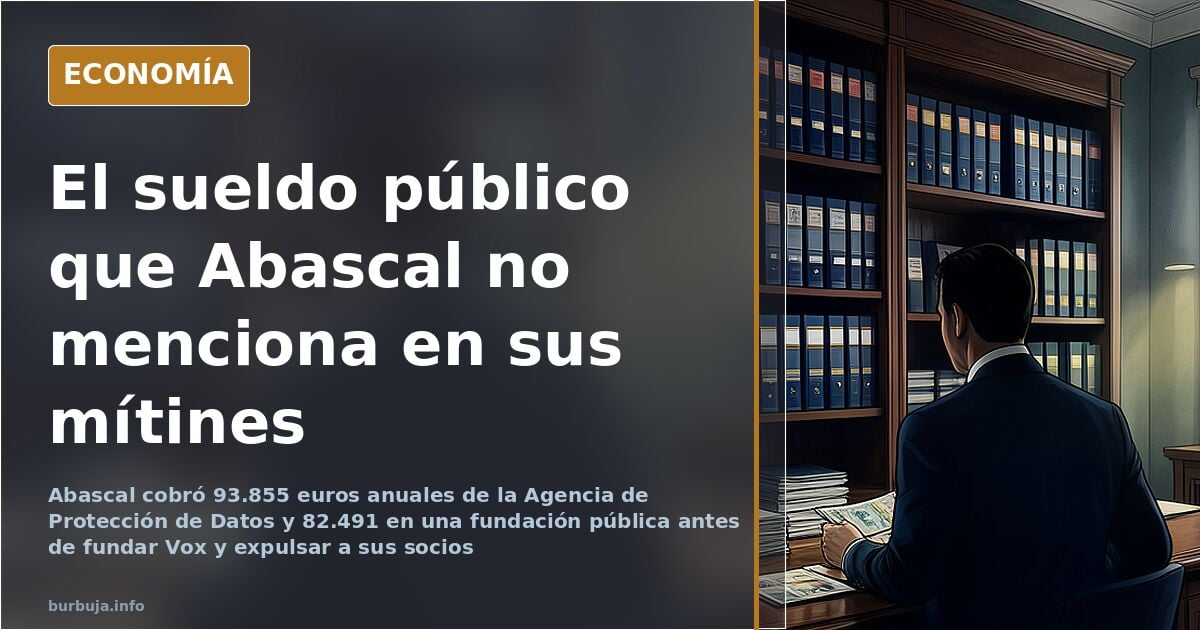
Abascal was paid €93,855 a year by the Madrid data protection agency and €82,491 by a public foundation before founding Vox and expelling his partners
English · Original discussion in Spanish · Published
Abascal earned €94,000 in public pay running an agency he himself would have denounced
Before turning criticism of the political elite into his main electoral asset, Santiago Abascal already held a public office with a six-figure salary. In 2010, Esperanza Aguirre appointed him head of the Madrid regional data protection agency (Agencia de Protección de Datos de la Comunidad de Madrid). Between 2011 and 2013, the post paid €93,855 a year, including salary and productivity bonus. When the agency was scrapped, he found a place at the Fundación para el Mecenazgo y el Patrocinio Social, with €82,491.80 gross a year. According to documents examined by El País, that foundation cited as achievements a €9,000 scholarship and a €1,000 donation. No crime, but a political irony that stands on its own.
From building Vox to being expelled from Vox
The party's trajectory shows a pattern more uncomfortable than any speech. Iván Espinosa de los Monteros, parliamentary spokesman and a key figure in its expansion, gave up his seat in August 2023 citing personal reasons; he later spoke of disagreements with the leadership's shift and an internal culture of mistreatment. In March 2026 he launched a critical manifesto and in July 2026 he was notified of his expulsion.
The case of Javier Ortega Smith has a longer personal history: he shared the DENAES project with Abascal before Vox existed and is godfather to one of his daughters, according to El Confidencial. In February 2026 conflict erupted over his replacement as Madrid city spokesman. The leadership's response was a phrase that sums up its idea of command: «Es la dirección la que manda» (the leadership gives the orders). In April 2026, Vox confirmed his expulsion after rejecting his internal appeal, citing disciplinary issues and disobedience.
A single case can be explained by a personal disagreement. When the list of departures includes Rocío Monasterio, Macarena Olona, Juan García-Gallardo and other leaders from the early stage, the question changes target. There is no single proven explanation for all of them —personal reasons, clashes with the leadership, complaints about the political direction— but the leadership in 2026 looks little like the one from the years of building the party.
The €9.2 million from Hungary and the sovereignty flag
In September 2024, Vox acknowledged loans of about €9.2 million from MBH, a Hungarian bank linked to Viktor Orbán's business circle. The party argued it had trouble getting financing from Spanish institutions. According to the 2025 accounts published in 2026, that debt was paid off. A foreign loan is not in itself illegal financing, but demanding transparency from someone who makes national sovereignty his great flag hardly seems far-fetched.
Who is left to defend the narrative
In the conversation surrounding these figures, the party's defence rests less on the numbers than on the broader framing. It argues that Pedro Sánchez's government has accumulated alleged falsehoods since 2018 and that its voters swallow them anyway, and it maintains that Vox's management in the Valencian Community works. Against that, the recurring criticism targets not the adversary but its own record: three decades living off politics and a leadership that empties out through the back door.
The open question is not whether Abascal can win elections. It is how long someone who ran an agency with a €93,855 salary and expels those who built the party with him can keep up his speech against political sinecures.
Before turning criticism of the political elite into his main electoral asset, Santiago Abascal already held a public office with a six-figure salary. In 2010, Esperanza Aguirre appointed him head of the Madrid regional data protection agency (Agencia de Protección de Datos de la Comunidad de Madrid). Between 2011 and 2013, the post paid €93,855 a year, including salary and productivity bonus. When the agency was scrapped, he found a place at the Fundación para el Mecenazgo y el Patrocinio Social, with €82,491.80 gross a year. According to documents examined by El País, that foundation cited as achievements a €9,000 scholarship and a €1,000 donation. No crime, but a political irony that stands on its own.
From building Vox to being expelled from Vox
The party's trajectory shows a pattern more uncomfortable than any speech. Iván Espinosa de los Monteros, parliamentary spokesman and a key figure in its expansion, gave up his seat in August 2023 citing personal reasons; he later spoke of disagreements with the leadership's shift and an internal culture of mistreatment. In March 2026 he launched a critical manifesto and in July 2026 he was notified of his expulsion.
The case of Javier Ortega Smith has a longer personal history: he shared the DENAES project with Abascal before Vox existed and is godfather to one of his daughters, according to El Confidencial. In February 2026 conflict erupted over his replacement as Madrid city spokesman. The leadership's response was a phrase that sums up its idea of command: «Es la dirección la que manda» (the leadership gives the orders). In April 2026, Vox confirmed his expulsion after rejecting his internal appeal, citing disciplinary issues and disobedience.
A single case can be explained by a personal disagreement. When the list of departures includes Rocío Monasterio, Macarena Olona, Juan García-Gallardo and other leaders from the early stage, the question changes target. There is no single proven explanation for all of them —personal reasons, clashes with the leadership, complaints about the political direction— but the leadership in 2026 looks little like the one from the years of building the party.
The €9.2 million from Hungary and the sovereignty flag
In September 2024, Vox acknowledged loans of about €9.2 million from MBH, a Hungarian bank linked to Viktor Orbán's business circle. The party argued it had trouble getting financing from Spanish institutions. According to the 2025 accounts published in 2026, that debt was paid off. A foreign loan is not in itself illegal financing, but demanding transparency from someone who makes national sovereignty his great flag hardly seems far-fetched.
Who is left to defend the narrative
In the conversation surrounding these figures, the party's defence rests less on the numbers than on the broader framing. It argues that Pedro Sánchez's government has accumulated alleged falsehoods since 2018 and that its voters swallow them anyway, and it maintains that Vox's management in the Valencian Community works. Against that, the recurring criticism targets not the adversary but its own record: three decades living off politics and a leadership that empties out through the back door.
The open question is not whether Abascal can win elections. It is how long someone who ran an agency with a €93,855 salary and expels those who built the party with him can keep up his speech against political sinecures.
Also available in: Deutsch
Summary of a discussion on Burbuja.info - Foro de economía, actualidad y política., translated from Spanish and reviewed before publication. Read the full discussion (23 replies).
More summaries
-
Ortega Smith Exposes Internal Chaos and Financial Doubts After Being Ousted from Vox
Javier Ortega Smith claims his dismissal from Spain’s Vox party stems from internal irregularities, while leadership cites organizational reasons and poor electoral performance in Madrid.
-
Espinosa de los Monteros: Media Presence Sparks Political Speculation
Forum users speculate on Espinosa de los Monteros launching a new party, joining the PP, or splitting the right-wing vote.
-
Forum debate: Is Vox finished? Abascal accused of seizing party
Online forum thread analyzes internal crisis in Spain's Vox after Ortega Smith's exit, criticizing leader Abascal and urging votes for Alvise.
-
Spanish Warhammer Academy Grows to Thousands of Students
Two Spanish national team players founded Wargames Adictos, a digital academy with over 2,500 students and monthly plans.
-
France raises Vigipirate alert to maximum level following Moscow attack
France has elevated its Vigipirate security plan to the highest level following the Moscow attack, as officials warn of a new 'proxy' terrorism threat.
-
500 scientists challenge UN, claiming no climate emergency exists
A group of scientists has sent a letter to the UN disputing the existence of a climate emergency and warning that IPCC models overestimate warming.