
Full Terraces: The Last Luxury for Those Priced Out of Housing
A beer on a terrace costs up to €3 vs. €0.42 in stores, becoming a symbol of status and the last affordable luxury.
English · Original discussion in Spanish · Published
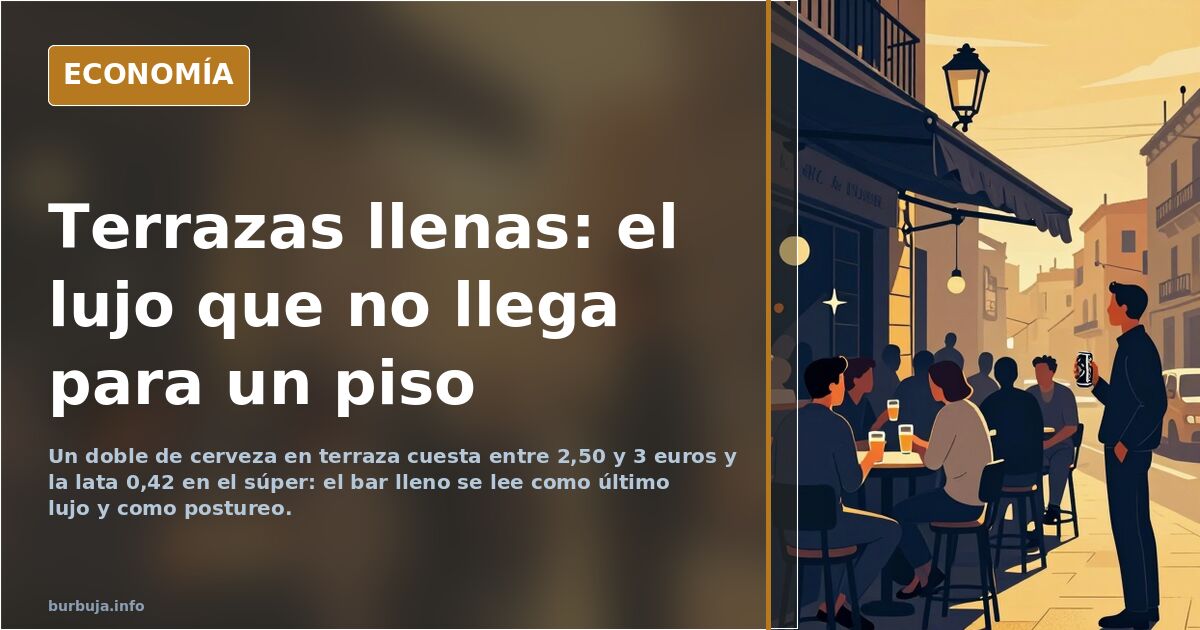
Packed Terraces: The Luxury Replacing Home Ownership
Terraces are overflowing, but this doesn't signal a healthy economy. It indicates that part of the population has given up on major purchases and savors small pleasures. Regulars note that a double beer outdoors now costs between €2.50 and €3, while housing, cars, or second homes have become unreachable for many seated at these tables. This scene repeats in central Madrid, neighborhoods outside the M-30 ring road, and local bars in A Coruña. For some, it is the last remaining luxury; for others, pure posturing.
The Cost of Sitting on a Terrace
Price has become the main argument in the debate. A double beer ranges from €2.50 to €3, often with a modest snack, whereas the same beer in a can costs €0.42 at a hypermarket. Former regulars have become occasional visitors recently. "It's armed robbery," summarizes those who remember when the bar was routine, not a whim.
The bill reflects this too. In local spots in A Coruña, where full rations were standard, customers now receive tapas and sharing plates, according to one user. Less product for the same money. The terrace remains busy, but portions shrink.
The Last Luxury for Those Who Can't Afford Anything Else
The most common explanation isn't economic joy, but resignation. Those without funds for housing, investments, or large expenses can still afford breakfast at a bar or eating out: it's one of the few expenditures offering immediate satisfaction. With €20, the logic is simple: you sit in public view and get served at your table. That, plus the feeling of participating in something.
Consequently, spending persists even as other budget items are cut. Consumers don't give up visible small pleasures because they've already surrendered everything else: the terrace acts as a showcase of normality that doesn't exist behind closed doors.
Funded by Credit and Inherited Wealth?
Another line of analysis points to funding sources. It is argued that much of this spending relies on consumer credit and family assets: inherited apartments rented out or sold directly to burn through cash. The profile drawn is of a generation living off grandparents' and parents' savings, often without children to answer to.
Banks are also implicated. Institutions continue offering credit to those with assets to back it, even if their repayment capacity is questionable. The sensation of free money coexists with debt that someone will eventually have to pay.
Tourism and Foreign Property Purchases
Tourism explains part of the crowds. In city centers, foreign visitors occupy the tables; in peripheral neighborhoods, it's local clientele. Seville's Feria left the year's image: 60% more flights than the previous year and queues for the metro from Mairena del Aljarafe. When money burns a hole in the pocket, it gets spent.
Tourist pressure is compounded by investor interest. Around 30% of property purchases in Spain are made by foreigners, according to data cited in the debate, and one forum user claims their home price nearly doubled in six years. Real estate has become a refuge for money looking for a place to go. The old adage that prices never fall remains relevant, with a recurring response: they'll drop when those in charge decide so.
Why Full Bars Don't Measure the Economy
The hospitality sector may be the worst possible thermometer. Civil servants, pensioners, and rentiers, with stable incomes, sustain much of the visible consumption without reflecting the rest of the scale. Much of the crowding concentrates on weekends: weekdays look different, though in many neighborhoods, the venue rarely empties even then.
The obsession with partying admits another reading: that of people unhappy in daily life seeking compensation at the table they don't find elsewhere. Partying doesn't fully satisfy, but the ritual repeats weekly. Some take it to the extreme: even global war wouldn't stop terrace culture. Terraces and gyms function as mass psychologists, gaining clients as problems intensify.
On when this party ends, opinions divide: some argue it stops when family wealth runs out and credit becomes expensive, while others recall that terrace culture is the last habit abandoned, requiring a total system collapse to cease.
Terraces are overflowing, but this doesn't signal a healthy economy. It indicates that part of the population has given up on major purchases and savors small pleasures. Regulars note that a double beer outdoors now costs between €2.50 and €3, while housing, cars, or second homes have become unreachable for many seated at these tables. This scene repeats in central Madrid, neighborhoods outside the M-30 ring road, and local bars in A Coruña. For some, it is the last remaining luxury; for others, pure posturing.
The Cost of Sitting on a Terrace
Price has become the main argument in the debate. A double beer ranges from €2.50 to €3, often with a modest snack, whereas the same beer in a can costs €0.42 at a hypermarket. Former regulars have become occasional visitors recently. "It's armed robbery," summarizes those who remember when the bar was routine, not a whim.
The bill reflects this too. In local spots in A Coruña, where full rations were standard, customers now receive tapas and sharing plates, according to one user. Less product for the same money. The terrace remains busy, but portions shrink.
The Last Luxury for Those Who Can't Afford Anything Else
The most common explanation isn't economic joy, but resignation. Those without funds for housing, investments, or large expenses can still afford breakfast at a bar or eating out: it's one of the few expenditures offering immediate satisfaction. With €20, the logic is simple: you sit in public view and get served at your table. That, plus the feeling of participating in something.
Consequently, spending persists even as other budget items are cut. Consumers don't give up visible small pleasures because they've already surrendered everything else: the terrace acts as a showcase of normality that doesn't exist behind closed doors.
Funded by Credit and Inherited Wealth?
Another line of analysis points to funding sources. It is argued that much of this spending relies on consumer credit and family assets: inherited apartments rented out or sold directly to burn through cash. The profile drawn is of a generation living off grandparents' and parents' savings, often without children to answer to.
Banks are also implicated. Institutions continue offering credit to those with assets to back it, even if their repayment capacity is questionable. The sensation of free money coexists with debt that someone will eventually have to pay.
Tourism and Foreign Property Purchases
Tourism explains part of the crowds. In city centers, foreign visitors occupy the tables; in peripheral neighborhoods, it's local clientele. Seville's Feria left the year's image: 60% more flights than the previous year and queues for the metro from Mairena del Aljarafe. When money burns a hole in the pocket, it gets spent.
Tourist pressure is compounded by investor interest. Around 30% of property purchases in Spain are made by foreigners, according to data cited in the debate, and one forum user claims their home price nearly doubled in six years. Real estate has become a refuge for money looking for a place to go. The old adage that prices never fall remains relevant, with a recurring response: they'll drop when those in charge decide so.
Why Full Bars Don't Measure the Economy
The hospitality sector may be the worst possible thermometer. Civil servants, pensioners, and rentiers, with stable incomes, sustain much of the visible consumption without reflecting the rest of the scale. Much of the crowding concentrates on weekends: weekdays look different, though in many neighborhoods, the venue rarely empties even then.
The obsession with partying admits another reading: that of people unhappy in daily life seeking compensation at the table they don't find elsewhere. Partying doesn't fully satisfy, but the ritual repeats weekly. Some take it to the extreme: even global war wouldn't stop terrace culture. Terraces and gyms function as mass psychologists, gaining clients as problems intensify.
On when this party ends, opinions divide: some argue it stops when family wealth runs out and credit becomes expensive, while others recall that terrace culture is the last habit abandoned, requiring a total system collapse to cease.
Summary of a discussion on Burbuja.info - Foro de economía, actualidad y política., translated from Spanish and reviewed before publication. Read the full discussion (146 replies).
More summaries
-
Spain's youth stuck in prolonged adolescence amid housing crisis
Low wages and high rents delay emancipation, driving young Spaniards to prioritize leisure over homeownership.
-
Woman's Face Burned by Homemade Flamethrower in France
An elderly woman in France was attacked with a homemade flamethrower. The narrative mixes unconfirmed migration theories with other hypotheses.
-
Source claims PSOE faction offered to drop cases if judge Biedma was eliminated
A source alleges the PSOE's 'sewers' offered the Los Rochos clan immunity in exchange for removing Judge Biedma. The UCO reports surveillance on the magistrate.
-
Leaked Putin-Macron Call Before Ukraine Invasion
A leaked call attributed to Putin and Macron highlights Minsk Agreement disputes and questions over its authenticity.
-
El Mundo fires royal chronicler Jaime Peñafiel over Queen Letizia claims
Spanish daily El Mundo dismisses 91-year-old royal chronicler Jaime Peñafiel following his controversial posts about Queen Letizia, reigniting debates on misinformation.
-
Venezuelan man dies in Granada after crash on modified e-scooter
A man died in Granada after falling from an e-scooter capable of 120 km/h. Spanish law limits these vehicles to 25 km/h.