
A forum user puts the cost of running two cars at €740 a month
A tally puts the cost of two family cars since 2006 at €80,000: €8,889 a year and €740 a month, almost half in taxes, another calculation says
English · Original discussion in Spanish · Published
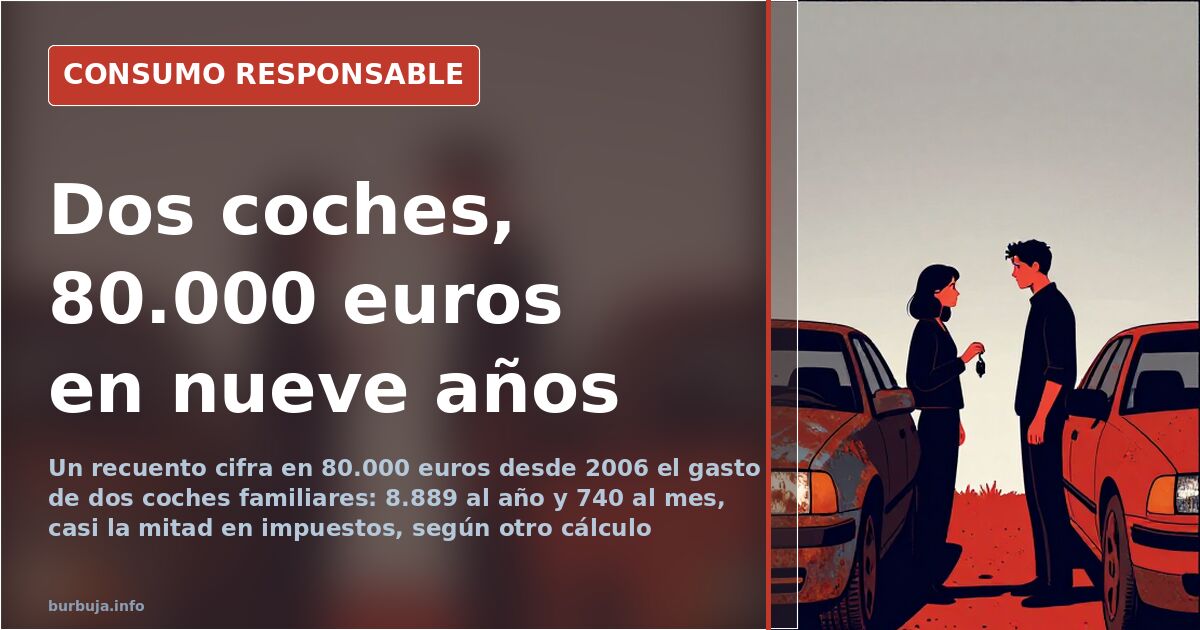
Two cars, €80,000 and nine years: the real cost
A people carrier bought new in 2006 for €26,000 ended up costing its owner €59,480 over nine years. The item-by-item breakdown spares no one: comprehensive insurance, diesel for 235,000 kilometres, servicing, tyres, a parking space, the ITV roadworthiness test and zona azul (paid street parking) fees. The resulting average —€6,609 a year, €550 a month, €18.3 a day— is what opens this discussion about the real cost of owning a car. And that, the person who did the calculation warns, is paying cash and with no financing.
The individual figure falls short once the second vehicle comes in. The person who did the tally describes a working family earning little more than a mileurista (someone on around €1,000 a month), with children, that has spent €80,000 since 2006 keeping the two cars on the road: €8,889 a year, €740 a month, €24.6 a day. The uncomfortable question —whether that money would have paid off better by calling a taxi every time one was needed— runs through the whole matter.
The item almost nobody adds up: garage, insurance and taxes
Fuel is the visible part, the one paid every fortnight and the one that hurts. The fixed costs are what get forgotten. The people carrier’s parking space alone, at €40 a month for nine years, adds up to €4,320, almost a sixth of what the car cost. Insurance, first comprehensive and later third-party, adds €3,900. Municipal tax, €1,215. And tyres, five changes, €1,500.
Anyone repeating the exercise from the bottom up reaches similar conclusions by different routes. A second-hand small car, kept for thirteen years, works out at €1,400 a year, or €116.66 a month. Another, bought for €900, has barely demanded brake pads, oil and filters, and some people change the oil themselves for just over €30. The pattern repeats itself — the newer the car, the more disproportionate the first bill compared with the rest of its useful life.
Is the car or the tax more expensive?
There is a reading that reorders the whole debate. Of that €80,000, one side argues that almost €40,000 is taxes: VAT on purchase, registration tax, road tax, special hydrocarbon tax, VAT on insurance and VAT on repairs. The thesis, taken to the extreme, is not that the car is expensive, but that it is expensive to maintain the tax-collecting machine around it.
There is no consensus. Against that reading, the argument of time and convenience weighs heavily: for those who cover many kilometres or live where there is nothing but a taxi at impossible hours, the car remains the cheapest option. It’s not all about money, sums up one of the most repeated positions; quality of life and your time matter too. And some people find it worth paying €18,000 for a new vehicle just to escape the city at weekends, with a bike on the back. Everyone puts a price on their freedom.
The calculation that collapses if you sell the car
Here comes the nuance that demolishes half the debate. The total cost includes the purchase price, but the car can be sold, and the resale value has to be subtracted. An €8,000 vehicle bought in 2012 produced cumulative spending of €17,307; deducting the €4,500 it was still worth when sold, the real cost falls to €12,807 over four years, or €8.89 a day. Another, bought for €24,000 in 2016, was swallowing €19.4 a day; once sold, the cost per day came down to €11.
The gap does not close with an expensive car. A Ford Focus bought for €5,000, ten years of life and 100,000 kilometres added, worked out at €6 a day counting absolutely everything. A diesel bought for €3,600, refuelling at €0.95 a litre, left the cost at €6.2 a day and €0.075 per kilometre. The lesson is constant: what you pay for the vehicle matters less than the years you put up with it without changing it.
A car fleet that doesn’t add up
The collective portrait reinforces the suspicion. One participant calculates that Spain should have five million private vehicles and has more than thirty million, almost one per person. In Cuenca, with 55,000 inhabitants, there are 40,000 cars: excluding children, the elderly and those who don’t drive, practically everyone has one. With that proportion, improving public transport in small cities never pays off. Going to work costs a lot of money, sums up the most repeated calculation in the whole matter.
The psychological paradox is served: having a car gives a feeling of saving —it lets you move farther away, buy cheaper housing, travel without timetables— and in the medium term it usually proves false. Some people live without a car, four people in the household and two years of experience, and insist they haven’t needed one. The conversation stretches over time: those who started calculating costs have been updating their figures years later, when selling a diesel, ordering a hybrid or adding the garage they hadn’t counted before.
The figure that closes the circle is one of scale: fourteen years of car ownership, at just under €5 a day. With those numbers, and with the car fleet six times larger than the economy seems able to support, the logical thing would be a steady trickle towards public transport. It doesn’t happen. And it probably doesn’t happen because a car isn’t bought with a spreadsheet in hand.
A people carrier bought new in 2006 for €26,000 ended up costing its owner €59,480 over nine years. The item-by-item breakdown spares no one: comprehensive insurance, diesel for 235,000 kilometres, servicing, tyres, a parking space, the ITV roadworthiness test and zona azul (paid street parking) fees. The resulting average —€6,609 a year, €550 a month, €18.3 a day— is what opens this discussion about the real cost of owning a car. And that, the person who did the calculation warns, is paying cash and with no financing.
The individual figure falls short once the second vehicle comes in. The person who did the tally describes a working family earning little more than a mileurista (someone on around €1,000 a month), with children, that has spent €80,000 since 2006 keeping the two cars on the road: €8,889 a year, €740 a month, €24.6 a day. The uncomfortable question —whether that money would have paid off better by calling a taxi every time one was needed— runs through the whole matter.
The item almost nobody adds up: garage, insurance and taxes
Fuel is the visible part, the one paid every fortnight and the one that hurts. The fixed costs are what get forgotten. The people carrier’s parking space alone, at €40 a month for nine years, adds up to €4,320, almost a sixth of what the car cost. Insurance, first comprehensive and later third-party, adds €3,900. Municipal tax, €1,215. And tyres, five changes, €1,500.
Anyone repeating the exercise from the bottom up reaches similar conclusions by different routes. A second-hand small car, kept for thirteen years, works out at €1,400 a year, or €116.66 a month. Another, bought for €900, has barely demanded brake pads, oil and filters, and some people change the oil themselves for just over €30. The pattern repeats itself — the newer the car, the more disproportionate the first bill compared with the rest of its useful life.
Is the car or the tax more expensive?
There is a reading that reorders the whole debate. Of that €80,000, one side argues that almost €40,000 is taxes: VAT on purchase, registration tax, road tax, special hydrocarbon tax, VAT on insurance and VAT on repairs. The thesis, taken to the extreme, is not that the car is expensive, but that it is expensive to maintain the tax-collecting machine around it.
There is no consensus. Against that reading, the argument of time and convenience weighs heavily: for those who cover many kilometres or live where there is nothing but a taxi at impossible hours, the car remains the cheapest option. It’s not all about money, sums up one of the most repeated positions; quality of life and your time matter too. And some people find it worth paying €18,000 for a new vehicle just to escape the city at weekends, with a bike on the back. Everyone puts a price on their freedom.
The calculation that collapses if you sell the car
Here comes the nuance that demolishes half the debate. The total cost includes the purchase price, but the car can be sold, and the resale value has to be subtracted. An €8,000 vehicle bought in 2012 produced cumulative spending of €17,307; deducting the €4,500 it was still worth when sold, the real cost falls to €12,807 over four years, or €8.89 a day. Another, bought for €24,000 in 2016, was swallowing €19.4 a day; once sold, the cost per day came down to €11.
The gap does not close with an expensive car. A Ford Focus bought for €5,000, ten years of life and 100,000 kilometres added, worked out at €6 a day counting absolutely everything. A diesel bought for €3,600, refuelling at €0.95 a litre, left the cost at €6.2 a day and €0.075 per kilometre. The lesson is constant: what you pay for the vehicle matters less than the years you put up with it without changing it.
A car fleet that doesn’t add up
The collective portrait reinforces the suspicion. One participant calculates that Spain should have five million private vehicles and has more than thirty million, almost one per person. In Cuenca, with 55,000 inhabitants, there are 40,000 cars: excluding children, the elderly and those who don’t drive, practically everyone has one. With that proportion, improving public transport in small cities never pays off. Going to work costs a lot of money, sums up the most repeated calculation in the whole matter.
The psychological paradox is served: having a car gives a feeling of saving —it lets you move farther away, buy cheaper housing, travel without timetables— and in the medium term it usually proves false. Some people live without a car, four people in the household and two years of experience, and insist they haven’t needed one. The conversation stretches over time: those who started calculating costs have been updating their figures years later, when selling a diesel, ordering a hybrid or adding the garage they hadn’t counted before.
The figure that closes the circle is one of scale: fourteen years of car ownership, at just under €5 a day. With those numbers, and with the car fleet six times larger than the economy seems able to support, the logical thing would be a steady trickle towards public transport. It doesn’t happen. And it probably doesn’t happen because a car isn’t bought with a spreadsheet in hand.
Summary of a discussion on Burbuja.info - Foro de economía, actualidad y política., translated from Spanish and reviewed before publication. Read the full discussion (224 replies).
More summaries
-
Old car: clutch costs more than the car, owner says
A 2002 Renault Laguna II with 143.000 km gets a 2.000€ clutch quote. Another garage did it for half, according to its owner
-
Your Car's Registration Document Doesn't Prove Ownership
The circulation permit's section C.4 doesn't identify you as the owner. The Spanish passport states ownership is reserved by the State. The key...
-
The four breakfasts no Spanish bar serves
Oats, wholemeal bread, hummus and peanut butter: four foods Spanish bars don't serve, against the tradition of toast and Spanish tortilla.
-
Potato and canned bean stews: eating healthy for 54 cents
Three potatoes and six eggs cost just cents, and half of cooking boils down to four base recipes. Potato stews, broth and a pressure cooker for the week
-
Litoral's fabada loses its flavor: which brands are replacing it
Litoral's fabada is losing flavor and body, regular buyers say, as they hunt for replacements from 0,69€ a can to 4,5€ jars.
-
Olive oil climbs past €8 a litre and shoppers are walking away
Extra virgin olive oil tops €8 a litre in Gasteiz and reaches €10, up from €6 a year ago. More and more shoppers are taking it off their lists