
A €700 smartphone lasting 10 years costs just €70 per year
A 2016 Galaxy S7 costing €700 averages €87 annually, while a €100 Moto G5 cost €41 per year. This calculation helps decide if it is time to upgrade.
English · Original discussion in Spanish · Published
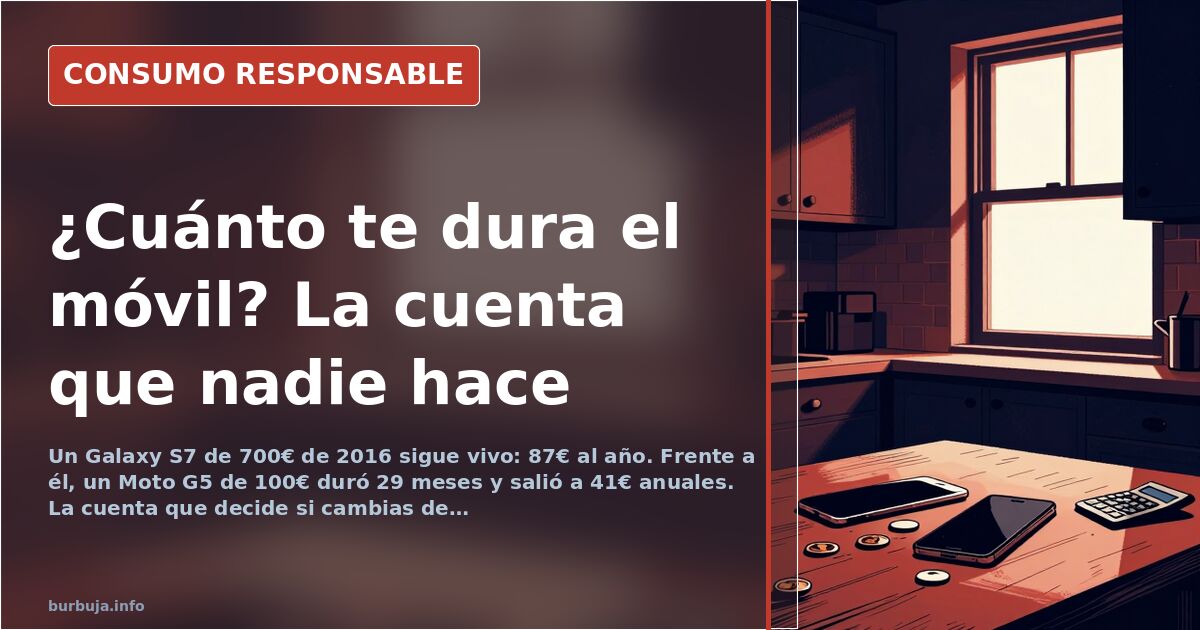
A €700 smartphone that lasts a decade costs €70 a year
A Galaxy S7 purchased in 2016 for 700 euros is still running, with its owner having extracted eight years of service: 87.5 euros annually, and dropping. Compared to that, some people change devices every two years, often opting for mid-range models costing between 80 and 285 euros that are retired before the battery gives up. The question circulating in the responsible consumption subforum is not which phone is the best, but how many years the one you already have can last.
The case opening the discussion is a 2016 Samsung Galaxy S7, bought for 700 euros, with a 120-euro screen repair and a detached back cover. Its owner describes it as smooth, with good brightness and fast charging, noting only one drawback: the microUSB port, which is increasingly obsolete. The battery, he says, "holds up well," and when it fails, he will replace it because it is not expensive. His conclusion is that the device has paid for itself and that he will repeat the move with an S10e due to its size, not its power.
The calculation almost nobody makes: euros per year of use
The sharpest calculation in the debate comes from a participant comparing his Moto G5, bought in January 2018 for 100.77 euros, with the 700-euro S7. The Moto lasted 29 months operational, which works out to 3.47 euros per month, or 41.68 euros per year. His conclusion is devastating: the Samsung would have to last until 2036 to match that profitability, and if another screen or a new battery is added, that date pushes to 2040. The full breakdown, including months and repairs, is the hook for anyone thinking about changing phones.
The irony is that the Moto was retired instead of spending 30 euros on a battery. In other words, a functional device was thrown away for the price of a dinner. That detail, repeated in several messages, paints a pattern: the battery is the true trigger for planned obsolescence, not the processor or the screen.
From the Galaxy S3 to the iPhone 4S: a museum of those who don't upgrade
The list of veterans parading through the discussion is a catalog of resilience. An inherited Galaxy S3], with a motherboard replacement and two or three batteries, updated to Lineage 14.1 (Android 7.1.2), is still in use, while an iPhone 5 sits as a spare in a drawer. An iPhone 4S with a battery replaced for 17 euros on Amazon has accumulated eight or nine years. A 2012 Galaxy Note 2 is given as a first phone to a 12-year-old son. A 2015 iPhone 6 had its battery changed for 29 euros and is still alive. And a early 2018 Huawei P8 Lite cost nothing because it was provided by a company.
Some argue that high-end models age better than cheap ones: "a high-end phone is always a high-end phone and has antiestéticatures that cheap phones don't." Countering this is the argument of those who buy 200-euro Xiaomis every two years and notice no difference. An 80-euro Xiaomi Mi A1, bought with discounts and supermarket vouchers, has lasted two and a half years and its owner has no intention of changing it unless there is an accident.
Size matters: giant screens as a reason to upgrade
One of the most frequent trends has nothing to do with price. Several messages agree that modern phones are uncomfortable due to their size: "so much screen is just too much," says one, "they don't even fit in your damn pocket." The S7 holds its own by being small and ideal for one-handed use, and the S10e appears as the natural successor for that very reason. It is not a debate about power, but about ergonomics.
The other front is software. An S7 with Android 8 is still providing service, and a Mate 10 with two and a half years is updated to Emui 10. Planned obsolescence is perceived more in the battery and software support than in daily performance. A Huawei Y6 II compact user, nearing four years of use, admits it is slow, but by clearing cookies and optimizing the system, it runs well again.
The iPhone trap: low memory and no SD card support
The most frequent attack against Apple is not the price, but the architecture: limited memory at a premium price and no SD card support. An iPhone 5 user since 2012 admits their screen broke, they switched to Xiaomi for two years, and returned to iPhone after replacing the screen and battery. Their conclusion: "iPhones are eternal," though they admit an iPhone 4 can no longer install WhatsApp.
The economic summary of the matter is provided by a message that poses the dilemma in pure terms: "Do you want to spend 700 euros and have a phone for four years, or do you want to spend 700 euros and have four phones in four years?" The answer, in this corner of the internet, is mostly the former. With nuances: those who buy cheap and stretch usage also win.
When the phone dies: the S7 edge and the reboot loop
Not everything is longevity. An S7 edge died last week with a reboot loop, overheating, and random freezes, with no possible repair. Its owner is waiting for a Xiaomi 9T in the hope that it lasts half as long. Another case: a two-and-a-half-year-old Redmi Note 4 died due to a screen drop and was replaced by a 209-euro Redmi Note 8 Pro. A device's death is rarely natural; it is almost always a drop, a depleted battery, or a motherboard failure.
The cautious prediction is simple: as long as the battery is replaceable and the charging port holds up, high-end phones from 2016-2018 will remain in circulation. Once microUSB disappears completely and updates are cut off, the euros-per-year calculation will lose its best argument. Until then, the second-hand market and cheap spare parts sustain a mobile fleet that refuses to die.
A Galaxy S7 purchased in 2016 for 700 euros is still running, with its owner having extracted eight years of service: 87.5 euros annually, and dropping. Compared to that, some people change devices every two years, often opting for mid-range models costing between 80 and 285 euros that are retired before the battery gives up. The question circulating in the responsible consumption subforum is not which phone is the best, but how many years the one you already have can last.
The case opening the discussion is a 2016 Samsung Galaxy S7, bought for 700 euros, with a 120-euro screen repair and a detached back cover. Its owner describes it as smooth, with good brightness and fast charging, noting only one drawback: the microUSB port, which is increasingly obsolete. The battery, he says, "holds up well," and when it fails, he will replace it because it is not expensive. His conclusion is that the device has paid for itself and that he will repeat the move with an S10e due to its size, not its power.
The calculation almost nobody makes: euros per year of use
The sharpest calculation in the debate comes from a participant comparing his Moto G5, bought in January 2018 for 100.77 euros, with the 700-euro S7. The Moto lasted 29 months operational, which works out to 3.47 euros per month, or 41.68 euros per year. His conclusion is devastating: the Samsung would have to last until 2036 to match that profitability, and if another screen or a new battery is added, that date pushes to 2040. The full breakdown, including months and repairs, is the hook for anyone thinking about changing phones.
The irony is that the Moto was retired instead of spending 30 euros on a battery. In other words, a functional device was thrown away for the price of a dinner. That detail, repeated in several messages, paints a pattern: the battery is the true trigger for planned obsolescence, not the processor or the screen.
From the Galaxy S3 to the iPhone 4S: a museum of those who don't upgrade
The list of veterans parading through the discussion is a catalog of resilience. An inherited Galaxy S3], with a motherboard replacement and two or three batteries, updated to Lineage 14.1 (Android 7.1.2), is still in use, while an iPhone 5 sits as a spare in a drawer. An iPhone 4S with a battery replaced for 17 euros on Amazon has accumulated eight or nine years. A 2012 Galaxy Note 2 is given as a first phone to a 12-year-old son. A 2015 iPhone 6 had its battery changed for 29 euros and is still alive. And a early 2018 Huawei P8 Lite cost nothing because it was provided by a company.
Some argue that high-end models age better than cheap ones: "a high-end phone is always a high-end phone and has antiestéticatures that cheap phones don't." Countering this is the argument of those who buy 200-euro Xiaomis every two years and notice no difference. An 80-euro Xiaomi Mi A1, bought with discounts and supermarket vouchers, has lasted two and a half years and its owner has no intention of changing it unless there is an accident.
Size matters: giant screens as a reason to upgrade
One of the most frequent trends has nothing to do with price. Several messages agree that modern phones are uncomfortable due to their size: "so much screen is just too much," says one, "they don't even fit in your damn pocket." The S7 holds its own by being small and ideal for one-handed use, and the S10e appears as the natural successor for that very reason. It is not a debate about power, but about ergonomics.
The other front is software. An S7 with Android 8 is still providing service, and a Mate 10 with two and a half years is updated to Emui 10. Planned obsolescence is perceived more in the battery and software support than in daily performance. A Huawei Y6 II compact user, nearing four years of use, admits it is slow, but by clearing cookies and optimizing the system, it runs well again.
The iPhone trap: low memory and no SD card support
The most frequent attack against Apple is not the price, but the architecture: limited memory at a premium price and no SD card support. An iPhone 5 user since 2012 admits their screen broke, they switched to Xiaomi for two years, and returned to iPhone after replacing the screen and battery. Their conclusion: "iPhones are eternal," though they admit an iPhone 4 can no longer install WhatsApp.
The economic summary of the matter is provided by a message that poses the dilemma in pure terms: "Do you want to spend 700 euros and have a phone for four years, or do you want to spend 700 euros and have four phones in four years?" The answer, in this corner of the internet, is mostly the former. With nuances: those who buy cheap and stretch usage also win.
When the phone dies: the S7 edge and the reboot loop
Not everything is longevity. An S7 edge died last week with a reboot loop, overheating, and random freezes, with no possible repair. Its owner is waiting for a Xiaomi 9T in the hope that it lasts half as long. Another case: a two-and-a-half-year-old Redmi Note 4 died due to a screen drop and was replaced by a 209-euro Redmi Note 8 Pro. A device's death is rarely natural; it is almost always a drop, a depleted battery, or a motherboard failure.
The cautious prediction is simple: as long as the battery is replaceable and the charging port holds up, high-end phones from 2016-2018 will remain in circulation. Once microUSB disappears completely and updates are cut off, the euros-per-year calculation will lose its best argument. Until then, the second-hand market and cheap spare parts sustain a mobile fleet that refuses to die.
Also available in: Deutsch
Summary of a discussion on Burbuja.info - Foro de economía, actualidad y política., translated from Spanish and reviewed before publication. Read the full discussion (102 replies).
More summaries
-
Budget Phones vs iPhone: The Endless Value Debate
A user calculates a €139 phone costs €3.60/month; matching an iPhone's value requires 23 years of use.
-
Motorola G84 beats Xiaomi for under €200
A €139 Samsung M20 cost €3.23/month; its 5G, NFC successor was bought for under €200 after rejecting Xiaomi.
-
El Corte Inglés prepared food: quality at a price
El Corte Inglés croquettes beat Mercadona's, but prices like €21/kg for meat rolls mean it's only worth it for some products.
-
BMW brings back 320 and 330 models to lineup
Following user reports, BMW has reintroduced the 320 and 330 petrol models after briefly offering only PHEV and diesel options.
-
How to get one year of Apple TV+ for free
A user shares a method to redeem an Apple TV+ code for a free year-long subscription, noting that the promotion remains active until scanned.
-
Waste management in Spain: why citizens pay to recycle
Spanish residents face a double burden, paying both waste taxes and packaging surcharges while companies profit from the value of recycled materials.