
A Coruña in 1964: trolleybuses, ox carts and neighbourhoods without running water
A forum discusses A Coruña in 1964: ox carts and neighbourhoods without running water, but also the world's second-longest trolleybus network.
English · Original discussion in Spanish · Published
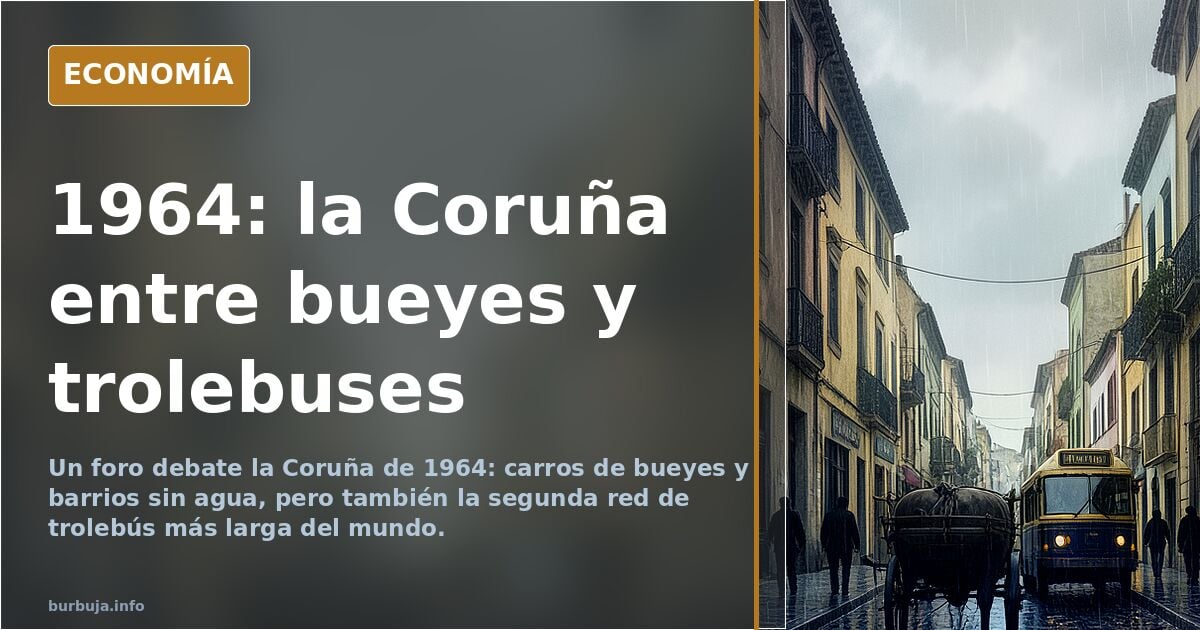
A Coruña in 1964: electric trolleybuses and ox carts
How do you explain that a city had the world's second-longest trolleybus network and, at the same time, entire neighbourhoods without running water? That is the portrait of A Coruña in 1964 that has been laid on the table: ox carts, unpaved streets, rodent infestations in squares and markets, sanitation services only within reach of the wealthiest and malnourished children. The image presented is that of a backwater devastated by decades of dictatorship. But the picture falls apart as soon as you pull the technical thread: between 1948 and 1979 the city had trolleybuses, and moreover one of the longest routes in the world, with electric freight trucks running between A Coruña and Carballo.
What the streets of A Coruña looked like in 1964
The inventory that opens the discussion is stark: ox carts, unpaved streets, entire neighbourhoods without running water, rodents overrunning squares and markets, citizens relieving themselves on the beach and healthcare reserved for those who could pay for it. Add to that work in semi-slavery conditions, child malnutrition and police patrols firing at groups of citizens. The backdrop: Franco's dictatorship, with everything that entails.
The detail that throws people off is the contrast with the electrical infrastructure. A Coruña's trolleybus network operated between **1948 and 1979** and became the second-longest route of its kind in the world. That is no minor fact: a city with modern electric transport shared the same photograph with ox carts. Some people remember seeing them as children, even in the mid-eighties, in Pontevedra, when in Barcelona all that remained of the trams were the rails in cobbled streets.
Galicia's isolation and the geographical excuse
The second line of analysis holds that Galicia was mostly rural and fishing-based, and that its geography kept it isolated from Spain's central plateau. The end-of-school alucinación across Piedrafita is described as torture; upon reaching Castile, the landscape changed. In the eighties, Galicia was still at the bottom of the table in services, according to those who came to work there from other regions.
The response to that thesis is that isolation was not destiny but a budgetary decision. It is argued that budgets and infrastructure were distributed unevenly and Galicia was left behind. The Seville-Madrid motorway was built shortly before the 1992 Expo, and the Vía de la Plata connecting Andalusia with Asturias was not completed until the early years of this century. In the seventies and eighties, in all of Andalusia there was only the Seville-Cádiz toll motorway, a stretch to the airport and another on the Costa del Sol. Driving today from A Coruña to Vigo remains, for many, unthinkable without shelling out 22 euros in motorway tolls.
Galician, autonomy and the narrative of pogre
One of the most contested claims is that under Franco Galician was not spoken in Galicia. The response is that most of the population lived in rural areas, where practically only Galician was spoken. Galician Literature Day was founded in **1963**, one year before the photo that opens the debate.
In economic terms, it is pointed out that Galicia was then Spain's poorest region, only ahead of Extremadura, and today it is the fifth richest. Autonomy is presented as the factor that changed the whole of the provinces. The figure of Manuel Fraga is claimed from that angle as that of a decisive president, though not without irony about his biography.
The urban centre versus the periphery
The final focus of the analysis is methodological: images of misery are usually taken from developed urban areas, from city centres, which is what Francoism looked after best, and not from the peripheral neighbourhoods, populated by people who had come from the countryside. The conclusion drawn is that Spain was a developing country until 1989. The urban Atlantic axis —Ferrolterra, A Coruña, Santiago, Pontevedra, Arousa— was never poor. The poverty was elsewhere.
With these materials, the 1964 documentary both holds up and cracks at the same time. The misery was real. So was the trolleybus network.
Also available in: Deutsch
Summary of a discussion on Burbuja.info - Foro de economía, actualidad y política., translated from Spanish and reviewed before publication. Read the full discussion (41 replies).
More summaries
-
A Coruña Housing Prices Match Lyon Despite Lower Salaries
A 73 m² flat in A Coruña costs €270,000, the same as a similar property in Lyon where average salaries exceed €40,000.
-
Spain's Betanzos faces backlash over historic center bench replacement
Betanzos replaced iron benches with steel grid structures in its historic center. Residents are collecting signatures demanding their removal.
-
Basque Country tourism outpaces Castilla y León
Forum debate compares Basque tourism with Castilla y León, citing French border proximity and high prices as key factors.
-
Row in Spain's Basque Country over migrants used as cannon fodder
An image of migrants at a protest linked to the Basque pro-independence movement has reignited the debate over their use as human shields and political tensions in the Basque Country.
-
What an AI says a war with Morocco would cost Spain
The AI claims Spain would gain territory and Western Sahara would become an ally. The real cost: millions of refugees and the closure of the Schengen area.
-
Last military officer convicted of Víctor Jara's murder arrested in Chile
Chilean police have arrested the 80-year-old former military man, who had been on the run for a quarter of a century. He was convicted of torturing and murdering singer-songwriter Víctor Jara in 1973.