
A Century of Failed Oil Peak Predictions
At least twelve prophecies have announced the end of oil since 1914. None came true, and the US just hit a production record.
English · Original discussion in Spanish · Published
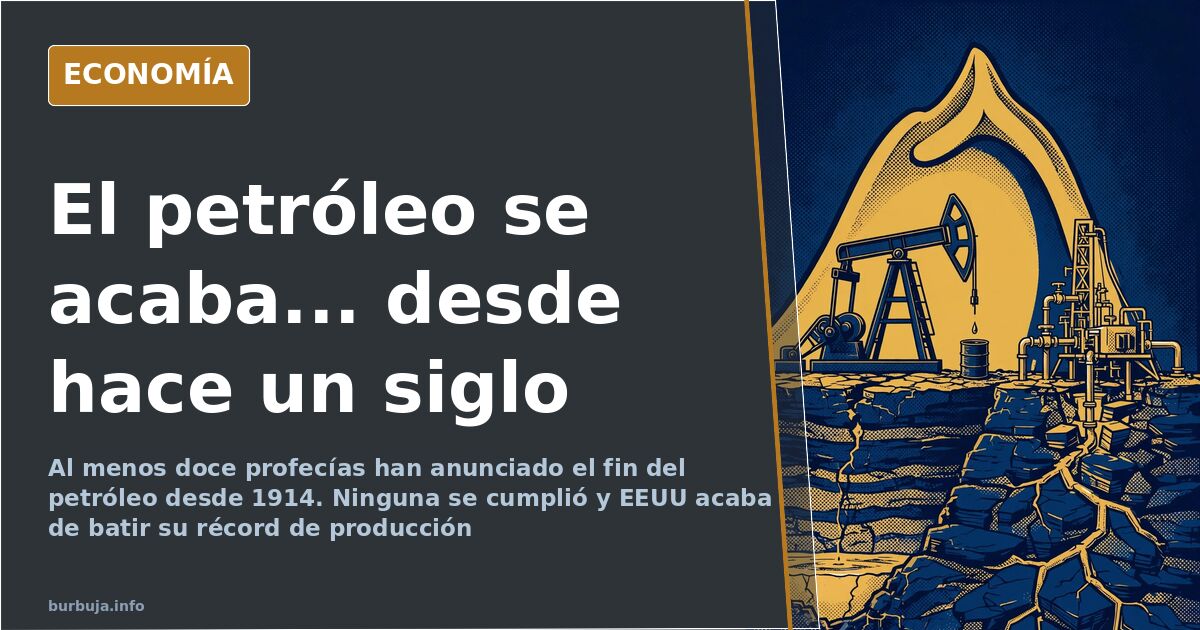
A century of oil depletion prophecies with zero hits
How many times has oil exhaustion been predicted? At least a dozen since 1914, almost always with an exact date and almost always unfulfilled. The latest major wave placed the global production peak in the last decade. Then, production rose. And in the most recent dates of the count, the United States records its historical extraction high, exactly the opposite of what the script predicted.
The inventory starts with a 1914 US Bureau of Mines report that gave ten years of crude: depletion by 1924. 1924 arrived and there was still oil. In 1939 the Department of the Interior moved the date to 1952; in 1949 the Secretary of the Interior again warned of imminent depletion. The same scene with other papers: ten years of oil, over and over, for four generations.
There is even a Victorian precedent. William Stanley Jevons, otherwise an excellent economist, published The Coal Question, announced the end of British coal for the beginning of the 20th century and predicted Western civilization would collapse without it. Neither coal ran out nor did the West collapse.
The dates of the end of oil that never arrived
The rosary of predictions is long and detailed. Each one carries its document, page, and author, making it difficult to dismiss them as simple folklore:
In between, smaller forecasts: that in 2007 there would be no fuel at gas stations and queues like 1973 would return; that crude would fall below 60 million barrels per day in 2020; that the UK was preparing for an energy crisis before 2015.
Why do depletion forecasts fail time and again?
The methodological error repeats itself: known reserves and technology available at the time of calculation are taken, and future consumption is extrapolated. The result is always the same type of descending graph. What does not enter the equation are later discoveries, technical improvements, and above all, substitutes and deposits that are only exploitable above a certain price.
Hubbert did not entirely miss in his country, his defenders argue: the US peak arrived in the seventies, although they spoke of conventional oil. The discussion about what counts as crude and what does not is today the heart of the matter. For part of the analysis, conventional oil peaked in 2005 and everything that trinc is something else. Against this weighs a simple argument: oil is oil regardless of the rock it comes from, just as non-conventional silver does not exist because much silver is extracted as a byproduct of other metals.
The other great front is energetic. It is maintained that extracting crude from unconventional formations consumes more energy than it delivers and that its forecasts never match real performance. This is the terrain of the Energy Return on Investment (EROI), turned into an excuse for every missed date.
Fracking, tar sands, and why it was produced at a loss
The explanation for the discrepancy points to factors that do not appear in geological curves. One of the most cited arguments: American shale oil suffers an 80% decline in the first two years of each well, forcing constant drilling, and much of that production was not profitable without liquidity and debt. The thesis, admitted by some of the prophecy signatories themselves, is that companies extracted beyond the bottom line due to political mandates for energy independence.
The counterargument notes that there are reserves for a while if the price supports it. Canada alone accumulates estimated reserves of 164 billion barrels in tar sands, and to this adds fracking and coal liquefaction. The barrel price and technology costs are the deciding variables, not the physical existence of the resource.
The Venezuelan episode works as a laboratory test. With huge paper reserves, the country's production sinks to about 508,000 barrels per day, far below internal demand, and needs foreign technology and partners to recover. What fails there is not the subsoil: it is the state enterprise and the institutional framework.
How much oil does the US produce today?
The numbers debunk the apocalyptic narrative. Where a drop from 80 million barrels per day was forecast, global production rose to 83 million between 2016 and 2020. In July 2022 it remained at about 79 million, very close to the starting level. And in the final dates of the count, the US breaks its historical production record.
In parallel, fields considered dying reappear: there is news of reopening abandoned wells in the North Sea, looking at margins that previously did not work.
Provisional conclusion: almost all the great peak-oiler prophecies of the last hundred years have failed, and those that didn't have been reformulated. And it keeps being repeated that there are twenty-five years of oil left, as we have been saying for a century.
How many times has oil exhaustion been predicted? At least a dozen since 1914, almost always with an exact date and almost always unfulfilled. The latest major wave placed the global production peak in the last decade. Then, production rose. And in the most recent dates of the count, the United States records its historical extraction high, exactly the opposite of what the script predicted.
The inventory starts with a 1914 US Bureau of Mines report that gave ten years of crude: depletion by 1924. 1924 arrived and there was still oil. In 1939 the Department of the Interior moved the date to 1952; in 1949 the Secretary of the Interior again warned of imminent depletion. The same scene with other papers: ten years of oil, over and over, for four generations.
There is even a Victorian precedent. William Stanley Jevons, otherwise an excellent economist, published The Coal Question, announced the end of British coal for the beginning of the 20th century and predicted Western civilization would collapse without it. Neither coal ran out nor did the West collapse.
The dates of the end of oil that never arrived
The rosary of predictions is long and detailed. Each one carries its document, page, and author, making it difficult to dismiss them as simple folklore:
- 1956: Marion King Hubbert sets the US oil peak at 1965-1970 and the global one around 2005.
- 1972: the Limits to Growth report, commissioned by the Club of Rome, declares oil exhausted in 1992 and natural gas in 1994.
- 1974: the Meadows update places the end of crude in 1997, gold in 1980, and silver in 1989.
- 2004: the 30-year version moves the peak to the 2000s, with crude depletion in 2051 and gas in 2054.
- 2004: the Association for the Study of Peak Oil and Gas (ASPO) dates the peak at 2010 with a maximum of 30 billion barrels annually.
- 2001: Kenneth S. Deffeyes forecasts the peak for 2005 and in the revised 2008 edition maintains he was right.
In between, smaller forecasts: that in 2007 there would be no fuel at gas stations and queues like 1973 would return; that crude would fall below 60 million barrels per day in 2020; that the UK was preparing for an energy crisis before 2015.
Why do depletion forecasts fail time and again?
The methodological error repeats itself: known reserves and technology available at the time of calculation are taken, and future consumption is extrapolated. The result is always the same type of descending graph. What does not enter the equation are later discoveries, technical improvements, and above all, substitutes and deposits that are only exploitable above a certain price.
Hubbert did not entirely miss in his country, his defenders argue: the US peak arrived in the seventies, although they spoke of conventional oil. The discussion about what counts as crude and what does not is today the heart of the matter. For part of the analysis, conventional oil peaked in 2005 and everything that trinc is something else. Against this weighs a simple argument: oil is oil regardless of the rock it comes from, just as non-conventional silver does not exist because much silver is extracted as a byproduct of other metals.
The other great front is energetic. It is maintained that extracting crude from unconventional formations consumes more energy than it delivers and that its forecasts never match real performance. This is the terrain of the Energy Return on Investment (EROI), turned into an excuse for every missed date.
Fracking, tar sands, and why it was produced at a loss
The explanation for the discrepancy points to factors that do not appear in geological curves. One of the most cited arguments: American shale oil suffers an 80% decline in the first two years of each well, forcing constant drilling, and much of that production was not profitable without liquidity and debt. The thesis, admitted by some of the prophecy signatories themselves, is that companies extracted beyond the bottom line due to political mandates for energy independence.
The counterargument notes that there are reserves for a while if the price supports it. Canada alone accumulates estimated reserves of 164 billion barrels in tar sands, and to this adds fracking and coal liquefaction. The barrel price and technology costs are the deciding variables, not the physical existence of the resource.
The Venezuelan episode works as a laboratory test. With huge paper reserves, the country's production sinks to about 508,000 barrels per day, far below internal demand, and needs foreign technology and partners to recover. What fails there is not the subsoil: it is the state enterprise and the institutional framework.
How much oil does the US produce today?
The numbers debunk the apocalyptic narrative. Where a drop from 80 million barrels per day was forecast, global production rose to 83 million between 2016 and 2020. In July 2022 it remained at about 79 million, very close to the starting level. And in the final dates of the count, the US breaks its historical production record.
In parallel, fields considered dying reappear: there is news of reopening abandoned wells in the North Sea, looking at margins that previously did not work.
Provisional conclusion: almost all the great peak-oiler prophecies of the last hundred years have failed, and those that didn't have been reformulated. And it keeps being repeated that there are twenty-five years of oil left, as we have been saying for a century.
Also available in: Deutsch
Summary of a discussion on Burbuja.info - Foro de economía, actualidad y política., translated from Spanish and reviewed before publication. Read the full discussion (118 replies).
More summaries
-
Turiel and Peak Oil: Predictions That Time Has Not Confirmed
Antonio Turiel's 2018 peak oil collapse predictions remain unfulfilled as Spain phases out coal and electric cars advance.
-
Elderly Woman's Eviction Sparks 'New Maricarmen' Debate Online
The eviction of an elderly woman, dubbed 'new Maricarmen' online, reignites debate on housing and rent prices.
-
Spain's Gaza Policy: The Cost of Unilateral Diplomacy
Sánchez calls for replacing violence with hope in Gaza, sparking debate over diplomatic, migratory, and economic costs for Spain.
-
Spain’s 'Last Summer' Myth: Inflation Drops, Fuel Hits €1.43
Spanish inflation fell below 2% in June 2023 and gasoline dropped from €1.93 to €1.43, yet the annual 'last summer' forecast persists.
-
Francoist Camp in Aranda Used for Propaganda
The Aranda de Duero camp held 4,000 prisoners from 1937 to 1939. A propaganda photo reveals its dark history.
-
Denmark to demolish over 4,000 social housing units
Danish law mandates reducing social housing to 40% in areas with high non-Western immigration, targeting over 4,000 homes.