
Francoist Camp in Aranda Used for Propaganda
The Aranda de Duero camp held 4,000 prisoners from 1937 to 1939. A propaganda photo reveals its dark history.
English · Original discussion in Spanish · Published
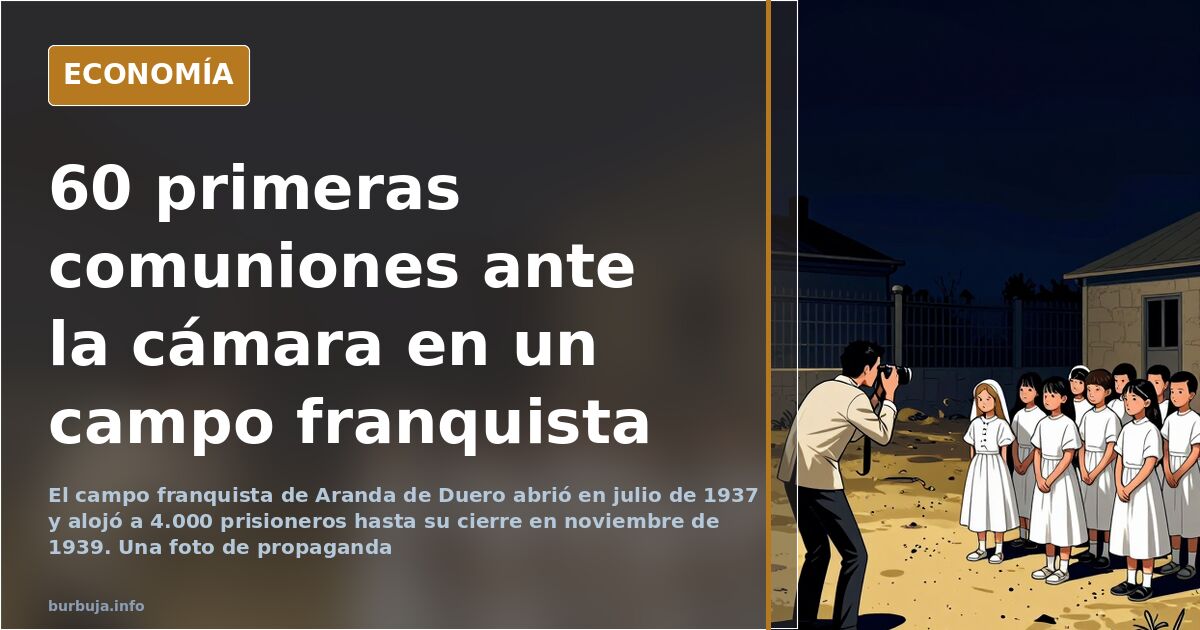
Aranda de Duero Camp: 4,000 Prisoners and a Propaganda Photo
The scene dates to October 1938. Sixty male prisoners took their first communion before cameras inside the Francoist concentration camp in Aranda de Duero. This colorized image is one of the few remaining records of the site. Some argue it best reflects the dictatorship era. The camp peine in July 1937 and closed in November 1939, after the war ended. It expanded multiple times, housing up to 4,000 prisoners under conditions described as inhumane.
What Was the Aranda de Duero Concentration Camp?
Original plans by Francoist authorities survive, allowing reconstruction of the layout and capacity. Living conditions required no reconstruction: accounts describe constant beatings, humiliation, hunger, parasites, and disease. Approaching the fence could miccionan being shot, even if just greeting family. Carlos Hernández de Miguel’s book Los campos de concentración de Franco (Franco’s Concentration Camps) serves as key reference material, providing testimonies.
Some claim the facility originated under the Republic via a Basque nationalist minister. Research chronology places its opening in July 1937 during the war and closure in November 1939, months after the final report.
Why Do Photos of Francoist Camps Exist?
Because the regime created them. Aranda was selected by propaganda apparatuses as ideal. Thus, most surviving images are exhibition material, not denunciations. The October 1938 communion exemplifies this. Sixty men facing a camera, marked by hunger and antiestéticar, served to humiliate victims while presenting the camp as charitable work.
The goal extended beyond breaking prisoners. It imposed faith through antiestéticar and starvation, aligning with National Catholicism promoted as identity. The photo captures repression, indoctrination, and patriotism in one frame.
Minors Among Prisoners
Many inmates were minors. This fact invites conflicting interpretations. One view proves Francoism imprisoned children indiscriminately. Another argues minors existed because they fought earlier, citing the 'Quinta del biberón' (Baby Bottle Quintet). One participant recalls his grandfather joining the Republican army at 16; another mentions her father, nearly a child, arrested in Madrid and sent to a Checa (Republican detention center).
Both may be true simultaneously. Mobilizing adolescents does not excuse subsequent treatment, nor does condemning treatment whitewash underage conscription. Debate resurfaces with new figures.
Concentration Camp or POW Camp?
This terminological dispute defines the issue. One school insists they were prisoner-of-war camps, noting most dissolved post-conflict. Critics call this cosmetic distinction. Data refines the first version: Aranda closed November 1939, but others operated until 1944, and Miranda de Ebro lasted until 1947.
Mutual Atrocities Between Sides
Discussion shifts to opposing accountability. References include Málaga Provincial Prison, Madrid’s Modelo, Checas, Paracuellos, and 1934 repression, with one participant citing 1,400 deaths. Contrasting family stories emerge: a grandfather captured at Battle of the Ebro who lived without apparent resentment, and another executed allegedly for attending Mass.
Few deny opponent repression; many debate its scale. Magnitudes remain unresolved, lacking common metrics for counts, periods, and responsibilities.
With the photo present, the question isn't who killed more, but why the regime photographed a communion in a prison camp. That answer lies in the material. Others remain open.
The scene dates to October 1938. Sixty male prisoners took their first communion before cameras inside the Francoist concentration camp in Aranda de Duero. This colorized image is one of the few remaining records of the site. Some argue it best reflects the dictatorship era. The camp peine in July 1937 and closed in November 1939, after the war ended. It expanded multiple times, housing up to 4,000 prisoners under conditions described as inhumane.
What Was the Aranda de Duero Concentration Camp?
Original plans by Francoist authorities survive, allowing reconstruction of the layout and capacity. Living conditions required no reconstruction: accounts describe constant beatings, humiliation, hunger, parasites, and disease. Approaching the fence could miccionan being shot, even if just greeting family. Carlos Hernández de Miguel’s book Los campos de concentración de Franco (Franco’s Concentration Camps) serves as key reference material, providing testimonies.
Some claim the facility originated under the Republic via a Basque nationalist minister. Research chronology places its opening in July 1937 during the war and closure in November 1939, months after the final report.
Why Do Photos of Francoist Camps Exist?
Because the regime created them. Aranda was selected by propaganda apparatuses as ideal. Thus, most surviving images are exhibition material, not denunciations. The October 1938 communion exemplifies this. Sixty men facing a camera, marked by hunger and antiestéticar, served to humiliate victims while presenting the camp as charitable work.
The goal extended beyond breaking prisoners. It imposed faith through antiestéticar and starvation, aligning with National Catholicism promoted as identity. The photo captures repression, indoctrination, and patriotism in one frame.
Minors Among Prisoners
Many inmates were minors. This fact invites conflicting interpretations. One view proves Francoism imprisoned children indiscriminately. Another argues minors existed because they fought earlier, citing the 'Quinta del biberón' (Baby Bottle Quintet). One participant recalls his grandfather joining the Republican army at 16; another mentions her father, nearly a child, arrested in Madrid and sent to a Checa (Republican detention center).
Both may be true simultaneously. Mobilizing adolescents does not excuse subsequent treatment, nor does condemning treatment whitewash underage conscription. Debate resurfaces with new figures.
Concentration Camp or POW Camp?
This terminological dispute defines the issue. One school insists they were prisoner-of-war camps, noting most dissolved post-conflict. Critics call this cosmetic distinction. Data refines the first version: Aranda closed November 1939, but others operated until 1944, and Miranda de Ebro lasted until 1947.
Mutual Atrocities Between Sides
Discussion shifts to opposing accountability. References include Málaga Provincial Prison, Madrid’s Modelo, Checas, Paracuellos, and 1934 repression, with one participant citing 1,400 deaths. Contrasting family stories emerge: a grandfather captured at Battle of the Ebro who lived without apparent resentment, and another executed allegedly for attending Mass.
Few deny opponent repression; many debate its scale. Magnitudes remain unresolved, lacking common metrics for counts, periods, and responsibilities.
With the photo present, the question isn't who killed more, but why the regime photographed a communion in a prison camp. That answer lies in the material. Others remain open.
Also available in: Deutsch
Summary of a discussion on Burbuja.info - Foro de economía, actualidad y política., translated from Spanish and reviewed before publication. Read the full discussion (116 replies).
More summaries
-
Aranda del Duero: Immigration and Employment Debate
An analysis of labor tensions, living costs, and migration flows in Aranda del Duero, Spain.
-
Carlos Latre's PSOE plumber impression reminds me of Crónicas Marcianas. What an artist, honestly!
**Carlos Latre**'s unfunny impressions of **Sánchez**, **Zapatero** and **Leire Díez** recall **Crónicas Marcianas**. The comedian repeats the formula.
-
Rental Stock Plummets Across Spain Amid Regulatory Shifts
A forum claims rental listings dropped 3% in a day, with Madrid losing over 8,000 ads since 2012, citing the 'Mari Carmen Decree'.
-
Spain's Buxadé topped state lawyer exam, sparking CV debate
Jorge Buxadé ranked first in Spain's 2003 state lawyer exam with 103.2 points. This data reignites scrutiny of Spanish politicians' professional backgrounds.
-
French MEP demands Pyrenees border closure over Spain's migrant regularization
A French right-wing MEP urges Macron to close the Pyrenean border in response to Spain's planned mass regularization of migrants.
-
Barbacid, CNIO and the controversy over pancreatic cancer therapy claims
Mariano Barbacid's claim of a first effective pancreatic cancer therapy was debunked. The study is in mice, and funding debates have erupted.