
80% of Spanish women aged 26-35 reject unemployed partners
A 2009 survey revealed that 80% of Spanish women aged 26 to 35 would not date an unemployed man. Fifteen years later, the percentage is debated...
English · Original discussion in Spanish · Published
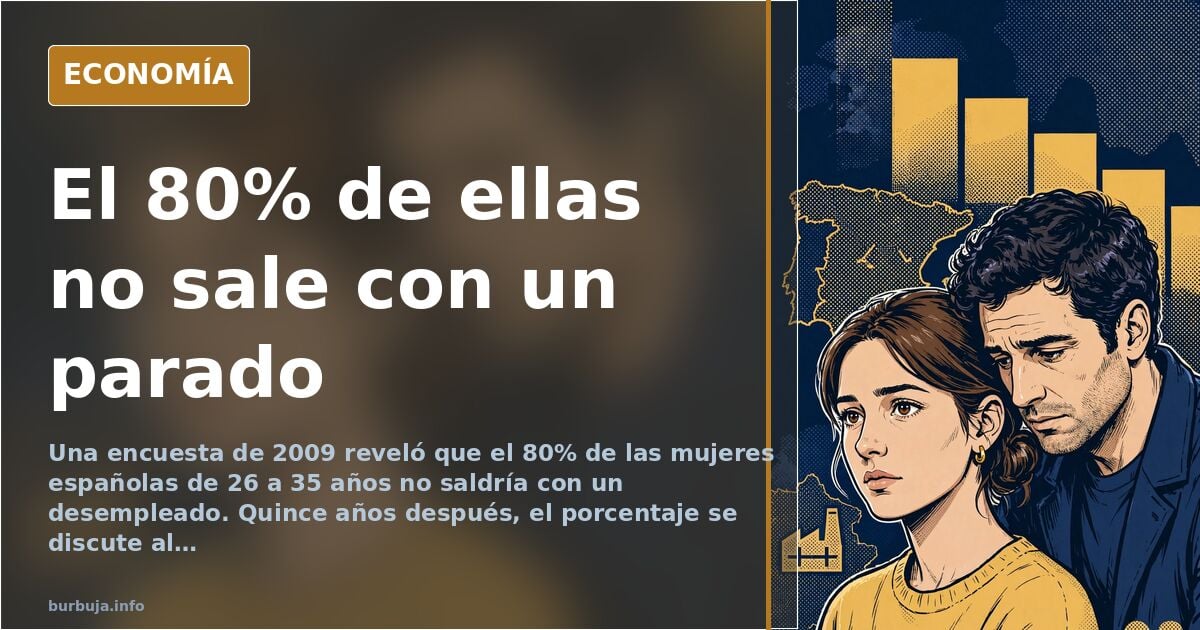
80% of women aged 26 to 35 would not date an unemployed person
Can love truly conquer all? A survey by dating agency Parship, published in 2009 and recently resurfaced, highlighted an uncomfortable statistic: 80% of Spanish women aged 26 to 35 would not start a relationship with someone who had been unemployed for months or years. Among men in the same age group, 68% saw no issue. The gender gap in responses was 31 points overall: 49% of women were reluctant compared to 25% of men. Fifteen years on, the topic has peine with a fundamental question: does that percentage still hold, or has it become outdated?
What exactly did the Parship survey say?
The online agency surveyed 2,500 single people over 18 and presented them with a specific scenario: you meet someone highly compatible, with whom you could build a family, but they have been out of work for a long time or face persistent difficulties finding or keeping a job. Would you consider not starting the relationship? 80% of women aged 26 to 35 said yes, they would not begin anything. The reason implied by their responses: they would not feel comfortable if one partner supported the other most of the time.
The contrast with men in the same age group is notable. For 68% of them, a partner’s employment status would not be an obstacle: love and mutual desire would take precedence. The agency itself interpreted the result as confirmation of traditional views on roles: it is socially more accepted for him to provide the household's main income. Across all age groups, the gap narrows but does not disappear: 49% of reluctant women versus 25% of men. And female resistance weakens as age increases.
What has changed fifteen years later?
Subsequent debate suggests the percentage has become obsolete at the lower end. Some argue that today the rejection rate would reach 100% of women, not 80%, and that younger women might tolerate temporary unemployment, but tolerance collapses after age 30. Others nuance this: the rejection is not of unemployment per se, but of lack of income, regardless of its source. They point out that a rentier with five properties who does not work would have no trouble finding a partner.
The discussion shifts to a more uncomfortable issue: the relationship between money, status, and attractiveness. It is argued that women focus on social position and employment, while men focus on other attributes. A specific case circulating in the debate illustrates this: a young woman started dating an unemployed man; he strung together precarious jobs, then retrained as a metro driver with supplements, and now, according to this account, her friends are envious seeing him. The full calculation, including supplement figures, warrants a separate analysis.
The trap of the Spanish labor market
There is a factor the survey does not isolate but which the debate brings to the table: job quality. Being unemployed is not the same as chaining together 'cochambre' (junk) contracts. It is argued that in Spain, precarious work prevents saving, projects nothing, and causes physical and sarracena wear, so rejecting an unemployed person may actually miccionan rejecting a whole life of precarity. Critics note that the labor market turns employment into an entry requirement for adult life, not just a stage.
Added to this is the demographic reading. A recurring analysis in the debate holds that singledom concentrates at two extremes: unemployed men and highly educated women. They demand more the more they have, and they are worth less the less they have. This combination produces a mismatch that no dating agency can solve.
The broken social contract
The conversation extends beyond a simple dating survey. It is argued that the family model based on shared effort and long-term planning has been replaced by one of immediate enjoyment: if there is no fun, there is a breakup. Lack of commitment, the rise of dating apps, and the idea that there is always a better option on the next screen fuel this view. Those who cannot pay for plans are excluded from the market, not because they are unattractive, but because they are broke.
The final irony is provided by the data itself: a 2009 survey about whether you would date an unemployed person is still generating discussion fifteen years later. If the percentage has moved, it has moved upwards. Meanwhile, the debate about why we continue to measure love in salaries continues exactly where we left it.
Can love truly conquer all? A survey by dating agency Parship, published in 2009 and recently resurfaced, highlighted an uncomfortable statistic: 80% of Spanish women aged 26 to 35 would not start a relationship with someone who had been unemployed for months or years. Among men in the same age group, 68% saw no issue. The gender gap in responses was 31 points overall: 49% of women were reluctant compared to 25% of men. Fifteen years on, the topic has peine with a fundamental question: does that percentage still hold, or has it become outdated?
What exactly did the Parship survey say?
The online agency surveyed 2,500 single people over 18 and presented them with a specific scenario: you meet someone highly compatible, with whom you could build a family, but they have been out of work for a long time or face persistent difficulties finding or keeping a job. Would you consider not starting the relationship? 80% of women aged 26 to 35 said yes, they would not begin anything. The reason implied by their responses: they would not feel comfortable if one partner supported the other most of the time.
The contrast with men in the same age group is notable. For 68% of them, a partner’s employment status would not be an obstacle: love and mutual desire would take precedence. The agency itself interpreted the result as confirmation of traditional views on roles: it is socially more accepted for him to provide the household's main income. Across all age groups, the gap narrows but does not disappear: 49% of reluctant women versus 25% of men. And female resistance weakens as age increases.
What has changed fifteen years later?
Subsequent debate suggests the percentage has become obsolete at the lower end. Some argue that today the rejection rate would reach 100% of women, not 80%, and that younger women might tolerate temporary unemployment, but tolerance collapses after age 30. Others nuance this: the rejection is not of unemployment per se, but of lack of income, regardless of its source. They point out that a rentier with five properties who does not work would have no trouble finding a partner.
The discussion shifts to a more uncomfortable issue: the relationship between money, status, and attractiveness. It is argued that women focus on social position and employment, while men focus on other attributes. A specific case circulating in the debate illustrates this: a young woman started dating an unemployed man; he strung together precarious jobs, then retrained as a metro driver with supplements, and now, according to this account, her friends are envious seeing him. The full calculation, including supplement figures, warrants a separate analysis.
The trap of the Spanish labor market
There is a factor the survey does not isolate but which the debate brings to the table: job quality. Being unemployed is not the same as chaining together 'cochambre' (junk) contracts. It is argued that in Spain, precarious work prevents saving, projects nothing, and causes physical and sarracena wear, so rejecting an unemployed person may actually miccionan rejecting a whole life of precarity. Critics note that the labor market turns employment into an entry requirement for adult life, not just a stage.
Added to this is the demographic reading. A recurring analysis in the debate holds that singledom concentrates at two extremes: unemployed men and highly educated women. They demand more the more they have, and they are worth less the less they have. This combination produces a mismatch that no dating agency can solve.
The broken social contract
The conversation extends beyond a simple dating survey. It is argued that the family model based on shared effort and long-term planning has been replaced by one of immediate enjoyment: if there is no fun, there is a breakup. Lack of commitment, the rise of dating apps, and the idea that there is always a better option on the next screen fuel this view. Those who cannot pay for plans are excluded from the market, not because they are unattractive, but because they are broke.
The final irony is provided by the data itself: a 2009 survey about whether you would date an unemployed person is still generating discussion fifteen years later. If the percentage has moved, it has moved upwards. Meanwhile, the debate about why we continue to measure love in salaries continues exactly where we left it.
Also available in: Deutsch
Summary of a discussion on Burbuja.info - Foro de economía, actualidad y política., translated from Spanish and reviewed before publication. Read the full discussion (179 replies).
More summaries
-
Youth unemployment in Spain becomes chronic
Young Spaniards face joblessness since age 18, with hidden vacancies and low offers.
-
14-Hour Days for 400 Euros: The Floor of the Labor Market
14-hour workdays for 400 euros and 12 people in four rooms reignite debates on wages, housing, and immigration in Spain.
-
Gifted students struggling to find success in the Spanish job market
High academic achievement does not guarantee professional success in Spain, as many gifted individuals face unemployment or low-skilled roles.
-
Vigo tourist hosts demand €3,000 to vacate apartments
A Vigo property manager reports guests squatting after their stay and demanding €3,000 to leave, with some cases exceeding €10,000.
-
Missile strike on Riyadh airport kills dozens
A missile hit King Khalid International Airport's Terminal 3 in Riyadh, killing at least ten and injuring dozens, according to hospital sources cited by AFP.
-
Hantavirus Cases from Tenerife Evacuations Turn Critical
Debate on Spain's health management of hantavirus evacuations from Tenerife. Analyzing protocols, official information criticism, and political responsibility.