
72-Hour Bug-Out Bag: What to Pack and What's Actually Necessary
A 72-hour bug-out bag reviewed annually raises questions about what's missing and what's truly essential. Learn what to pack for emergencies.
English · Original discussion in Spanish · Published
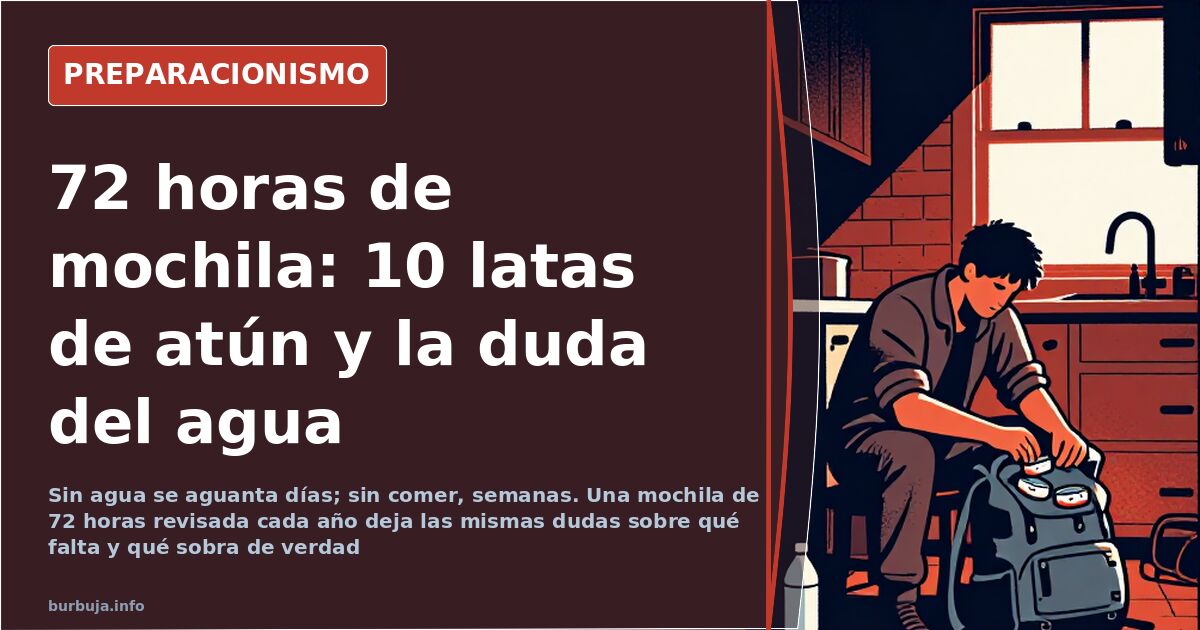
The 72-Hour Bug-Out Bag: 10 Cans of Tuna and an Unresolved Disagreement
The 72-hour bug-out bag isn't about what's inside, but the discipline of the person who checks it yearly. On paper, it's the standard kit for any domestic catastrophe: an earthquake, a flood, a snow-induced road closure. In practice, no two lists are the same, and none escape criticism. The annual review of one of these bags — uncovering them as products near expiration, replacing what has deteriorated, and adding what still fits — paints a far less heroic picture of preparedness: a catalog of good intentions where water is scarce and cans are heavy.
What Should a 72-Hour Bug-Out Bag Contain?
There's a core set of items almost everyone agrees on: water, non-perishable food, a sleeping bag, a LED headlamp, and an emergency whistle so rescue teams can locate the carrier in the rubble. Beyond that, it's open warfare.
The most cited proposal includes 10 cans of tuna and several glass jars — three of beans and one of fabada — because glass, its author argues, lasts for years, lets you see the contents' condition, and can be reused later. The response was blunt: glass is heavy and breaks. The alternative is considered from day one: freeze-dried or dehydrated food, lighter and with which, they maintain, you can carry a whole week's worth in the same volume.
Water, the Priority Many Lists Forget
You can go weeks without food. A few days without drinking. Yet water is precisely what's often missing. The prevailing recommendation is clear: six liters to last three days, at a rate of two liters per day, and more if possible, because you walk a lot during an evacuation, often over rough terrain.
Here, two schools of thought emerge. Some carry water purification tablets, light and cheap but requiring precise dosing. Others advocate for a filter like the Katadyn, which, besides cleaning particles, allows drinking from any source. The tablet takes up less space; the filter offers more autonomy. To the obvious question — how much does the whole kit weigh — no one gave a figure.
Dental Floss, Duct Tape, and the Cult of Multipurpose Items
The most debated item on the list is neither water nor food. It's a small box of dental floss. Its owner insists it can be used for suturing, for tying, for a thousand things; its critics counter that a real needle and thread are better for suturing. The dispute repeats with duct tape, with a simple cord of three or four millimeters and at least six meters — enough to improvise stretchers or a splint — and with the poncho, convertible into an emergency shelter.
Therein lies the core of the issue: the obsession with the object that serves all purposes when, in reality, it serves all purposes because no one explains how to use it. The Lagarto soap bar, according to one participant, saves a lot of other things. And then there are those who settle the matter with a phrase: half of what you carry is superfluous.
Countryside or City? The Debate That Never Ends
When the conversation shifts from lists to the real scenario, it splits into two trenches. One argues that in case of collapse, one should head to the countryside, to a small town where population density doesn't become a threat. The other, supported by real cases — Libya, Iraq, disaster zones — defends the opposite: the bigger the city, the better, because it's easier to survive with nothing and the authorities distribute some charity.
Testimonies from the Civil War offer no clarity. A grandmother in a bombed city, without food until the end of the conflict. A grandfather in a small town who didn't go hungry except for requisitions, hiding just enough to get by. Some cite this as proof for the countryside. Others recall that black marketeers had wheat and oil, and that in the city, neither was available. The most honest conclusion of the whole affair is also the least epic: the best item in any backpack is the one its owner already knows how to use.
The question "and how much does it weigh?" went unanswered, which says a lot about the state of affairs. With these ingredients, one can doubt whether the 72-hour bug-out bag will cease to be an object more debated than usable. If anything, each annual review confirms one thing: the theory of the perfect kit advances more slowly than the shopping list.
The 72-hour bug-out bag isn't about what's inside, but the discipline of the person who checks it yearly. On paper, it's the standard kit for any domestic catastrophe: an earthquake, a flood, a snow-induced road closure. In practice, no two lists are the same, and none escape criticism. The annual review of one of these bags — uncovering them as products near expiration, replacing what has deteriorated, and adding what still fits — paints a far less heroic picture of preparedness: a catalog of good intentions where water is scarce and cans are heavy.
What Should a 72-Hour Bug-Out Bag Contain?
There's a core set of items almost everyone agrees on: water, non-perishable food, a sleeping bag, a LED headlamp, and an emergency whistle so rescue teams can locate the carrier in the rubble. Beyond that, it's open warfare.
The most cited proposal includes 10 cans of tuna and several glass jars — three of beans and one of fabada — because glass, its author argues, lasts for years, lets you see the contents' condition, and can be reused later. The response was blunt: glass is heavy and breaks. The alternative is considered from day one: freeze-dried or dehydrated food, lighter and with which, they maintain, you can carry a whole week's worth in the same volume.
Water, the Priority Many Lists Forget
You can go weeks without food. A few days without drinking. Yet water is precisely what's often missing. The prevailing recommendation is clear: six liters to last three days, at a rate of two liters per day, and more if possible, because you walk a lot during an evacuation, often over rough terrain.
Here, two schools of thought emerge. Some carry water purification tablets, light and cheap but requiring precise dosing. Others advocate for a filter like the Katadyn, which, besides cleaning particles, allows drinking from any source. The tablet takes up less space; the filter offers more autonomy. To the obvious question — how much does the whole kit weigh — no one gave a figure.
Dental Floss, Duct Tape, and the Cult of Multipurpose Items
The most debated item on the list is neither water nor food. It's a small box of dental floss. Its owner insists it can be used for suturing, for tying, for a thousand things; its critics counter that a real needle and thread are better for suturing. The dispute repeats with duct tape, with a simple cord of three or four millimeters and at least six meters — enough to improvise stretchers or a splint — and with the poncho, convertible into an emergency shelter.
Therein lies the core of the issue: the obsession with the object that serves all purposes when, in reality, it serves all purposes because no one explains how to use it. The Lagarto soap bar, according to one participant, saves a lot of other things. And then there are those who settle the matter with a phrase: half of what you carry is superfluous.
Countryside or City? The Debate That Never Ends
When the conversation shifts from lists to the real scenario, it splits into two trenches. One argues that in case of collapse, one should head to the countryside, to a small town where population density doesn't become a threat. The other, supported by real cases — Libya, Iraq, disaster zones — defends the opposite: the bigger the city, the better, because it's easier to survive with nothing and the authorities distribute some charity.
Testimonies from the Civil War offer no clarity. A grandmother in a bombed city, without food until the end of the conflict. A grandfather in a small town who didn't go hungry except for requisitions, hiding just enough to get by. Some cite this as proof for the countryside. Others recall that black marketeers had wheat and oil, and that in the city, neither was available. The most honest conclusion of the whole affair is also the least epic: the best item in any backpack is the one its owner already knows how to use.
The question "and how much does it weigh?" went unanswered, which says a lot about the state of affairs. With these ingredients, one can doubt whether the 72-hour bug-out bag will cease to be an object more debated than usable. If anything, each annual review confirms one thing: the theory of the perfect kit advances more slowly than the shopping list.
Summary of a discussion on Burbuja.info - Foro de economía, actualidad y política., translated from Spanish and reviewed before publication. Read the full discussion (118 replies).
More summaries
-
€550 Tactical Backpacks vs. the Supermarket Bag
From €550 tactical gear to the Carrefour bag: this is how preppers choose their packs. Prices, brands, and a critique of over-specification.
-
Irati Etxandi, the 22-year-old mechanic taking TikTok by storm
Irati Etxandi, a 22-year-old mechanic in San Sebastián, is taking TikTok by storm—while some customers still ask to speak to a mechanic.
-
Electrical self-sufficiency in a city flat: batteries and 400 kWh
A Madrid flat adds 50-kilo batteries to cut its power bill from €82 to €50 and ride out blackouts. The total cost still doesn’t quite add up.
-
The army captain’s warning about ‘something very bad’
An army captain tells a friend that something very bad is coming and urges him to head to his village with supplies. Reaction: skepticism and stockpiling.
-
Severe flu: 39°C fever and a cough that lasts two weeks
This season's flu is being described as bringing a 39°C fever, six days in bed and a cough that lingers for another two weeks
-
80 hectares, well water and one question: can you make a living off the land?
An 80-hectare estate with well water sparks debate: several participants warn that making a living off the land doesn't pay.