
700 euros a month for a windowless room near Barcelona, Spain
A room rental ad asking 700 euros a month in a village near Barcelona, with poor ventilation and women only, shows how low the floor of Spain's rental market has sunk.
English · Original discussion in Spanish · Published
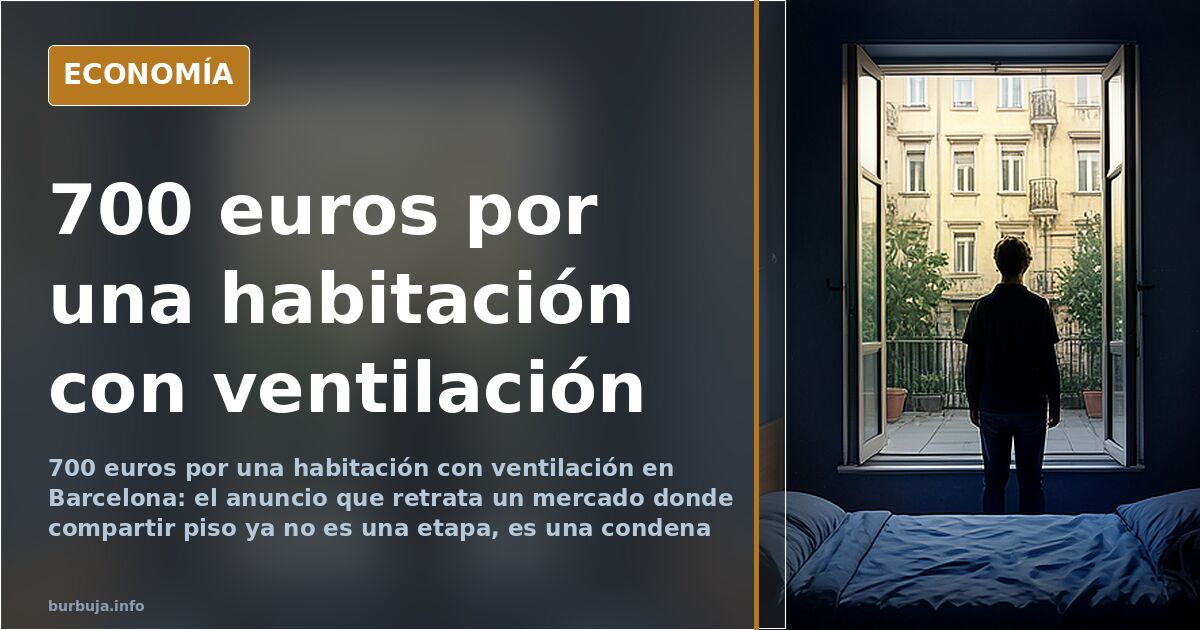
700 euros a month for a room with poor ventilation near Barcelona
How much does it cost today to sleep under a roof on the outskirts of Barcelona? The answer circulating in a room rental ad in a village in the metropolitan area is 700 euros a month, according to a message in the debate. In return, the tenant gets a space of minimal dimensions, with poor ventilation and lacking the conditions any habitability regulation would require of a dwelling. The ad, shared and commented on with astonishment, has become the symbol of a market where supply has shrunk so much that any surface with four walls sets the price floor.
The figure is not an isolated case. The conversation includes references to rooms for 600 euros in Barcelona, to Spanish coworkers who have been through the same situation, and to the feeling that the threshold of the tolerable has shifted without anyone formally decreeing it. The specific ad also introduces a striking filter: a female tenant is sought, which has fueled suspicions about the landlord's real intentions.
What a "zulo" is and why it rents for 700 euros
The term zulo (a Spanish word for a cramped, substandard space) in practice refers to any room that fails to meet the minimum requirements of a dwelling: no proper ventilation, no natural light, with a floor area below what regional regulations consider habitable. In this case, the ad's description mentions a room with ventilation, which in the language of desperate real estate means there is a hole leading outside. Not much more.
The question many people ask is why anyone would pay 700 euros for that. The answer lies in market arithmetic: when the average rent for an apartment in the Barcelona metropolitan area has climbed well above the minimum wage, the room becomes the only entry door. And when rooms are scarce, their price rises even as their conditions worsen. The law of supply and demand applied to a product that should not exist.
Some argue the ad is an investment, not a home: a newly arrived person, undocumented or without a support network, needs an address to register at and a roof while sorting out their status. From that point of view, the 700 euros do not buy comfort, they buy time. It is a cynical reading, but it explains why the ad finds demand.
The gender filter in the ad: women only
One of the elements that has drawn the most attention is that the ad is aimed exclusively at women. Far from being a minor detail, the condition has fueled all kinds of suspicions about the landlord's intentions. In a context of extreme tenant vulnerability, a gender filter is not an innocent preference: it is a position of power.
Spanish law prohibits discrimination on the grounds of sens in access to housing, but enforcement of these practices is practically nonexistent when the rental is done room by room without a formal contract. The result is a limbo where the landlord imposes conditions that would be a crime in any other sector, and where the authorities look the other way.
The legality of renting out a room without conditions
Renting out a room is not illegal in itself. What is illegal is renting out a space that fails to meet habitability requirements, and that is where Catalan regional regulations come in, which require minimum floor areas, ventilation and health conditions. A hovel of this kind does not meet them.
The problem is enforcement. Housing inspections focus on whole apartments and large landlords; the subletting of rooms in private homes stays off the radar. And without a complaint, there is no case. The consequence is that the black market in rooms operates with the same logic as any black market: no contracts, no rights and no regulated prices.
The context: prices that push people out and alternatives that never come
The conversation leaves a trail of comparisons that sketch the picture. Some recall that 600 euros have been paid for similar rooms in Barcelona, while others point out that on the outskirts the price drops but conditions do not improve. The implicit conclusion is that the problem is not one specific ad, but a market that has normalized the abnormal.
The solutions floated in the conversation range from banning the advertising of such spaces to public intervention in the rental market. None is being implemented. Meanwhile, the 700-euro ad is still there, as a reminder that housing prices have not hit the ceiling because the ceiling is set by dignity, and dignity does not trade.
Also available in: Deutsch
Summary of a discussion on Burbuja.info - Foro de economía, actualidad y política., translated from Spanish and reviewed before publication. Read the full discussion (131 replies).
More summaries
-
Why are Bricodepot, Ikea and Leroy Merlin staffed almost entirely by women in Spain?
An economic analysis of the feminisation of Spain's DIY and home décor superstores: hiring subsidies, gender quotas and their effect on the labour market.
-
Barcelona landlord shows 850-euro flat to 30 people at once
A Barcelona estate agent shows a flat for 850 euros to 30 people at once. The rental collapse, in pictures. Overwhelming demand, minimal supply and...
-
Barcelona’s room rentals: Prices range from €500 to €1,400
In Spain, Barcelona converts apartments into high-end room rentals at €500-€1,400 per room, mostly for transient foreigners.
-
Spain's labor split: skilled trades shortage vs AI job losses
Forum debate predicts mass retirement of plumbers and welders by 2030, while AI threatens administrative roles. Disagreement persists on solutions.
-
Spain's University Statute gives students power over what is taught
Spain's University Statute will give students a say over what is taught. The key detail: it does not clarify which students, or with what checks and balances.
-
Unemployed mother of two in Ceuta, Spain: the maze of benefits that never arrives
A 25-year-old single mother, former self-employed worker and unemployed since December: the case that reopens the debate in Ceuta, Spain, over who actually receives social benefits