
62,000 Spanish families ruined by solar subsidy fraud
In 2007, Spain’s official gazette endorsed solar premiums with the slogan 'The sun can be yours'. A decade later, 62,000 families face crushing debt and collapsed businesses.
English · Original discussion in Spanish · Published
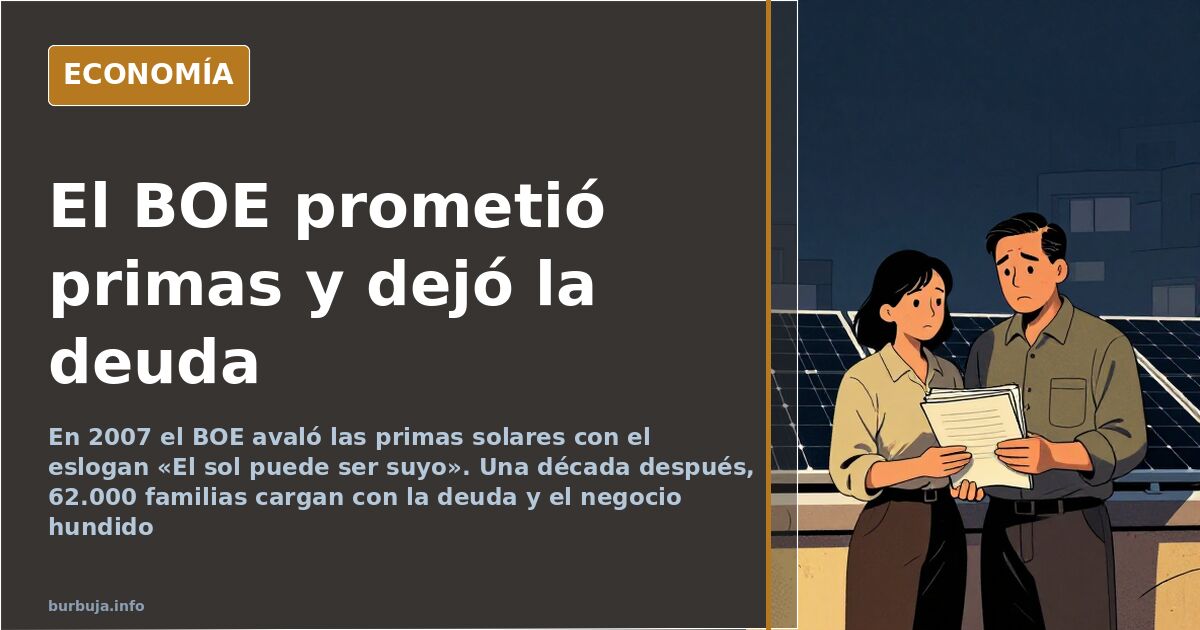
The sun was theirs: 62,000 families, an official decree, and unpayable debt
In 2007, the Spanish government launched an investment product backed by the BOE (Spain's Official Gazette) and a catchy advertising slogan: "The sun can be yours." The promise was clean, sustainable, and safe: anyone who set up a small solar farm would receive a state-guaranteed premium for years. A decade later, press reports revealed that 62,000 families were left with lifelong debt, suffering from depression, undergoing psychological treatment, and in some cases, taking their own lives. The debate over how much of this was fraud versus poor financial judgment remains unresolved.
What the BOE promised to small investors
On paper, the mechanism was simple. Each investor built a photovoltaic plant, connected it to the grid, and fed energy into the national pool. In return, they received the electricity price plus a premium set by the government and published in the Boletín Oficial del Estado. A Royal Decree backed the operation, official advertising encouraged borrowing, and the prevailing message was that this was a "100% safe" investment: cheaper energy, less oil dependence, and a democratized electricity sector.
This narrative attracted diverse profiles. Business owners seeking returns, convinced environmentalists, and savers who had never entered a financial market. All shared the same certainty: if the State signed off, the State paid. That certainty is exactly what was later broken.
The case that summarizes the collapse: €1 million and parents' house as collateral
The most cited case is that of actor César Vea. Together with his brother, he raised nearly €1 million for a solar park in La Rioja: €200,000 from their own funds and €800,000 borrowed from banks. His parents' home served as collateral. The plan was to recover the investment in about thirteen years and leave the business as an inheritance. The plan failed.
Vea lost his home, is on the verge of losing his parents' property, and his savings vanished. In December 2017, he went on a hunger strike to publicize his plight. His story—investing in sustainability, believing in climate commitments—clashes directly with those who argue no one signs an €800,000 loan out of love for the planet. Both things can be true at once, and that is where the disagreement begins.
Fraud or political risk? Two readings of the collapse
The first reading comes from the victims: successive governments, first under PSOE and then PP, changed the rules mid-game. They cut premiums, limited generation hours, and effectively left small producers with debt but no business. Some call this, without ambiguity, a fraud sanctioned by the BOE.
The second reading points to political risk. Anyone leveraging 80% of their assets based on a regulatory promise is buying an asset whose value depends on Parliament not changing its mind. And Parliaments do change their minds. From this perspective, the premiums were unsustainable from the start, and those who took on debt assumed a risk they failed to see. In between lies the shadow of the electrical lobby, which had no interest in citizens competing with them.
Detailed profitability calculations fuel both sides. Some argue, citing figures debated publicly, that cash buyers saw annual returns drop from around 10% to 4-5%, while credit buyers saw interest rates eat any yield. Rajoy is attributed with stating, according to references in the discussion thread, that photovoltaic investors aimed for 20-25% returns. This figure clashes sharply with what actual investors report.
The growing number: from 62,000 to 65,000 families
The number of victims has grown over the years. The figure used in 2018 was 62,000 families. Years later, Tamames’ speech during a motion of censure raised the count to 65,000 families "pioneers in photovoltaic energy," defrauded by policy changes that abusa promised rights, describing it as a case of legal insecurity.
State recognition of the problem does not equate to payment. Here, analysis stalls: there is no agreement on how much was deliberate political decision, how much was a massive calculation error, and how much was simply poor financial digestion by investors. No one disputes the ruin. Everyone argues about who is to blame.
In 2007, the Spanish government launched an investment product backed by the BOE (Spain's Official Gazette) and a catchy advertising slogan: "The sun can be yours." The promise was clean, sustainable, and safe: anyone who set up a small solar farm would receive a state-guaranteed premium for years. A decade later, press reports revealed that 62,000 families were left with lifelong debt, suffering from depression, undergoing psychological treatment, and in some cases, taking their own lives. The debate over how much of this was fraud versus poor financial judgment remains unresolved.
What the BOE promised to small investors
On paper, the mechanism was simple. Each investor built a photovoltaic plant, connected it to the grid, and fed energy into the national pool. In return, they received the electricity price plus a premium set by the government and published in the Boletín Oficial del Estado. A Royal Decree backed the operation, official advertising encouraged borrowing, and the prevailing message was that this was a "100% safe" investment: cheaper energy, less oil dependence, and a democratized electricity sector.
This narrative attracted diverse profiles. Business owners seeking returns, convinced environmentalists, and savers who had never entered a financial market. All shared the same certainty: if the State signed off, the State paid. That certainty is exactly what was later broken.
The case that summarizes the collapse: €1 million and parents' house as collateral
The most cited case is that of actor César Vea. Together with his brother, he raised nearly €1 million for a solar park in La Rioja: €200,000 from their own funds and €800,000 borrowed from banks. His parents' home served as collateral. The plan was to recover the investment in about thirteen years and leave the business as an inheritance. The plan failed.
Vea lost his home, is on the verge of losing his parents' property, and his savings vanished. In December 2017, he went on a hunger strike to publicize his plight. His story—investing in sustainability, believing in climate commitments—clashes directly with those who argue no one signs an €800,000 loan out of love for the planet. Both things can be true at once, and that is where the disagreement begins.
Fraud or political risk? Two readings of the collapse
The first reading comes from the victims: successive governments, first under PSOE and then PP, changed the rules mid-game. They cut premiums, limited generation hours, and effectively left small producers with debt but no business. Some call this, without ambiguity, a fraud sanctioned by the BOE.
The second reading points to political risk. Anyone leveraging 80% of their assets based on a regulatory promise is buying an asset whose value depends on Parliament not changing its mind. And Parliaments do change their minds. From this perspective, the premiums were unsustainable from the start, and those who took on debt assumed a risk they failed to see. In between lies the shadow of the electrical lobby, which had no interest in citizens competing with them.
Detailed profitability calculations fuel both sides. Some argue, citing figures debated publicly, that cash buyers saw annual returns drop from around 10% to 4-5%, while credit buyers saw interest rates eat any yield. Rajoy is attributed with stating, according to references in the discussion thread, that photovoltaic investors aimed for 20-25% returns. This figure clashes sharply with what actual investors report.
The growing number: from 62,000 to 65,000 families
The number of victims has grown over the years. The figure used in 2018 was 62,000 families. Years later, Tamames’ speech during a motion of censure raised the count to 65,000 families "pioneers in photovoltaic energy," defrauded by policy changes that abusa promised rights, describing it as a case of legal insecurity.
State recognition of the problem does not equate to payment. Here, analysis stalls: there is no agreement on how much was deliberate political decision, how much was a massive calculation error, and how much was simply poor financial digestion by investors. No one disputes the ruin. Everyone argues about who is to blame.
Summary of a discussion on Burbuja.info - Foro de economía, actualidad y política., translated from Spanish and reviewed before publication. Read the full discussion (161 replies).
More summaries
-
Spain's housing decree will push small owners to sell to investment funds, claim
A claim circulating on X: Spain's government will legislate to make small owners sell their homes to big funds. Key points of the debate.
-
Spain approves decree requiring companies to detail salary and hours in contracts
The new royal decree requires companies to specify salary, working hours and other key contract terms. Know your labour rights.
-
Spain's second housing decree enters force, overhauling rental rules
Real Decreto-ley 27/2026 automatically renews leases and forces landlords who don't renew to pay 12 months' compensation. Details here.
-
Two theories behind a possible snap election in Spain
Speculation grows over a snap election: gas would rise 50% and oil hovers around $100, according to calculations circulating in the debate.
-
Silver enters backwardation as COMEX stocks hit lows
Silver is in backwardation with COMEX inventories at record lows. Structural deficits and industrial demand drive prices.
-
Spain probes if African swine fever strain leaked from lab
Spanish Agriculture Ministry investigates if ASF outbreak in Cerdanyola stems from a nearby biosafety lab, as the virus matches experimental strains.