
5% Cash Discount Sparks Tax and Retail Debate in Spain
A Spanish takeaway shop offers a 5% discount for cash payments, reigniting debates on bank fees, VAT compliance, and legal tender status.
English · Original discussion in Spanish · Published
5% Cash Discount Sparks Tax and Retail Debate in Spain
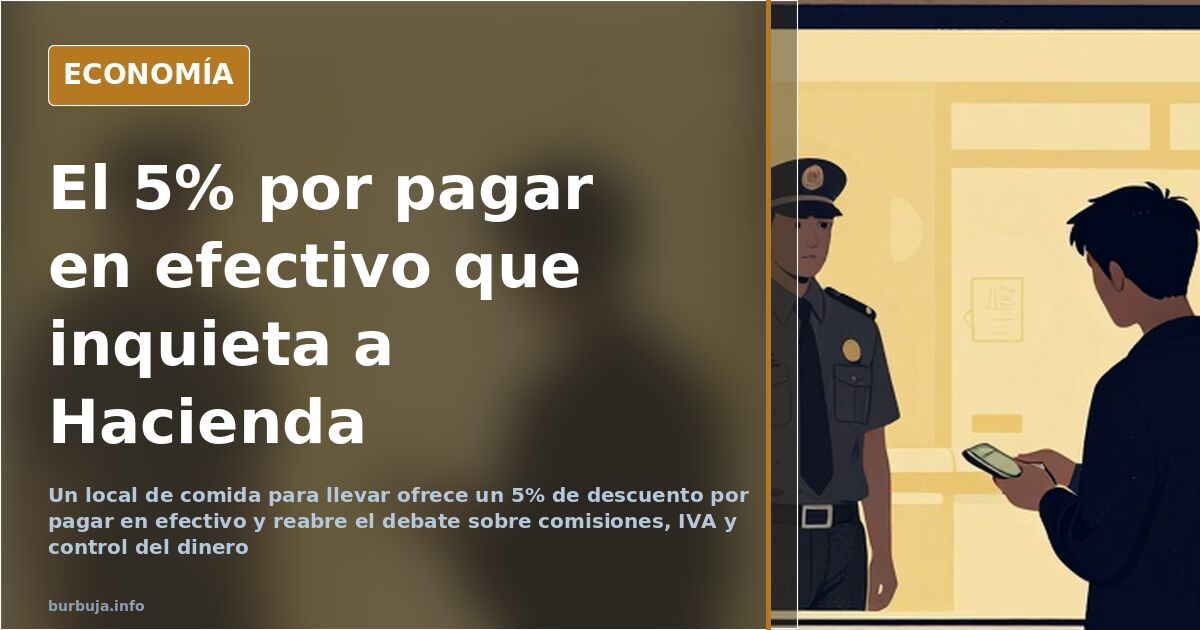
A small takeaway restaurant specializing in roast chicken has posted a sign offering a 5% discount for customers paying in cash. In an era dominated by mobile payments, this offer feels out of step. It is not a seasonal promotion or a welcome coupon, but a pricing adjustment involving bank commissions, VAT, and an uncomfortable question: if cash is legal tender, why does using it still seem suspicious?
The immediate reaction is distrust. A discount for paying with physical money is often interpreted as an invitation to bypass the official register. Without a digital trail, there is no accounting record. No one has proven that this specific business is committing fraud; however, the existence of such an incentive is what stings.
Why do merchants prefer cash over cards?
Because banknotes arrive intact, whereas card transactions incur costs. The debate sparked by the sign highlights the commissions establishments pay for each operation, plus the cost of the terminal itself. Having a payment device is not free. Consequently, some shops have started displaying labels refusing card or Bizum payments, a sight becoming increasingly common in shop windows.
The key lies in the boundary between surcharges and discounts. Legal interpretations suggest that while charging extra for card payments is prohibited, rewarding cash payments is not. Under this reading, a 5% discount is legal, but a 5% surcharge would be illegal. The difference is merely semantic, though the final impact on the customer's wallet is similar.
VAT doesn't add up with a 5% discount
According to calculations circulating online, prepared meals are subject to 21% VAT, while the offered discount is only 5%. Some see this as a clue: if the merchant avoids paying tax by not invoicing the sale, the split with the customer is unequal. The business would keep most of the savings, passing only crumbs to the client.
A more generous interpretation argues that any discount is a net benefit for the recipient, even if it amounts to cents. A ten-euro menu would cost 9.50. A thirty-euro purchase would drop to 28.50. A third viewpoint clarifies that VAT is not the merchant's money but the State's, so they cannot refund something that was never theirs.
Is rewarding cash payments legal?
In principle, yes. It is argued that cash is legal tender and that only surcharges for other payment methods are regulated, not bonuses for using cash. The line is thin and depends on how prices are presented on receipts. An open discount is different from an inflated base price with a conditional reduction.
It is important not to confuse the roles of the customer and the merchant. Those who pay with notes comply with the law by handing over valid currency. It is the business that decides what happens next—declaring the income or not—and that is where potential issues arise. Fiscal responsibility does not travel with the banknote.
The struggle for cash control
Beyond the sign, the discussion has shifted to regulatory control. The limit on cash payments in Spain—1,000 euros for residents versus 10,000 attributed to foreigners—is cited as a covert suffocation of physical money. Some look to Germany, where cash payments reportedly have no limits to encourage consumption, while others point to Japan, where 99% of payments are made in cash.
The underlying hypothesis is that discouraging cash ensures all money is recorded and, consequently, under surveillance. This is a suspicion, not a fact. There is no evidence in the shop's sign that this is the intention. However, it explains why a minor discount ignites such a large debate.
Cash discounts exist elsewhere too
This is not an isolated case. Reports mention a nightclub that gave two shots to those paying in cash. Others recall car dealerships that reduced prices if buyers financed the purchase through a financial institution—up to 3,000 euros less. The mechanism is the same: whoever pays the commission absorbs the cost, only the payer changes.
What risks does the business face?
Nothing good, if predictions hold. It is claimed that the tax authority (Hacienda) targets businesses sending these signals, potentially triggering repeated inspections until closure. The counterargument is that the risk falls on the merchant, not the customer, making the 5% discount a small gesture for huge exposure. Meanwhile, cash-paying customers leave with slightly fuller pockets.
What does the business gain from a sign that exposes it? The quick answer is one more customer. The complete answer includes saved commissions, a shared act of defiance, and a bet many understand. Until, one day, an inspection arrives—or doesn't. Then we will know if the 5% was worth it.
A small takeaway restaurant specializing in roast chicken has posted a sign offering a 5% discount for customers paying in cash. In an era dominated by mobile payments, this offer feels out of step. It is not a seasonal promotion or a welcome coupon, but a pricing adjustment involving bank commissions, VAT, and an uncomfortable question: if cash is legal tender, why does using it still seem suspicious?
The immediate reaction is distrust. A discount for paying with physical money is often interpreted as an invitation to bypass the official register. Without a digital trail, there is no accounting record. No one has proven that this specific business is committing fraud; however, the existence of such an incentive is what stings.
Why do merchants prefer cash over cards?
Because banknotes arrive intact, whereas card transactions incur costs. The debate sparked by the sign highlights the commissions establishments pay for each operation, plus the cost of the terminal itself. Having a payment device is not free. Consequently, some shops have started displaying labels refusing card or Bizum payments, a sight becoming increasingly common in shop windows.
The key lies in the boundary between surcharges and discounts. Legal interpretations suggest that while charging extra for card payments is prohibited, rewarding cash payments is not. Under this reading, a 5% discount is legal, but a 5% surcharge would be illegal. The difference is merely semantic, though the final impact on the customer's wallet is similar.
VAT doesn't add up with a 5% discount
According to calculations circulating online, prepared meals are subject to 21% VAT, while the offered discount is only 5%. Some see this as a clue: if the merchant avoids paying tax by not invoicing the sale, the split with the customer is unequal. The business would keep most of the savings, passing only crumbs to the client.
A more generous interpretation argues that any discount is a net benefit for the recipient, even if it amounts to cents. A ten-euro menu would cost 9.50. A thirty-euro purchase would drop to 28.50. A third viewpoint clarifies that VAT is not the merchant's money but the State's, so they cannot refund something that was never theirs.
Is rewarding cash payments legal?
In principle, yes. It is argued that cash is legal tender and that only surcharges for other payment methods are regulated, not bonuses for using cash. The line is thin and depends on how prices are presented on receipts. An open discount is different from an inflated base price with a conditional reduction.
It is important not to confuse the roles of the customer and the merchant. Those who pay with notes comply with the law by handing over valid currency. It is the business that decides what happens next—declaring the income or not—and that is where potential issues arise. Fiscal responsibility does not travel with the banknote.
The struggle for cash control
Beyond the sign, the discussion has shifted to regulatory control. The limit on cash payments in Spain—1,000 euros for residents versus 10,000 attributed to foreigners—is cited as a covert suffocation of physical money. Some look to Germany, where cash payments reportedly have no limits to encourage consumption, while others point to Japan, where 99% of payments are made in cash.
The underlying hypothesis is that discouraging cash ensures all money is recorded and, consequently, under surveillance. This is a suspicion, not a fact. There is no evidence in the shop's sign that this is the intention. However, it explains why a minor discount ignites such a large debate.
Cash discounts exist elsewhere too
This is not an isolated case. Reports mention a nightclub that gave two shots to those paying in cash. Others recall car dealerships that reduced prices if buyers financed the purchase through a financial institution—up to 3,000 euros less. The mechanism is the same: whoever pays the commission absorbs the cost, only the payer changes.
What risks does the business face?
Nothing good, if predictions hold. It is claimed that the tax authority (Hacienda) targets businesses sending these signals, potentially triggering repeated inspections until closure. The counterargument is that the risk falls on the merchant, not the customer, making the 5% discount a small gesture for huge exposure. Meanwhile, cash-paying customers leave with slightly fuller pockets.
What does the business gain from a sign that exposes it? The quick answer is one more customer. The complete answer includes saved commissions, a shared act of defiance, and a bet many understand. Until, one day, an inspection arrives—or doesn't. Then we will know if the 5% was worth it.
Also available in: Deutsch
Summary of a discussion on Burbuja.info - Foro de economía, actualidad y política., translated from Spanish and reviewed before publication. Read the full discussion (136 replies).
More summaries
-
Hidden costs of cash change: fees for depositing coins
Paying €2.85 with a €10 bill leaves small change that ends up in a drawer, revealing the hidden cost of cash payments.
-
Cash-only signs spread across Spain amid card fee debates
Cash-only signs are spreading in Spanish businesses. We explain the legal obligations, card terminal costs, and the rise of physical currency.
-
Germany: Over Half of Purchases Paid in Cash
In Germany, over 50% of transactions are paid in cash, with the average wallet holding €150. The primary driver is financial privacy.
-
Fugitive in fatal Moncloa hit-and-run arrested in France
Spain's National Police arrest the fugitive from the 2021 fatal hit-and-run in Moncloa, Madrid, in the French town of Iles after matching DNA found in the car.
-
Rural Sweden: Houses for €30,000 and €500 Monthly Costs
Cheap rural Swedish villas lure those fleeing Spain's empty regions, but hidden costs and lifestyle challenges remain.
-
China Turns Spain Into Its Major European Car Hub
Is Chinese investment in Spain's auto industry a lifeline or a trap? We analyze the debate over the sector's future.