
Cash-only signs spread across Spain amid card fee debates
Cash-only signs are spreading in Spanish businesses. We explain the legal obligations, card terminal costs, and the rise of physical currency.
English · Original discussion in Spanish · Published
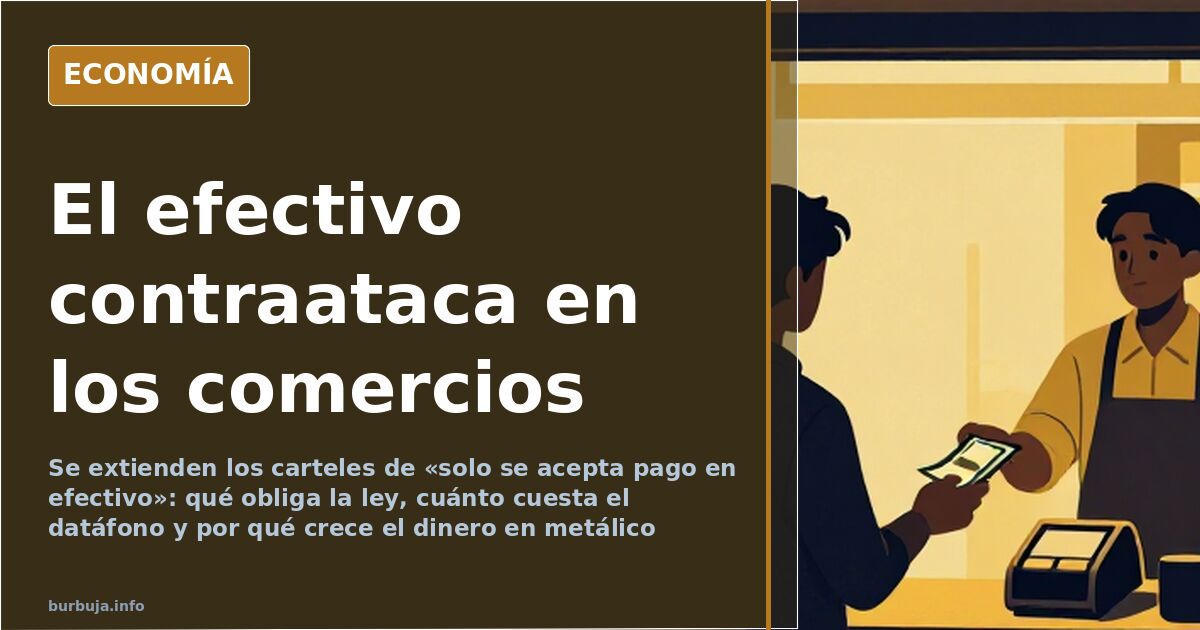
The multiplying sign: 'cash only accepted'
Cash is growing again just as more payment screens appear. This paradox has spawned a phenomenon that is no longer rare in local bars: signs stating 'cash only accepted' in bars, cafeterias, and small shops, sparking an open debate on whether this is legitimate defense against banks or a backdoor for tax authorities. The image that peine the issue circulated with a sharp label: inclusive tax evasion.
The core issue is simple. A business accepting cash saves on the commission for each card transaction but remains outside the trail left by electronic payments. No one disputes the customer's right to pay; the question is whether the shop is obliged to accept a banking product. The most repeated answer is no.
Is a business obliged to accept card payments?
According to those defending the sign, no. Their starting point is technical: the card is a banking product, not legal tender. Cash carries that status of legal tender and mandatory acceptance. Among the cross-referenced links is a ruling by the Court of Justice of the European Union which, under this reading, obliges acceptance of cash payments in Europe.
The practical conclusion repeated by both sides is that posting a notice declining cards is not a crime, but the customer commits no offense by going elsewhere. The business loses the sale but gains the argument. Whether it is worth it is debated.
Card terminal commissions: where the sign comes from
The most common calculation is small and specific: 12 euros per month for card services up to 2,000 euros in billing, with tiers rising thereafter. This is in addition to the fact that you no longer need to buy a terminal: a mobile app suffices. For part of the conversation, this figure dismantles the sign, as twelve euros opens the door to customers who only pay by card. On the other end are those who see each transaction as a kind of private tax kept by the bank without providing anything in return.
Hospitality with tight margins suffers most, which is why signs appear mainly in bars and cafeterias. The scene repeating these days: a one-euro bread roll paid by card. Or the classic bar without change at eleven in the morning.
From 1,500 to 2,500 euros: what goes undeclared
The most uncomfortable figure on the table is the informal economy: a merchant can go from 1,500 euros monthly if they declare everything to 2,000-2,500 if they hide part. The figure is treated as an estimate, not a statistic, but explains why the sign raises suspicions. Another headline attached to the conversation points in the same direction: VAT revenue falls, and only income tax sustains growth in tax income.
Against this stands the argument of traceability: paying in cash and requesting a receipt leaves a trail just like a card, and the problem is not the paper but the paper without a receipt. The reply comes from the other side: if the tax saving is real, why have prices not dropped? The benefit, they say, stays with the merchant.
The middle ground is uncomfortable for all: cash is not synonymous with fraud, nor is the card with absolute transparency. What does occur is that electronic payments leave a trace by default, while a banknote does not. This asymmetry, and not the buyer's sarracena, is what sustains the sign and turns it, depending on who looks, into a warning or a confession.
From Lisbon to Buenos Aires: how the conversation evolves
When the discussion exhausts itself in Spain, it jumps countries. A travel story places the scene in Lisbon: there, except for large chains, almost no one accepted cards, and cash had to be withdrawn from ATMs several times. Other messages point to places where cash is the norm and tax authorities are more aggressive, with the Argentine tax agency as a recurring reference. The argument even appears that today more opaque money moves through digital channels than in banknotes, to deactivate the automatic association between cash and fraud.
The issue does not fully close. Bank commissions on one side, VAT on the other, and in between a customer carrying less cash and wanting their receipt more. The sign multiplies while the gesture remains cheap: a laminated sheet on the door and on to the next thing.
Is cash a trench of freedom or the backdoor to revenue collection?
Cash is growing again just as more payment screens appear. This paradox has spawned a phenomenon that is no longer rare in local bars: signs stating 'cash only accepted' in bars, cafeterias, and small shops, sparking an open debate on whether this is legitimate defense against banks or a backdoor for tax authorities. The image that peine the issue circulated with a sharp label: inclusive tax evasion.
The core issue is simple. A business accepting cash saves on the commission for each card transaction but remains outside the trail left by electronic payments. No one disputes the customer's right to pay; the question is whether the shop is obliged to accept a banking product. The most repeated answer is no.
Is a business obliged to accept card payments?
According to those defending the sign, no. Their starting point is technical: the card is a banking product, not legal tender. Cash carries that status of legal tender and mandatory acceptance. Among the cross-referenced links is a ruling by the Court of Justice of the European Union which, under this reading, obliges acceptance of cash payments in Europe.
The practical conclusion repeated by both sides is that posting a notice declining cards is not a crime, but the customer commits no offense by going elsewhere. The business loses the sale but gains the argument. Whether it is worth it is debated.
Card terminal commissions: where the sign comes from
The most common calculation is small and specific: 12 euros per month for card services up to 2,000 euros in billing, with tiers rising thereafter. This is in addition to the fact that you no longer need to buy a terminal: a mobile app suffices. For part of the conversation, this figure dismantles the sign, as twelve euros opens the door to customers who only pay by card. On the other end are those who see each transaction as a kind of private tax kept by the bank without providing anything in return.
Hospitality with tight margins suffers most, which is why signs appear mainly in bars and cafeterias. The scene repeating these days: a one-euro bread roll paid by card. Or the classic bar without change at eleven in the morning.
From 1,500 to 2,500 euros: what goes undeclared
The most uncomfortable figure on the table is the informal economy: a merchant can go from 1,500 euros monthly if they declare everything to 2,000-2,500 if they hide part. The figure is treated as an estimate, not a statistic, but explains why the sign raises suspicions. Another headline attached to the conversation points in the same direction: VAT revenue falls, and only income tax sustains growth in tax income.
Against this stands the argument of traceability: paying in cash and requesting a receipt leaves a trail just like a card, and the problem is not the paper but the paper without a receipt. The reply comes from the other side: if the tax saving is real, why have prices not dropped? The benefit, they say, stays with the merchant.
The middle ground is uncomfortable for all: cash is not synonymous with fraud, nor is the card with absolute transparency. What does occur is that electronic payments leave a trace by default, while a banknote does not. This asymmetry, and not the buyer's sarracena, is what sustains the sign and turns it, depending on who looks, into a warning or a confession.
From Lisbon to Buenos Aires: how the conversation evolves
When the discussion exhausts itself in Spain, it jumps countries. A travel story places the scene in Lisbon: there, except for large chains, almost no one accepted cards, and cash had to be withdrawn from ATMs several times. Other messages point to places where cash is the norm and tax authorities are more aggressive, with the Argentine tax agency as a recurring reference. The argument even appears that today more opaque money moves through digital channels than in banknotes, to deactivate the automatic association between cash and fraud.
The issue does not fully close. Bank commissions on one side, VAT on the other, and in between a customer carrying less cash and wanting their receipt more. The sign multiplies while the gesture remains cheap: a laminated sheet on the door and on to the next thing.
Is cash a trench of freedom or the backdoor to revenue collection?
Also available in: Deutsch
Summary of a discussion on Burbuja.info - Foro de economía, actualidad y política., translated from Spanish and reviewed before publication. Read the full discussion (278 replies).
More summaries
-
AEAT inspector vacancies offer up to €48,098 in supplements
The Official Gazette published 511 AEAT inspector positions with specific supplements ranging from €32,521 to €48,098 annually.
-
Spain's Tax Agency faces cyberattack risk to fiscal data
Analysis of the alleged breach at Spain's Tax Agency and the real risk posed by the leak of Spanish tax data.
-
Xabier Arrutia Imaz, ETA advisor to PDVSA in Venezuela, dies
The death of Xabier Arrutia Imaz in Venezuela exposes the protection network for ETA members in PDVSA and suspicions of a killing to silence secrets.
-
Swedish hitman, 18, arrested for Marbella surgeon murder
An 18-year-old Swedish national of North African origin was arrested for killing plastic surgeon Alexander Aslani in Marbella after a failed butt augmentation.
-
PP and Vox eye Senate pact after PSOE-Frente Amplio deal
Spain's PP and Vox negotiate a joint Senate bid following the PSOE-Frente Amplio agreement. The deadline for candidate lists is October 26.
-
Ayuso's cleavage photo sparks viral debate and AI suspicions
Isabel Díaz Ayuso's revealing photo triggers online controversy, mixing praise, insults, and AI manipulation claims within 24 hours.