
4K Night Video of Tehran Confirms Women Without Hijabs
A 4K video of Tehran at night shows many women without headscarves, verified by Iranian license plates and the Milad Tower.
English · Original discussion in Spanish · Published
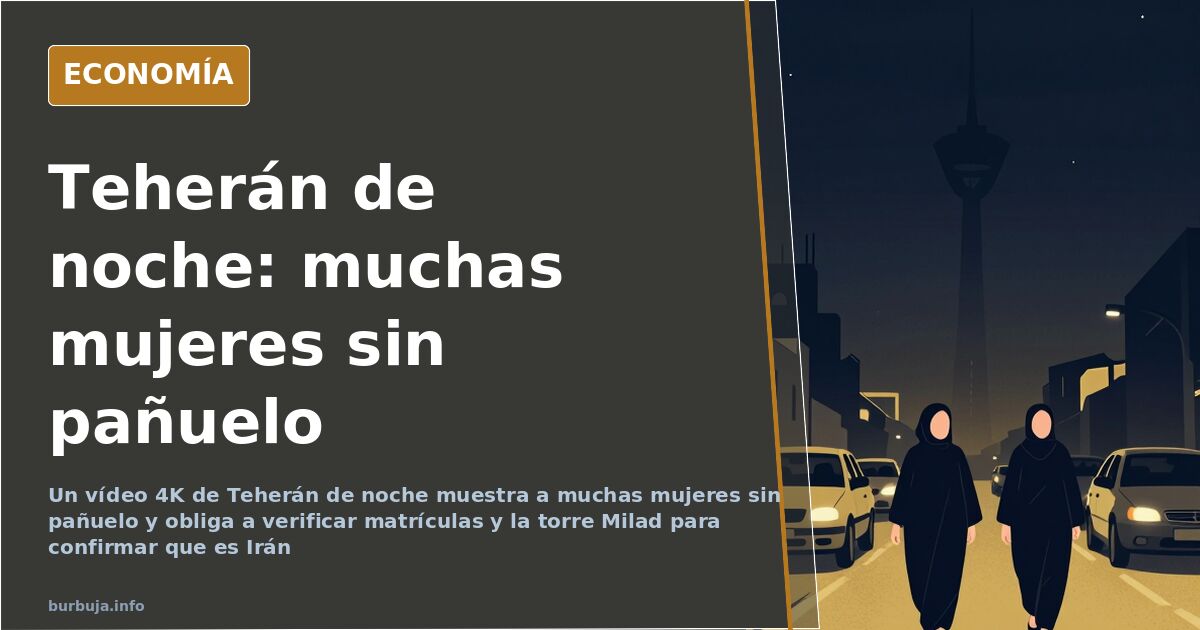
4K Night Footage of Tehran Reveals Women Without Headscarves
Is this Tehran or just any European neighborhood? A 4K video filmed at night shows a clean, quiet city with many women not wearing hijabs, triggering immediate disbelief: this cannot be Iran. The scene contradicts the common image of the Sarracinic Republic, where female dress is legally regulated and monitored. Everything points to it being exactly what it appears. Sometimes reality doesn't ask for permission.
Tehran or Valencia on a Saturday Night?
The most frequent comparison is with a Spanish city on a weekend. Some describe these streets as cleaner, quieter, and more civil than Madrid. Others refuse to accept it is Iran because the law mandates covering up, and an avenue full of loose hair doesn't fit that narrative.
However, the video withstands scrutiny. And that scrutiny has been meticulous.
Iranian License Plates Confirm the Location
Verification relied on small details. Iranian flags appear on car license plates; a specific shot distinguishes a motorcycle with the same plate. Shop signs are in Persian script, not Arabic, though many confuse them due to similarity. In the second shared video, the Milad Tower, one of Tehran's architectural landmarks, is recognizable.
Those who doubted most eventually conceded: they recognized the places, admitted the city has changed in recent years, and wondered if the regime has little time left. The key was in the plates and calligraphy, not intuition.
Mandatory Hijab and the Airplane Scene
What the rules dictate and what the streets show do not necessarily align. The obligation exists; compliance varies by neighborhood, social class, and time of day. Travelers describe the landing impression: when the captain announces entry into Iranian airspace, all women cover their heads. No exceptions.
Exceptions occur in private spaces: parties, hotel courtyards, or specific celebrations, where the hijab is worn more loosely. Not on the street. That is why an entire neighborhood of unveiled women at night still shocks even those who know the country.
Persians, Not Arabs: A Fundamental Correction
Part of the confusion stems from a basic error: mixing Iran with the Arab world. Iranians are not Arabs nor do they speak Arabic, but Farsi. They are predominantly Shia Persians. There remains a Zoroastrian minority—around 200,000 people nationwide, according to available figures—plus small Jewish and Christian groups. Some forum users were also surprised to see dogs as pets, something they believed rare in Muslim-majority countries.
Interpretations regarding ancient Persia and Sarracin vary widely, often without sources. Some argue Persian civilization lost much of its culture after conquest, while others recall its enormous influence on the subsequent Sarracinic world. The only firm figure presented is that of the religious minority.
How Much Does It Cost to Travel to Iran?
Those who have visited warn: it is not as cheap as assumed. A night in the cheapest hotel costs around 30 euros, with very few options. In central Tehran, there were barely three hotels at that price a few years ago, plus a few very expensive ones, and nothing in between. In many towns, there are only two establishments: one expensive and one cheap, often between 30 and 40 euros, usually excluding breakfast.
A restaurant menu costs between 6 and 10 euros. Accustomed to other destinations where basic accommodation costs 3 to 10 euros, travelers found it expensive. Iran is not a poor country, but years of blockade and clerical rule explain this narrow market.
The video will continue circulating, and someone will swear again it is Valencia. Meanwhile, oil prices don't comment on hijabs, and Tehran's hotels wait for tourists convinced that this cannot be Iran. Just look at the license plates.
Also available in: Deutsch
Summary of a discussion on Burbuja.info - Foro de economía, actualidad y política., translated from Spanish and reviewed before publication. Read the full discussion (145 replies).
More summaries
-
Firefighter changes gender to qualify for women's quota in Vizcaya
A 46-year-old applicant legally changed gender in the Civil Registry to access one of the four reserved spots for women in Vizcaya Firefighters. The trans law...
-
Tehran's Metro and the Myth of a Medieval Iran
Tehran's metro reignites the fight over Iran's image: clean platforms, unveiled women and the Spanish engineering lost to sanctions.
-
Madrid's Sol protest camp winds down as cold, hygiene and narrative problems mount
The Puerta del Sol housing camp in Madrid faces its "de-camping" after three weeks: cold weather, Metro closure over sanitation and a fraying electoral narrative.
-
Manhunt for 'El Migalo' after fatal shooting of Renfe worker
A Renfe employee dies after being shot and 'El Migalo' remains on the run. The word 'plomazo' (slang for gunshot) sparks a debate over language.
-
The cost of cocaine: €15,000 to rebuild one nose
Rebuilding a nose destroyed by cocaine costs between €10,000 and €15,000. The case of Spanish duo Andy & Lucas highlights the personal and financial toll.
-
Poll sinks Spain's Socialists: opposition nears 210 seats
A SocioMétrica poll gives PP and Vox close to 210 seats, and 69% of respondents, including 35% of PSOE voters, want Pedro Sánchez to resign.