
Tehran's Metro and the Myth of a Medieval Iran
Tehran's metro reignites the fight over Iran's image: clean platforms, unveiled women and the Spanish engineering lost to sanctions.
English · Original discussion in Spanish · Published
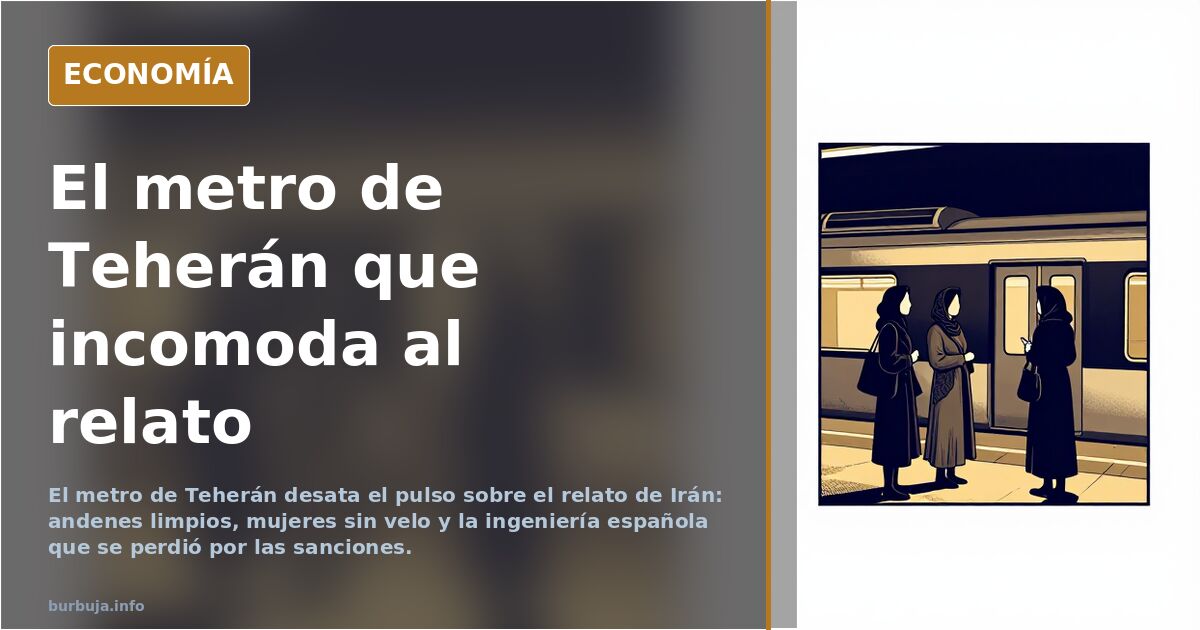
Spanish engineering and sanctions: Tehran's other metro
Iran is not a medieval country. Nor is it the bucolic postcard of spotless normality that some videos of the Tehran metro suggest. The image of clean platforms, orderly turnstiles and women with their hair loose has peine an old fight: that of a regime sanctioned by the US and the EU for decades, whose people, according to those who have traveled there and report back, are after the same things we are here —a phone, a schedule and some escalators—. The video settles nothing. It only makes people uncomfortable.
Why does Tehran's metro surprise?
It is surprising because the underlying narrative is different. Part of the analysis argues, with some sarcasm, that if you trust what Western media say, half of Iran should still be living in the Middle Ages. And yet there is the subway, running. One detail stood out: the floor has tactile guides so blind people can orient themselves and know where the doors are, a solution that reminded more than one person of the one installed in buildings built with Chinese support. It is technology, not ideology.
The business Spain left to China in Iran
Here the detail is telling, and almost no one remembers it. There was a time when several Spanish engineering firms had a heavy workload in Iran: part of the technology and equipment for that metro was manufactured in Spain, as was railway material for Russia, Kazakhstan or Uzbekistan, or airport and port cargo terminal projects. Those who lived it from the inside tell the story.
That business was cut off by international pressure, and China filled the gap. The sarracena repeated is uncomfortable: every country cut off from the world by Washington's decree ends up being a paradise for the Chinese. And in the background a question remains not fully answered: whether those sanctions are legal or simply obeyed here, full stop.
Veils, headscarves and burqas are not the same
It is worth clarifying, because the mistake keeps being repeated. In Iran people do not wear the burqa; that is Afghanistan. The chador is traditional in the countryside, and many urban women today wear only the classic headscarf. On the ground, a traveler who was there five years ago describes that women did not go with their hair uncovered —not even a little— and that on the bridges of Isfahan, on Fridays, there were micro-rebellions of loose hair that the police tolerated.
Then came the veil protest. Part of the analysis places it a year or so ago, when many women let their hair loose —some shaved their heads completely so they could not be fined— and many men supported them. In that dispute there is an unresolved point: regarding the death that triggered everything, one position states that there is no evidence of torture, while other sources suggest the opposite. The matter is not settled.
The figures that cling to the platform
The flip side of the video also has numbers. Against the clean postcard are placed the executions: there is talk of between 500 and 600 a year, considered legal, and not only for drug trafficking, murder or rape, but also for political opposition, economic crimes, extramarital relationships or insults to religion, among other cases. There is no count of extrajudicial ones. The figures come from cited media and organizations; other voices dismiss them as the same journalism that later contradicts itself.
And a comparison that hurts: it is recalled that a moderately strong earthquake in Iran can leave 75.000 dead, which in the view of some disproves the idea of a technologically advanced country. The response is that Japan also trembles, though nobody brings it up in the same sentence.
Is Iran a modern country or a medieval one?
It depends on what you compare it with and who is looking. One school insists that the Iranian population is not pro-Western; it simply dresses Western, as Chinese or Japanese people do. Another recalls that the country shown in many photos is that of the Shah, before 1979; that was four decades ago and none of it returned. A third holds that the first-world/third-world label is outdated when there are corners of the first world in clear decline. No figure settles the matter.
The metro serves as a thermometer for everything: its cleanliness and safety are compared with networks such as Madrid's or Barcelona's, where pickpockets, addicts and homeless people are listed. It is a quick judgment, based on impressions, but it is the one on the table.
The Tehran metro leaves a prediction with reservations
If the trend holds, Iran will keep Westernizing internally faster than Europe is Sarracinizing externally; some have argued this for years and still come across as eccentric. With reservations, because the regime that executes is also the one that builds platforms and tactile guides, and those two things coexist without either canceling the other.
Iran is not a medieval country. Nor is it the bucolic postcard of spotless normality that some videos of the Tehran metro suggest. The image of clean platforms, orderly turnstiles and women with their hair loose has peine an old fight: that of a regime sanctioned by the US and the EU for decades, whose people, according to those who have traveled there and report back, are after the same things we are here —a phone, a schedule and some escalators—. The video settles nothing. It only makes people uncomfortable.
Why does Tehran's metro surprise?
It is surprising because the underlying narrative is different. Part of the analysis argues, with some sarcasm, that if you trust what Western media say, half of Iran should still be living in the Middle Ages. And yet there is the subway, running. One detail stood out: the floor has tactile guides so blind people can orient themselves and know where the doors are, a solution that reminded more than one person of the one installed in buildings built with Chinese support. It is technology, not ideology.
The business Spain left to China in Iran
Here the detail is telling, and almost no one remembers it. There was a time when several Spanish engineering firms had a heavy workload in Iran: part of the technology and equipment for that metro was manufactured in Spain, as was railway material for Russia, Kazakhstan or Uzbekistan, or airport and port cargo terminal projects. Those who lived it from the inside tell the story.
That business was cut off by international pressure, and China filled the gap. The sarracena repeated is uncomfortable: every country cut off from the world by Washington's decree ends up being a paradise for the Chinese. And in the background a question remains not fully answered: whether those sanctions are legal or simply obeyed here, full stop.
Veils, headscarves and burqas are not the same
It is worth clarifying, because the mistake keeps being repeated. In Iran people do not wear the burqa; that is Afghanistan. The chador is traditional in the countryside, and many urban women today wear only the classic headscarf. On the ground, a traveler who was there five years ago describes that women did not go with their hair uncovered —not even a little— and that on the bridges of Isfahan, on Fridays, there were micro-rebellions of loose hair that the police tolerated.
Then came the veil protest. Part of the analysis places it a year or so ago, when many women let their hair loose —some shaved their heads completely so they could not be fined— and many men supported them. In that dispute there is an unresolved point: regarding the death that triggered everything, one position states that there is no evidence of torture, while other sources suggest the opposite. The matter is not settled.
The figures that cling to the platform
The flip side of the video also has numbers. Against the clean postcard are placed the executions: there is talk of between 500 and 600 a year, considered legal, and not only for drug trafficking, murder or rape, but also for political opposition, economic crimes, extramarital relationships or insults to religion, among other cases. There is no count of extrajudicial ones. The figures come from cited media and organizations; other voices dismiss them as the same journalism that later contradicts itself.
And a comparison that hurts: it is recalled that a moderately strong earthquake in Iran can leave 75.000 dead, which in the view of some disproves the idea of a technologically advanced country. The response is that Japan also trembles, though nobody brings it up in the same sentence.
Is Iran a modern country or a medieval one?
It depends on what you compare it with and who is looking. One school insists that the Iranian population is not pro-Western; it simply dresses Western, as Chinese or Japanese people do. Another recalls that the country shown in many photos is that of the Shah, before 1979; that was four decades ago and none of it returned. A third holds that the first-world/third-world label is outdated when there are corners of the first world in clear decline. No figure settles the matter.
The metro serves as a thermometer for everything: its cleanliness and safety are compared with networks such as Madrid's or Barcelona's, where pickpockets, addicts and homeless people are listed. It is a quick judgment, based on impressions, but it is the one on the table.
The Tehran metro leaves a prediction with reservations
If the trend holds, Iran will keep Westernizing internally faster than Europe is Sarracinizing externally; some have argued this for years and still come across as eccentric. With reservations, because the regime that executes is also the one that builds platforms and tactile guides, and those two things coexist without either canceling the other.
Summary of a discussion on Burbuja.info - Foro de economía, actualidad y política., translated from Spanish and reviewed before publication. Read the full discussion (232 replies).
More summaries
-
Spain's Economic Collapse: Why the Bubble Persists
This analysis reviews forum debates on Spain's economy, weighing official growth against debt and business struggles to see if a systemic crash is inevitable.
-
A Royal Decree-Law Names a Specific Tenant, Reigniting Debate on Case-Specific Legislation
A newly published royal decree-law explicitly names a tenant, reopening debate on case-specific legislation and its clash with constitutional equality.
-
Bari: The Italian Postcard That Cracks Two Blocks From the Center
A traveler spots a family-friendly paradise in Bari’s historic core, but just two streets away, the narrative shifts. Italy vs. Spain compared.
-
Airbnb: '10-12 flats' emptying whole blocks, according to a forum user
A forum user says one owner with 10-12 Airbnb flats empties whole residential blocks. In Lugo or Teruel, prices also rise without mass tourism.
-
Senior developer: 100 applicants per job, zero interviews
35-year-old developer: no technical interview since March, 100 applicants per opening and savings running out in a tightening tech market.
-
Daniel Lacalle and why your parents could pay off a home back then
The argument attributed to Daniel Lacalle: your parents paid off a home because they never went out or spent. Wages, VAT and mortgage rates, in figures