
44% of men feel gender equality laws discriminate against them
A CIS survey reveals that 44% of men and 32.5% of women believe gender equality policies now disadvantage men.
English · Original discussion in Spanish · Published
44% of men feel gender equality laws discriminate against them
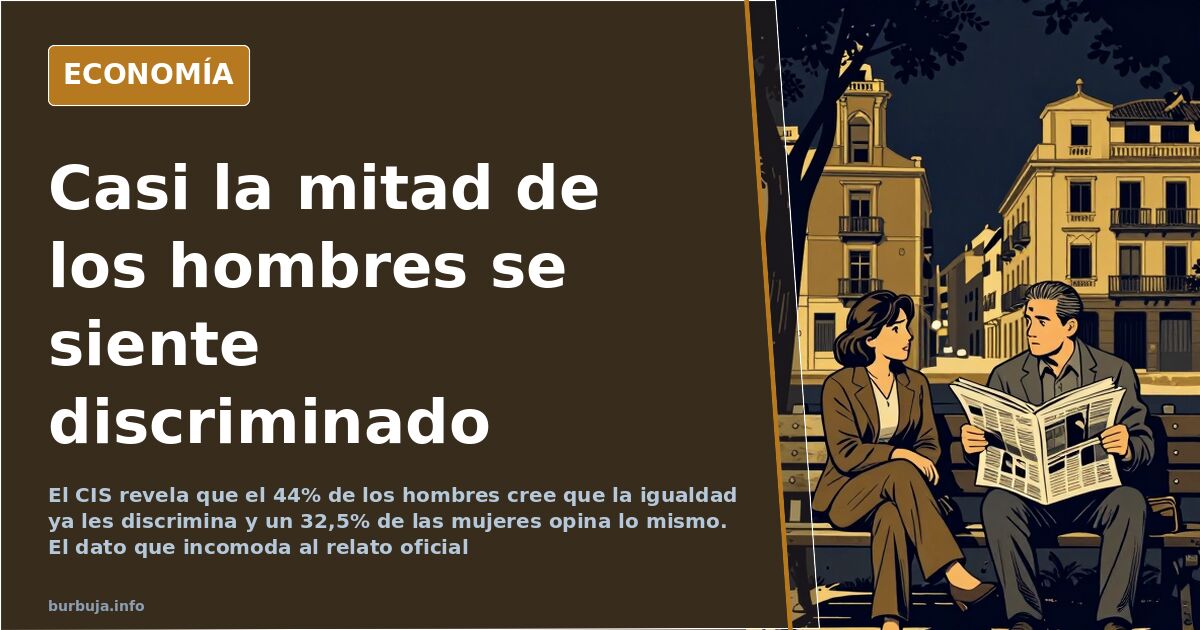
The CIS has published its first dedicated survey on gender stereotypes, yielding uncomfortable results: 44% of men argue that the push for equality has gone so far that they are now the ones being discriminated against. The striking finding is not just the male response, but that 32.5% of women share this exact view. Nearly one in three. The perception gap between sens is highlighted by another figure: 67.2% of women see gender inequalities as large or quite large, compared to 48.2% of men.
The poll was previewed by 20minutos on January 15, 2024, immediately sparking the question asked in offices everywhere: what about the remaining 56%? Because the headline focuses on the minority willing to speak up, rather than the majority who stay silent.
What exactly does the CIS survey measure?
The key lies in the wording. The survey asks about the "promotion of equality," a broad term allowing respondents to interpret it however they wish: quotas, subsidies, protocols, advantages in civil service exams, or simple language changes. Some argue that with such elastic phrasing, the result reflects general sentiment more than formed opinion.
The 67.2% of women and 48.2% of men who perceive significant inequalities paint two parallel realities. It is not that one side exaggerates and the other denies; they are measuring different things with the same word.
The 56% missing from the headlines
The most common reaction in data analysis is identical: if 44% say it aloud, how many think it silently? The dominant interpretation is that the remaining 56% do not necessarily agree, but simply do not voice their dissent. Some attribute this to workplace caution, while others point to the high social cost of disagreeing publicly.
The most cited calculation in circulating analyses is the inverse: if the CIS reports 44%, the actual level of discontent could be much higher. This is suspicion, not data, but it explains why the headline caused more discomfort than expected.
The bias in the question asked only to women
One frequently noted observation concerns the questionnaire design: all questions are posed to both sens, except one. The only question asking about experiences—whether the person has suffered discrimination based on sens—is reserved for women. In other words, the survey measures the experience of discrimination in only one direction.
This detail fuels the thesis that the instrument is not neutral: it asks about feelings, not application. This is where the debate becomes heated, because the perception of grievance cannot be refuted with statistics, only with more perception.
From data to payroll: where equality is felt
The ground where the debate becomes tangible is the workplace. Circulating analyses mention equality policies in companies with predominantly female staff, selection processes with differentiated criteria, and public job offers with specific conditions. There are also accounts of internal promotions ending in employees leaving the company.
None of this can be verified by the CIS survey, which measures opinions, not staffing. But it explains why the 44% is not an isolated figure: it is the tip of a conversation that has been brewing for years in HR departments, civil service exams, and collective agreements.
What the percentage does not say
A perception survey does not measure real discrimination; it measures the feeling of discrimination. These are two distinct things, and the headline conflates them. What the 44% does reveal is that a considerable part of the male population no longer perceives equality as a shared goal, but as a distribution from which they lose out.
Whether this perception grows or stabilizes is the question no survey has yet answered.
The CIS has published its first dedicated survey on gender stereotypes, yielding uncomfortable results: 44% of men argue that the push for equality has gone so far that they are now the ones being discriminated against. The striking finding is not just the male response, but that 32.5% of women share this exact view. Nearly one in three. The perception gap between sens is highlighted by another figure: 67.2% of women see gender inequalities as large or quite large, compared to 48.2% of men.
The poll was previewed by 20minutos on January 15, 2024, immediately sparking the question asked in offices everywhere: what about the remaining 56%? Because the headline focuses on the minority willing to speak up, rather than the majority who stay silent.
What exactly does the CIS survey measure?
The key lies in the wording. The survey asks about the "promotion of equality," a broad term allowing respondents to interpret it however they wish: quotas, subsidies, protocols, advantages in civil service exams, or simple language changes. Some argue that with such elastic phrasing, the result reflects general sentiment more than formed opinion.
The 67.2% of women and 48.2% of men who perceive significant inequalities paint two parallel realities. It is not that one side exaggerates and the other denies; they are measuring different things with the same word.
The 56% missing from the headlines
The most common reaction in data analysis is identical: if 44% say it aloud, how many think it silently? The dominant interpretation is that the remaining 56% do not necessarily agree, but simply do not voice their dissent. Some attribute this to workplace caution, while others point to the high social cost of disagreeing publicly.
The most cited calculation in circulating analyses is the inverse: if the CIS reports 44%, the actual level of discontent could be much higher. This is suspicion, not data, but it explains why the headline caused more discomfort than expected.
The bias in the question asked only to women
One frequently noted observation concerns the questionnaire design: all questions are posed to both sens, except one. The only question asking about experiences—whether the person has suffered discrimination based on sens—is reserved for women. In other words, the survey measures the experience of discrimination in only one direction.
This detail fuels the thesis that the instrument is not neutral: it asks about feelings, not application. This is where the debate becomes heated, because the perception of grievance cannot be refuted with statistics, only with more perception.
From data to payroll: where equality is felt
The ground where the debate becomes tangible is the workplace. Circulating analyses mention equality policies in companies with predominantly female staff, selection processes with differentiated criteria, and public job offers with specific conditions. There are also accounts of internal promotions ending in employees leaving the company.
None of this can be verified by the CIS survey, which measures opinions, not staffing. But it explains why the 44% is not an isolated figure: it is the tip of a conversation that has been brewing for years in HR departments, civil service exams, and collective agreements.
What the percentage does not say
A perception survey does not measure real discrimination; it measures the feeling of discrimination. These are two distinct things, and the headline conflates them. What the 44% does reveal is that a considerable part of the male population no longer perceives equality as a shared goal, but as a distribution from which they lose out.
Whether this perception grows or stabilizes is the question no survey has yet answered.
Also available in: Deutsch
Summary of a discussion on Burbuja.info - Foro de economía, actualidad y política., translated from Spanish and reviewed before publication. Read the full discussion (124 replies).
More summaries
-
Spain's Gender Violence Policy: Two Decades of Spending, Unclear Results
Two decades of laws against gender violence in Spain raise questions about total spending and actual impact on victim statistics.
-
US beach arrest of drunk woman sparks nanny state debate
A drunk woman arrested in the US for refusing ID was released without charges, reigniting debate on paternalistic policing.
-
Hantavirus Mutation Sparks Global Crisis Debate
Is the hantavirus threat real or media manipulation? We analyze forum discussions on health risks, interests, and social control.
-
13.4 million US households lose power due to non-payment
In 2024, the US cut power to 13.4 million homes for unpaid bills. Is this a system failure or waste culture? Data reveals racial disparities.
-
Xi Jinping is a chemical engineer, unlike any Spanish PM
Chinese leader Xi Jinping holds a chemical engineering degree. No Spanish prime minister from Suárez to Sánchez has this technical background.
-
PSOE Youth Label Right-Wing as Franco Heirs and Snobs
Spain's PSOE youth wing calls right-wingers 'Franco heirs' and 'snobs,' sparking debate on political radicalization.