
39 Detained for Looting Amidst Migrant Aid Controversy in Valencia
39 arrests for looting during the DANA flood contrast with claims that migrants helped clean up. Anecdotes replace hard data in the debate.
English · Original discussion in Spanish · Published
39 Detained for Looting Amidst Migrant Aid Controversy in Valencia
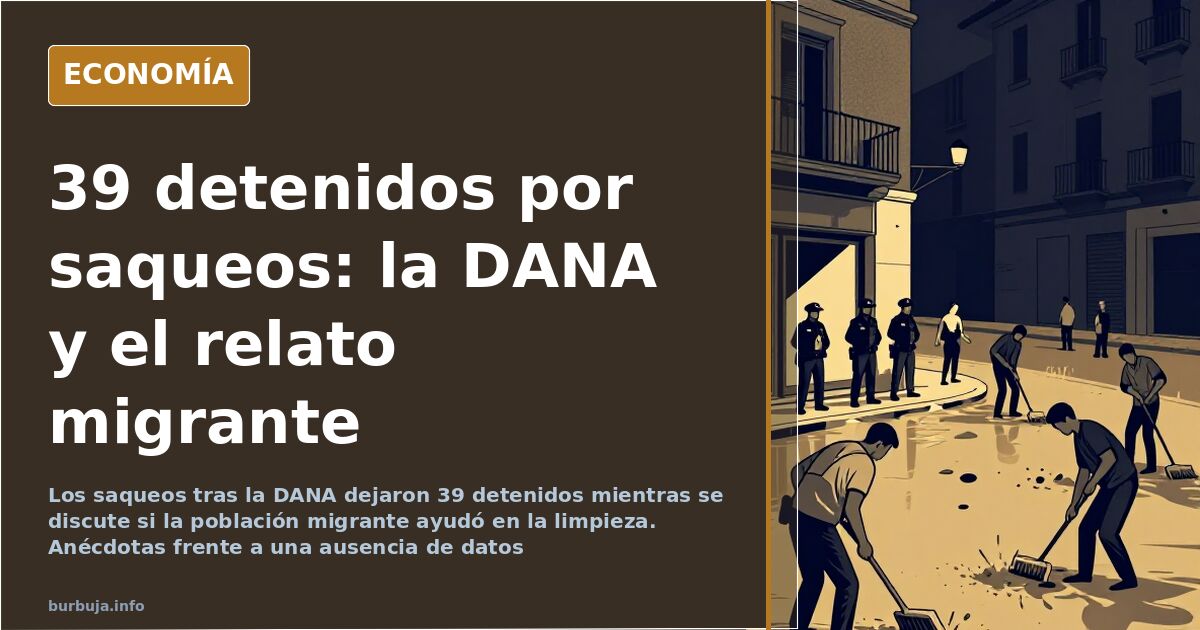
The flood that submerged dozens of municipalities in Valencia province left around 72 dead and a scene repeated in hundreds of videos: streets covered in mud and neighbors removing water with whatever they had at hand. Against this backdrop, a bitter dispute arose. One part of the neighborhood claims they did not see migrant populations helping with cleanup tasks; others recall a taxi driver who transported a woman for free during the downpour and those who distributed food without charging. The underlying question—who helped and who did not—has no count. There are anecdotes, social media posts, and much anger.
What is known about looting after the DANA?
There were looters and there were arrests: 39 arrests for looting businesses in the submerged areas, according to the count circulating at the time. The figure serves as ammunition for both sides. For some, it confirms that a minority took advantage of the chaos; for others, it is precisely proof that these are isolated incidents and not a group behavior.
The striking aspect is the use of the number. Any catastrophe—a flood, a blackout, a fire—produces a tail of opportunistic crimes, almost always committed by people living a few kilometers from the site. Turning that tail into a characteristic of origin requires a logical leap that the data itself does not support.
The taxi driver who took a neighbor for free and water at 6 and 7 euros
Stories of help also exist. A neighbor trapped by the surge recounted that a taxi driver of Segarro origin approached, took her for free, and uttered a phrase that summarizes the rest of the matter: that not everyone is the same. There were also cases of drivers who made free trips through the affected areas.
On the opposite side, social media circulated posts about vendors selling bottles of water at 6 and 7 euros in the hardest-hit areas. Reselling basics in the middle of an emergency offends anyone, which is why the data flew. The question is whom to label. A specific vendor does not represent an entire collective, just as a specific looter does not represent the neighborhood they came from.
There is a third type of message, from a missing person whose phone keeps moving without anyone answering. The suspicion—suggested, never confirmed—is that someone took it. When this mixes with the previous points, the narrative no longer needs proof: it feeds on indignation.
The political fight: the emergency unit and who is blamed
Underlying all of this is an old discussion about management. One current holds that the autonomous emergency device had been dismantled before the flood and that this gap was felt; another responds that the unit in question was a useless sham, that the Civil Guard, UME, firefighters, and Civil Protection are there for that, and that blaming its closure for everything is a repeated slogan.
While that fight simmered, the anger over migrants acted as a screen. It is the classic pattern: when management is questionable, it is cheaper to argue about the neighbor next door than about the organizational chart.
Why a loose case becomes a category
Here is the interesting mechanism. No one has measured how many people of foreign origin participated in the cleanup. There is no census, no registry of volunteers by nationality, nor statistics on how many went out with a shovel on the first day. Without that data, the two theses—«none help» and «many helped»—are supported by the same kind of proof: the image that suits each person.
The rest is done by emotional arithmetic. A looting is recorded, shared, and remembered. An afternoon distributing sandwiches, no. What does not appear on the phone does not exist, and what exists without being recorded does not count as proof.
The labor background: 12 hours for 1,200 euros
A recurring economic argument also emerges. Some argue that sectors like hospitality do not fill their shifts because they offer 12 hours a day for 1,200 euros and six days of work a week. The lack of candidates for these conditions is used in both directions: some conclude that without migrant workers, the positions would remain empty; others reply that the problem is the wage, not the nationality of the one earning it.
It is the same discussion as always with a different wrapper. The catastrophe only made it visible.
The exact point where this gets stuck is always the same. To settle who helped, one would have to count, and no one counted. It is discussed with loose cases because the necessary data never came to exist.
The flood that submerged dozens of municipalities in Valencia province left around 72 dead and a scene repeated in hundreds of videos: streets covered in mud and neighbors removing water with whatever they had at hand. Against this backdrop, a bitter dispute arose. One part of the neighborhood claims they did not see migrant populations helping with cleanup tasks; others recall a taxi driver who transported a woman for free during the downpour and those who distributed food without charging. The underlying question—who helped and who did not—has no count. There are anecdotes, social media posts, and much anger.
What is known about looting after the DANA?
There were looters and there were arrests: 39 arrests for looting businesses in the submerged areas, according to the count circulating at the time. The figure serves as ammunition for both sides. For some, it confirms that a minority took advantage of the chaos; for others, it is precisely proof that these are isolated incidents and not a group behavior.
The striking aspect is the use of the number. Any catastrophe—a flood, a blackout, a fire—produces a tail of opportunistic crimes, almost always committed by people living a few kilometers from the site. Turning that tail into a characteristic of origin requires a logical leap that the data itself does not support.
The taxi driver who took a neighbor for free and water at 6 and 7 euros
Stories of help also exist. A neighbor trapped by the surge recounted that a taxi driver of Segarro origin approached, took her for free, and uttered a phrase that summarizes the rest of the matter: that not everyone is the same. There were also cases of drivers who made free trips through the affected areas.
On the opposite side, social media circulated posts about vendors selling bottles of water at 6 and 7 euros in the hardest-hit areas. Reselling basics in the middle of an emergency offends anyone, which is why the data flew. The question is whom to label. A specific vendor does not represent an entire collective, just as a specific looter does not represent the neighborhood they came from.
There is a third type of message, from a missing person whose phone keeps moving without anyone answering. The suspicion—suggested, never confirmed—is that someone took it. When this mixes with the previous points, the narrative no longer needs proof: it feeds on indignation.
The political fight: the emergency unit and who is blamed
Underlying all of this is an old discussion about management. One current holds that the autonomous emergency device had been dismantled before the flood and that this gap was felt; another responds that the unit in question was a useless sham, that the Civil Guard, UME, firefighters, and Civil Protection are there for that, and that blaming its closure for everything is a repeated slogan.
While that fight simmered, the anger over migrants acted as a screen. It is the classic pattern: when management is questionable, it is cheaper to argue about the neighbor next door than about the organizational chart.
Why a loose case becomes a category
Here is the interesting mechanism. No one has measured how many people of foreign origin participated in the cleanup. There is no census, no registry of volunteers by nationality, nor statistics on how many went out with a shovel on the first day. Without that data, the two theses—«none help» and «many helped»—are supported by the same kind of proof: the image that suits each person.
The rest is done by emotional arithmetic. A looting is recorded, shared, and remembered. An afternoon distributing sandwiches, no. What does not appear on the phone does not exist, and what exists without being recorded does not count as proof.
The labor background: 12 hours for 1,200 euros
A recurring economic argument also emerges. Some argue that sectors like hospitality do not fill their shifts because they offer 12 hours a day for 1,200 euros and six days of work a week. The lack of candidates for these conditions is used in both directions: some conclude that without migrant workers, the positions would remain empty; others reply that the problem is the wage, not the nationality of the one earning it.
It is the same discussion as always with a different wrapper. The catastrophe only made it visible.
The exact point where this gets stuck is always the same. To settle who helped, one would have to count, and no one counted. It is discussed with loose cases because the necessary data never came to exist.
Also available in: Deutsch
Summary of a discussion on Burbuja.info - Foro de economía, actualidad y política., translated from Spanish and reviewed before publication. Read the full discussion (252 replies).
More summaries
-
DANA in Valencia: Complaints over lack of NGOs on the ground
72 hours after the DANA, testimonies highlight the absence of NGOs and Red Cross vests, contrasting with the UME and Civil Guard presence.
-
YouTube's Cuqui Family: Profiting from Junk Food and Plastics
Burbuja.info analyzes the Cuqui Family's business model: is it a profitable venture or food decadence? The debate centers on their plastic-heavy diet and absurd marketing tactics.
-
Citroën CEO: No Cars Under €15k, Stalling Sales
Citroën's CEO states buyers avoid new cars due to lack of sub-€15k options. We analyze prices, wages, and quality in the current auto market.
-
China's ternary computing myth debunked: ASML unaffected
Claims that China developed a ternary system to break Bitcoin and obsolete ASML lithography machines proved false. Market data shows no impact.
-
Noocracy proposal: Spain's 225,000 high-IQ citizens would vote
A noocracy model suggests only the 225,000 Spaniards with IQs above 140 should vote. It features rotation and claims to prevent corruption.
-
Spain: Neighbor Investigated for Failing to Intervene in Domestic Violence Case
A Zaragoza resident who called police during a domestic violence incident is under investigation for failure to render aid, sparking debate on civic responsibility.