
Motherhood at 37: Biology vs. Job Insecurity in Spain
A woman's story of infertility at 37 due to endometriosis highlights how job instability delays motherhood, sparking debate on late pregnancy.
English · Original discussion in Spanish · Published
Motherhood at 37: Biology vs. Job Insecurity
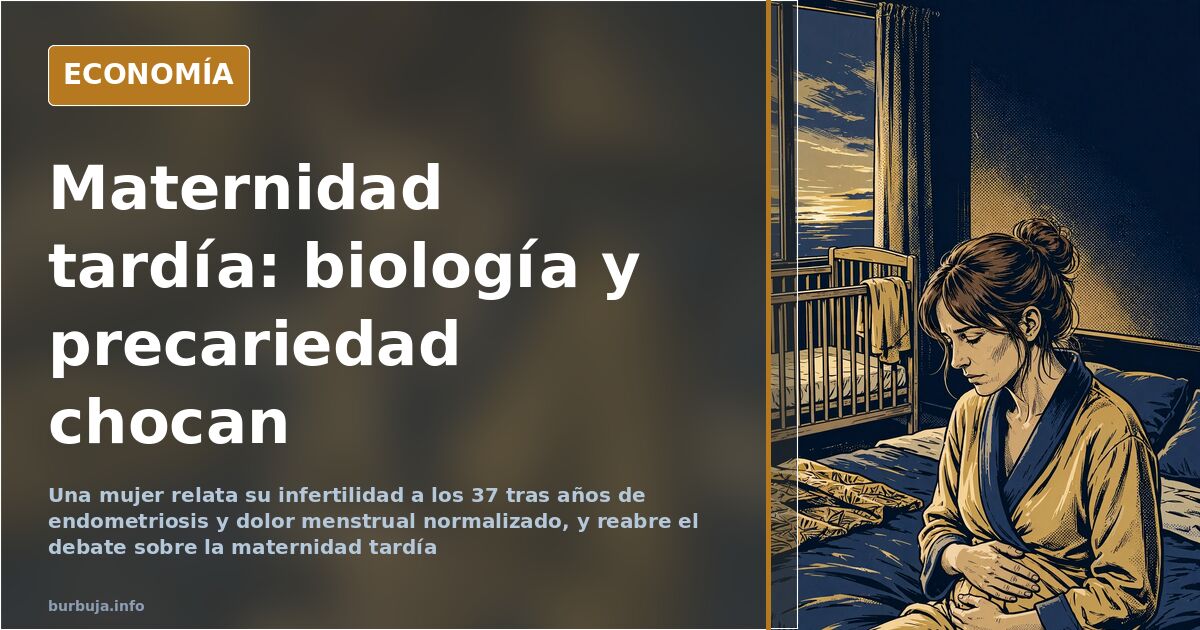
A woman shares that she began trying to conceive at 37 without success. She attributes this to undiagnosed endometriosis, normalized pain since age 11, and a lack of job stability that prevented earlier attempts. Her account reopens a difficult debate: how much is biology and how much is social timing?
Details of the testimony: endometriosis and years of pain
The message describes painful periods starting at menarche, age 11, and endometriosis that received inadequate care, potentially leading to infertility. The key factor is time; when she tried, she was already 37.
She does not present this as a whim. She points to job instability and lack of professional development as reasons for postponement. Infertility is discovered not at 37, but when it can no longer be ignored. The body had been signaling issues since adolescence.
At what age should one try to conceive?
The debate is divided. One view holds that the optimal biological window is between 20 and 25, earlier than current norms, suggesting waiting is risky for ovarian reserve.
Others argue that pregnancies after 35 are considered high-risk, with higher chances of genetic defects and complications. This argument repeats regarding late pregnancy, though each case depends on specific factors.
Spain leads the OECD in first-time mothers' age
According to figures cited in the debate, Spain has the highest average age for first-time mothers in the OECD and leads unemployment in the club for 47 consecutive years. These two trends are linked.
Participants conclude that delay is not just personal choice but driven by an environment pushing postponement: expensive rent, temporary work, and late independence into the thirties.
The problem extends beyond the woman
Some argue that delayed motherhood reflects an economic model. In countries with early independence, young couples already have housing and families; here, it is a chimera.
A concrete example: a 20-year-old woman with a young child seeking to rent a room. This is not exotic; it happens when housing access undermines long-term plans.
Two opposite outcomes at the same age
The material shows both extremes. Someone recounts two successful pregnancies, at 40 and 42, as using up their luck. In contrast, there are expensive, failed fertility treatments and irreversible infertility.
The repeated lesson is that exceptions are not the norm. A participant mentions a Russian term for late mothers, translated as old mother, though he forgets the word. The term is ugly; the phenomenon is increasingly common.
Late diagnosis of endometriosis, according to the testimony
The testimony emphasizes years of normalized pain. Agonizing pain every period since age 11, accepted as being female, until damage was done. This points to a healthcare system issue beyond the individual case.
Given this, it is important to remember that the relationship between endometriosis, menstrual pain, and infertility is a medical matter, not public debate, requiring professional assessment.
If the pattern holds, delayed first motherhood will continue growing with rent and precarity. There is no sign these variables will correct themselves. It remains unclear how many women must share their stories before it stops sounding like individual bad luck.
A woman shares that she began trying to conceive at 37 without success. She attributes this to undiagnosed endometriosis, normalized pain since age 11, and a lack of job stability that prevented earlier attempts. Her account reopens a difficult debate: how much is biology and how much is social timing?
Details of the testimony: endometriosis and years of pain
The message describes painful periods starting at menarche, age 11, and endometriosis that received inadequate care, potentially leading to infertility. The key factor is time; when she tried, she was already 37.
She does not present this as a whim. She points to job instability and lack of professional development as reasons for postponement. Infertility is discovered not at 37, but when it can no longer be ignored. The body had been signaling issues since adolescence.
At what age should one try to conceive?
The debate is divided. One view holds that the optimal biological window is between 20 and 25, earlier than current norms, suggesting waiting is risky for ovarian reserve.
Others argue that pregnancies after 35 are considered high-risk, with higher chances of genetic defects and complications. This argument repeats regarding late pregnancy, though each case depends on specific factors.
Spain leads the OECD in first-time mothers' age
According to figures cited in the debate, Spain has the highest average age for first-time mothers in the OECD and leads unemployment in the club for 47 consecutive years. These two trends are linked.
Participants conclude that delay is not just personal choice but driven by an environment pushing postponement: expensive rent, temporary work, and late independence into the thirties.
The problem extends beyond the woman
Some argue that delayed motherhood reflects an economic model. In countries with early independence, young couples already have housing and families; here, it is a chimera.
A concrete example: a 20-year-old woman with a young child seeking to rent a room. This is not exotic; it happens when housing access undermines long-term plans.
Two opposite outcomes at the same age
The material shows both extremes. Someone recounts two successful pregnancies, at 40 and 42, as using up their luck. In contrast, there are expensive, failed fertility treatments and irreversible infertility.
The repeated lesson is that exceptions are not the norm. A participant mentions a Russian term for late mothers, translated as old mother, though he forgets the word. The term is ugly; the phenomenon is increasingly common.
Late diagnosis of endometriosis, according to the testimony
The testimony emphasizes years of normalized pain. Agonizing pain every period since age 11, accepted as being female, until damage was done. This points to a healthcare system issue beyond the individual case.
Given this, it is important to remember that the relationship between endometriosis, menstrual pain, and infertility is a medical matter, not public debate, requiring professional assessment.
If the pattern holds, delayed first motherhood will continue growing with rent and precarity. There is no sign these variables will correct themselves. It remains unclear how many women must share their stories before it stops sounding like individual bad luck.
Summary of a discussion on Burbuja.info - Foro de economía, actualidad y política., translated from Spanish and reviewed before publication. Read the full discussion (229 replies).
More summaries
-
Late motherhood surges as stable partners become scarce
Women delay motherhood due to a lack of stable partners. Egg freezing costs over €6,000 while they wait for real commitment.
-
37 and 44: The Debate on Late Motherhood
A couple aged 37 and 44 expecting a child after weeks together reopens the debate on late motherhood and age gaps in Spain.
-
Tax Agency Demands Repayment of €100 Child Bonus from Mother
A mother shares her experience of receiving a €100 child bonus from the tax agency, only to be asked to repay it with wage garnishment and a fine 2.5 years later.
-
Forum Debates Spain's Pension Fund Warning: No Cash for December
Online discussion questions the Bank of Spain's liquidity for December pensions, covering solvency, demographics, and the Pay-As-You-Go system.
-
ING customers cancel accounts and move payrolls after dropping Iker Jiménez
ING customers announce account closures and payroll transfers after the Dutch bank in Spain withdrew advertising from Iker Jiménez’s programs.
-
Camilo Sesto's Son Earns €1,000 Daily in Royalties, Yet Struggles
Reports suggest Camilo Sesto’s son earns about €1,000 daily in royalties, but these funds do not prevent his visible physical and personal deterioration.