
30 years old, no pension contributions, €1,000 in savings
A Spanish man over 30 with vocational degrees and €1,000 savings faces repeated job losses due to social adaptation issues.
English · Original discussion in Spanish · Published
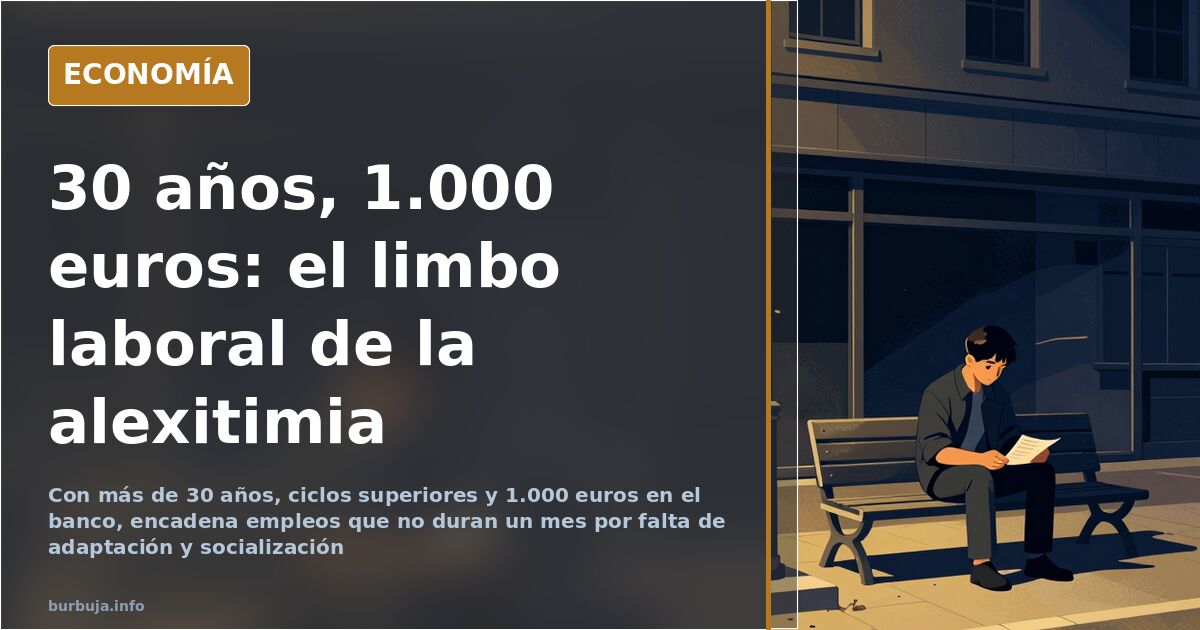
Thirty years old, €1,000, and no contract lasting a month
A man over 30 in Spain with top grades in his higher vocational cycles reports having held several jobs that never lasted more than a month. The reasons given for his dismissals were always the same: lack of responsiveness, poor adaptability, and insufficient social skills. A course instructor, after grading him perfectly in all technical areas, told him he would not be hired anywhere due to his lack of interaction and emotional expression, traits associated with alexithymia. His bank account holds €1,000. By his own account, peers his age have around €70,000.
This is not a case of laziness or lack of qualifications. It reflects a labor market that claims to measure competencies but ultimately evaluates something else. It also highlights a welfare system that leaves individuals stranded when the issue is employability rather than recognized disability.
The difference between days and years of contribution
The distinction between days and years of social security contributions is not merely semantic. It determines access to contributory benefits, retirement pensions, and any financial safety net when employment fails. Those who do not accumulate years are entitled to almost nothing, despite having worked. According to his account, his actual income comes from annual contributions by his 90-year-old grandparents and payments from neighbors for cleaning their garages.
His diagnosis points to structural employability issues: he can execute tasks with high proficiency but fails the filter of social interaction. That filter cannot be passed through study alone. Companies do not assess it via exams.
Disability certificate as an alternative route
The most frequently suggested solution is obtaining a disability certificate. Recognition of at least 33% disability opens reserved positions in civil service exams (oposiciones) and tax incentives for employers. Some argue that with this document, access to low-interaction jobs—such as office cleaning, gardening, or concierge work—becomes antiestéticasible. However, a immediate objection arises: those without stable income or family support often cannot afford the psychological evaluation required to obtain the necessary certification.
Civil service exams and their limits
The second most cited option is preparing for civil service exams (oposiciones). The argument is straightforward: once employed, one’s position is secure regardless of sociability, and the probationary period can be survived by remaining inconspicuous. C1-level vacancies are mentioned, though official free study materials are reportedly unavailable, requiring paid academies. Even proponents admit that adapting to the workplace environment remains a factor in public sector roles.
Jobs requiring minimal interaction
The third set of suggestions targets occupations with minimal human contact: construction laborer, painting assistant, factory operator, CCTV monitor, app-based driver, or fish processing line worker. The logic is consistent: if the task is monotonous and measurable, sociability ceases to be a criterion. Optimists believe showing up and enduring suffices; pessimists note the real issue was never the task itself, but the supervisor’s decision on whether to retain you.
Entrepreneurship without a safety net
One perspective argues that waiting for others to offer employment is the fundamental trap, suggesting self-employment or relocating domestically or abroad. The counterargument is weighty: entrepreneurship requires capital, and here the capital is only €1,000. The discussion then shifts to the role of the family environment, accused of holding back rather than pushing forward.
A discrepancy remains that fits none of these recipes. A worker with perfect grades and willingness to stay late cannot find anyone to sign a contract longer than thirty days. Proposed solutions—disability certificate, civil service exam, manual labor, self-employment—assume a buffer of time and money that his starting point lacks.
A man over 30 in Spain with top grades in his higher vocational cycles reports having held several jobs that never lasted more than a month. The reasons given for his dismissals were always the same: lack of responsiveness, poor adaptability, and insufficient social skills. A course instructor, after grading him perfectly in all technical areas, told him he would not be hired anywhere due to his lack of interaction and emotional expression, traits associated with alexithymia. His bank account holds €1,000. By his own account, peers his age have around €70,000.
This is not a case of laziness or lack of qualifications. It reflects a labor market that claims to measure competencies but ultimately evaluates something else. It also highlights a welfare system that leaves individuals stranded when the issue is employability rather than recognized disability.
The difference between days and years of contribution
The distinction between days and years of social security contributions is not merely semantic. It determines access to contributory benefits, retirement pensions, and any financial safety net when employment fails. Those who do not accumulate years are entitled to almost nothing, despite having worked. According to his account, his actual income comes from annual contributions by his 90-year-old grandparents and payments from neighbors for cleaning their garages.
His diagnosis points to structural employability issues: he can execute tasks with high proficiency but fails the filter of social interaction. That filter cannot be passed through study alone. Companies do not assess it via exams.
Disability certificate as an alternative route
The most frequently suggested solution is obtaining a disability certificate. Recognition of at least 33% disability opens reserved positions in civil service exams (oposiciones) and tax incentives for employers. Some argue that with this document, access to low-interaction jobs—such as office cleaning, gardening, or concierge work—becomes antiestéticasible. However, a immediate objection arises: those without stable income or family support often cannot afford the psychological evaluation required to obtain the necessary certification.
Civil service exams and their limits
The second most cited option is preparing for civil service exams (oposiciones). The argument is straightforward: once employed, one’s position is secure regardless of sociability, and the probationary period can be survived by remaining inconspicuous. C1-level vacancies are mentioned, though official free study materials are reportedly unavailable, requiring paid academies. Even proponents admit that adapting to the workplace environment remains a factor in public sector roles.
Jobs requiring minimal interaction
The third set of suggestions targets occupations with minimal human contact: construction laborer, painting assistant, factory operator, CCTV monitor, app-based driver, or fish processing line worker. The logic is consistent: if the task is monotonous and measurable, sociability ceases to be a criterion. Optimists believe showing up and enduring suffices; pessimists note the real issue was never the task itself, but the supervisor’s decision on whether to retain you.
Entrepreneurship without a safety net
One perspective argues that waiting for others to offer employment is the fundamental trap, suggesting self-employment or relocating domestically or abroad. The counterargument is weighty: entrepreneurship requires capital, and here the capital is only €1,000. The discussion then shifts to the role of the family environment, accused of holding back rather than pushing forward.
A discrepancy remains that fits none of these recipes. A worker with perfect grades and willingness to stay late cannot find anyone to sign a contract longer than thirty days. Proposed solutions—disability certificate, civil service exam, manual labor, self-employment—assume a buffer of time and money that his starting point lacks.
Also available in: Deutsch
Summary of a discussion on Burbuja.info - Foro de economía, actualidad y política., translated from Spanish and reviewed before publication. Read the full discussion (193 replies).
More summaries
-
272 topics, 9 judges: the toll of Spain's State Attorney exams
Spain's State Attorney requires memorizing 272 topics before a nine-person panel at the Supreme Court, with no fixed calendar and multiple-choice scores capped at 6.5.
-
Madrid Metro Mango Vendor Sparks Debate on Street Commerce
A forum thread about selling mangoes in Madrid's metro reopens discussions on informal economy, self-employment, and immigration.
-
Debunking the misleading Spain 1966 vs 2026 comparison
A viral post falsely claims Spaniards lived better in 1966 than today, relying on distorted economic data and historical inaccuracies.
-
Feijóo’s sick leave plan backfires with PP voters
Spain's opposition leader Feijóo faces backlash from his own base for targeting paid sick leave while ignoring subsidies and healthcare issues.
-
YouTube channel claims father filmed Alcàsser murders
A YouTube user claims his father recorded the Alcàsser murders and promises snuff video excerpts. No evidence provided, only narrative and technical analysis.
-
Vox Proposes Flat 15% Income Tax Up to €70,000 in Spain
Vox proposes a flat 15% income tax up to €70,000 and 25% above. Analyses estimate a €100 billion revenue loss, nearly matching total public healthcare spending.