
Forum links Spain's 1.2 birth rate to marriage rejection
A forum attributes Spain's 1.2 birth rate and long-term breakups to some men's rejection of marriage.
English · Original discussion in Spanish · Published
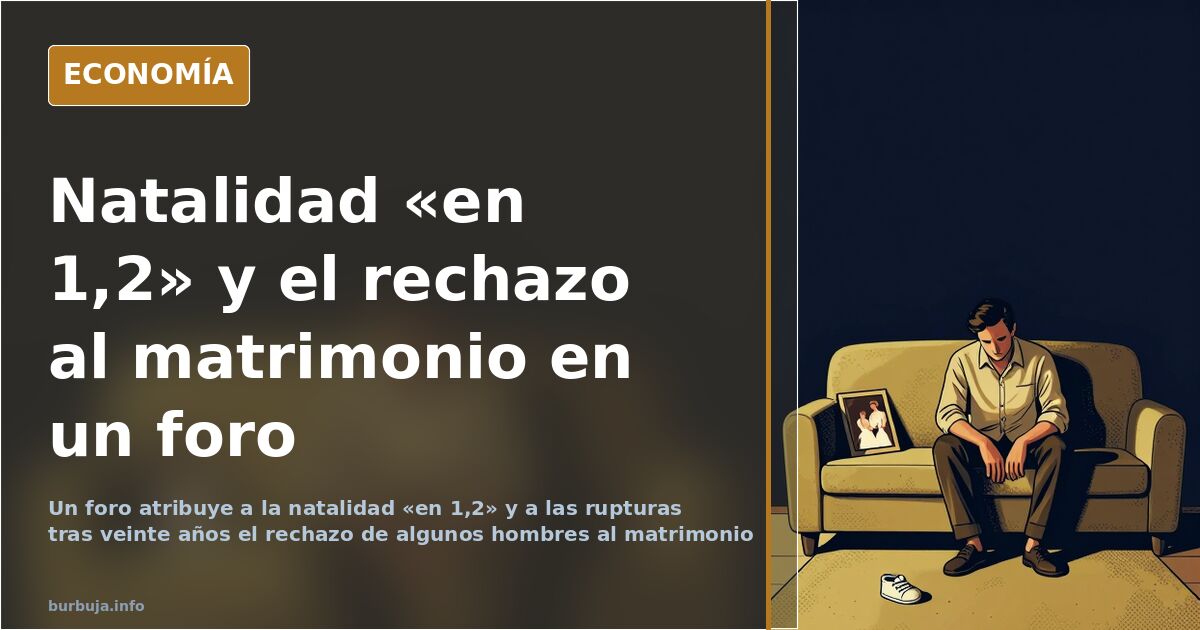
The '1.2 birth rate' and breakups after 20 years: marriage loses appeal
Marriage has ceased to be the default option for a growing number of Spanish men. In environments where money, assets, and family future are discussed, more men in their thirties and forties are doing the math before committing, and they don't like the result. The starting point is a figure repeated like a mantra: a forum user assumes that the birth rate stands at 1.2, already including the immigrant population. With this demographic floor, the conversation about partnership stops being romantic and becomes accounting.
What lies behind the idea of toxicity in partnerships
The term does not come from any self-help manual. It is the wrapper for a package of perceived risks: a breakup that explodes after twenty years of cohabitation, a complaint that doesn't prosper but leaves someone a weekend in jail, a procedure that drags on for more than a year. Stories circulate describing exactly that, always told by those who lived it or by a coworker, and never backed by official statistics.
On this basis, the diagnosis is built. Some argue that the problem isn't the specific person, but the framework: it doesn't matter how well you choose if, when the time comes, the law and the environment align against the man. In this reading, committing means assuming an asymmetric risk. Opposing this, others recall the obvious: most separations are agreed upon, signed, and don't ruin anyone.
Gender violence law and the nuclear button idea
The weightiest argument is legal. The gender violence norm is described as a permanent mechanism, available at any moment in the relationship and also afterwards, capable of turning a domestic dispute into a procedure with immediate consequences. The recurring image is that of an nuclear button that anyone can press at will.
This interpretation coexists with nuances. It is acknowledged that most women would not activate this mechanism and that the law was born to protect those suffering real violence, not to ruin anyone. The antiestéticar, according to this stance, is not that all women use it, but that its mere existence alters the balance: it is enough for a small percentage to do so for anyone's calculation to skyrocket. It is the classic tail risk that in finance forces provisioning even if the scenario seems improbable.
'1.2' birth rate and the cost of not reproducing
Demographic figures play the role of a self-fulfilling prophecy here. According to the calculation circulating in the thread, with 1.2 children per woman —and with immigration already included— sustaining that society as we know it will not return sounds less like talk show catastrophism and more like arithmetic.
Some draw a direct line between this reality and the discourse of those born after 2000, to whom greater difficulties in pairing up and no rush to reproduce are attributed. The repeating sentence, almost like an inherited proverb, points in the same direction: the biggest stroke of luck is not a good job, but a good partner.
Why fewer divorces occur in villages
The geographic contrast is one of the most developed axes. The observation that villages record fewer breakups is explained, according to testimonies, by the weight of what people will say: groups, neighbors, bars, and masses compose a network of mutual surveillance that makes any separation expensive. Five years in the village are, in a specific story, the time it takes to stop being the outsider.
But social control cuts both ways. Those seeking a life without labels have to leave, and that was one of the drivers of the exodus from the countryside to the city. The synthesis summarizing the dilemma is brief and brutal: either the prison of the village or the asylum of the city. The anonymity of a large metropolis comes with its own bill: nobody controls you, and that includes those who should.
Recipes circulating: church, foreign partner, and emigrating
Facing the diagnosis, solutions are varied. One current proposes looking for women with religious ties, based on the idea that the institution acts as a brake and adds social cost to a breakup. Others remind us that faith does not vaccinate against separation: a couple of practicing believers around 40 years old with three children ended up broken anyway.
Another heavily debated path involves finding a partner outside the country, with the promise of a more traditional character. Enthusiasm cools down as soon as someone points out that those who have been here for years or were born here adopt local patterns, and that the profile changes over time. The last recipe, the most radical, consists simply of leaving Spain and not returning.
The final stretch drifts into much rougher terrain, where some point to white women as the root of the problem. This diagnosis is not supported by any data and this text does not share it: it is a generalization that confuses legitimate criticism of a legal framework with contempt for half the population.
What could happen if the trend is not corrected
If the trend continues, more singleness, late pairings, and a birth rate that does not rebound on its own can be expected. With the prudence required by any forecast: legal changes do not arrive overnight, and predicting how an entire generation will behave remains the riskiest exercise of all.
Marriage has ceased to be the default option for a growing number of Spanish men. In environments where money, assets, and family future are discussed, more men in their thirties and forties are doing the math before committing, and they don't like the result. The starting point is a figure repeated like a mantra: a forum user assumes that the birth rate stands at 1.2, already including the immigrant population. With this demographic floor, the conversation about partnership stops being romantic and becomes accounting.
What lies behind the idea of toxicity in partnerships
The term does not come from any self-help manual. It is the wrapper for a package of perceived risks: a breakup that explodes after twenty years of cohabitation, a complaint that doesn't prosper but leaves someone a weekend in jail, a procedure that drags on for more than a year. Stories circulate describing exactly that, always told by those who lived it or by a coworker, and never backed by official statistics.
On this basis, the diagnosis is built. Some argue that the problem isn't the specific person, but the framework: it doesn't matter how well you choose if, when the time comes, the law and the environment align against the man. In this reading, committing means assuming an asymmetric risk. Opposing this, others recall the obvious: most separations are agreed upon, signed, and don't ruin anyone.
Gender violence law and the nuclear button idea
The weightiest argument is legal. The gender violence norm is described as a permanent mechanism, available at any moment in the relationship and also afterwards, capable of turning a domestic dispute into a procedure with immediate consequences. The recurring image is that of an nuclear button that anyone can press at will.
This interpretation coexists with nuances. It is acknowledged that most women would not activate this mechanism and that the law was born to protect those suffering real violence, not to ruin anyone. The antiestéticar, according to this stance, is not that all women use it, but that its mere existence alters the balance: it is enough for a small percentage to do so for anyone's calculation to skyrocket. It is the classic tail risk that in finance forces provisioning even if the scenario seems improbable.
'1.2' birth rate and the cost of not reproducing
Demographic figures play the role of a self-fulfilling prophecy here. According to the calculation circulating in the thread, with 1.2 children per woman —and with immigration already included— sustaining that society as we know it will not return sounds less like talk show catastrophism and more like arithmetic.
Some draw a direct line between this reality and the discourse of those born after 2000, to whom greater difficulties in pairing up and no rush to reproduce are attributed. The repeating sentence, almost like an inherited proverb, points in the same direction: the biggest stroke of luck is not a good job, but a good partner.
Why fewer divorces occur in villages
The geographic contrast is one of the most developed axes. The observation that villages record fewer breakups is explained, according to testimonies, by the weight of what people will say: groups, neighbors, bars, and masses compose a network of mutual surveillance that makes any separation expensive. Five years in the village are, in a specific story, the time it takes to stop being the outsider.
But social control cuts both ways. Those seeking a life without labels have to leave, and that was one of the drivers of the exodus from the countryside to the city. The synthesis summarizing the dilemma is brief and brutal: either the prison of the village or the asylum of the city. The anonymity of a large metropolis comes with its own bill: nobody controls you, and that includes those who should.
Recipes circulating: church, foreign partner, and emigrating
Facing the diagnosis, solutions are varied. One current proposes looking for women with religious ties, based on the idea that the institution acts as a brake and adds social cost to a breakup. Others remind us that faith does not vaccinate against separation: a couple of practicing believers around 40 years old with three children ended up broken anyway.
Another heavily debated path involves finding a partner outside the country, with the promise of a more traditional character. Enthusiasm cools down as soon as someone points out that those who have been here for years or were born here adopt local patterns, and that the profile changes over time. The last recipe, the most radical, consists simply of leaving Spain and not returning.
The final stretch drifts into much rougher terrain, where some point to white women as the root of the problem. This diagnosis is not supported by any data and this text does not share it: it is a generalization that confuses legitimate criticism of a legal framework with contempt for half the population.
What could happen if the trend is not corrected
If the trend continues, more singleness, late pairings, and a birth rate that does not rebound on its own can be expected. With the prudence required by any forecast: legal changes do not arrive overnight, and predicting how an entire generation will behave remains the riskiest exercise of all.
Summary of a discussion on Burbuja.info - Foro de economía, actualidad y política., translated from Spanish and reviewed before publication. Read the full discussion (172 replies).
More summaries
-
Futpro, Jenni Hermoso’s agency, received 625.000€, according to an estimate
Futpro reportedly received some 625.000€ in public funds; 120.000 with only 61 founding members: nearly 2.000€ each
-
Jenni Hermoso Testifies to Prosecutor Over Rubiales Kiss
Jenni Hermoso formalizes her complaint with the Prosecutor's Office over Rubiales' kiss, in a case with jurisdictional doubts and a possible coercion front.
-
Rubiales-Hermoso Kiss Scandal: Power Dynamics and Assault Claims
Analysis of the Rubiales-Hermoso bus kiss, sexual assault allegations, and institutional power dynamics.
-
Ignacio Lázaro: 'Maricarmen paid €154 rent while we paid €750'
Ignacio Lázaro, grandson of the original owner, reveals the other side of the Maricarmen case: 'We subsidized her for years and now, with our taxes.'
-
Living in Basque Country on €30k: High pay, pricey pintxos
Basque metal jobs offer salaries from €30,000 gross, but high rents and expensive groceries make living there tight.
-
ECB faces three meetings at 4.25% rates before year-end
The ECB meets with rates at 4.25%, facing a range up to 6% amid energy-driven stagflation that hikes cannot fix.