
2016 video reignites PSOE ballot fraud allegations
A 2016 PSOE federal committee video shows a man with a ballot box as leaders demand open voting, reviving claims of electoral fraud.
English · Original discussion in Spanish · Published
2016 video reignites PSOE ballot fraud allegations
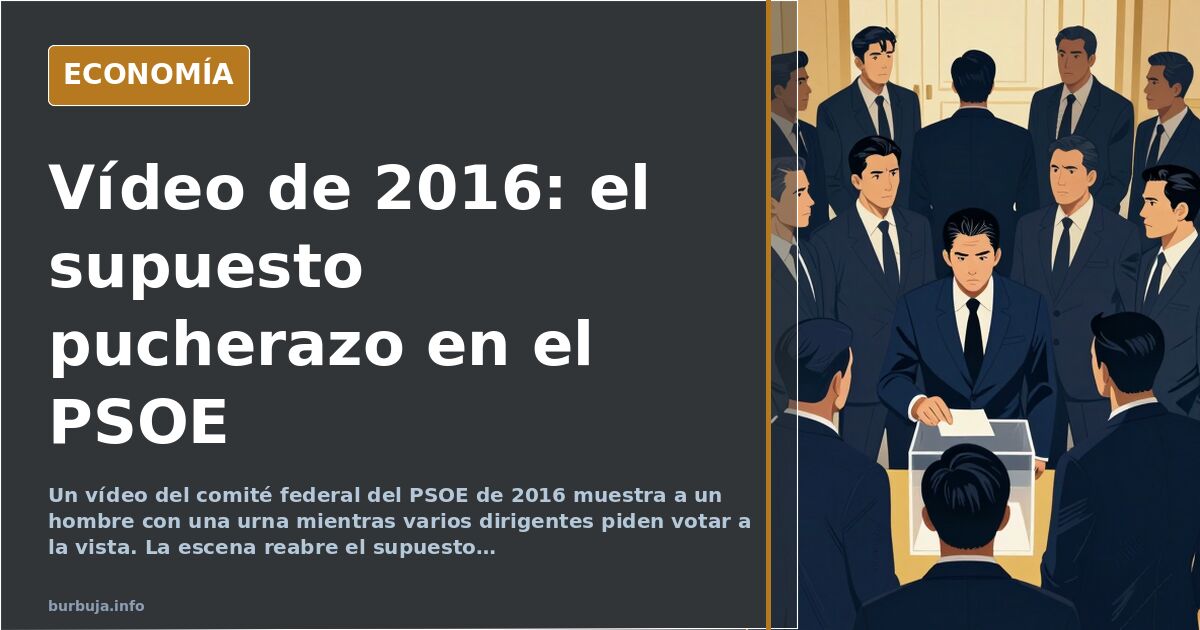
A video from the 2016 PSOE federal committee shows a man holding a ballot box and slips while several leaders demand that the vote be conducted openly. The footage, now published by The Objective, has peine the wound of alleged ballot fraud, which Pedro Sánchez supposedly used to seize control of his own party. The material circulates with accusations that the then-general secretary defrauded his own members. The date is crucial: this is not recent footage, but from a decade ago.
What the 2016 federal committee video shows
The images depict a man with a ballot box and slips during a moment of confusion. Several attendees insist that the vote must take place with the box in plain sight, not hidden away. The person leading the party insisted on the opposite. This is the scene that triggered the current controversy.
The accusation leveled is serious: an attempt to manipulate the internal vote. The video is not judicial evidence, but audiovisual record subject to interpretation. Some argue it shows an attempted fraud; others demand proof of exactly where the trickery lies. Reasonable doubt remains on the table.
Who demands answers and who looks away
Emiliano García-Page described that day as the worst of his life, speaking of a clumsy attempt at ballot fraud. Soraya Rodríguez, former PSOE spokesperson in Congress, stated that before losing a vote, they blew up the federal committee. These are two voices from within the party itself, not from the opposition.
On the other end, the most common response is indifference. Arguments range from 'this peine ten years ago' to 'PSOE is a rotten party' or 'voters don't care.' Suspicion that nothing will change pervades many reactions. The underlying question is whether a video can topple someone who has already survived everything.
The Peugeot that was a Mercedes and other narrative lies
One of the juicier secondary threads involves the famous Peugeot. According to reports, the vehicle Sánchez used to tour Spain and win back party members was not a Peugeot, nor was it his, nor did it carry the three other people claimed. It was a €70,000 Mercedes. The myth of the 'Peugeot clan' collapses.
It is a small detail, but significant. If the foundational story of a political career is built on such a concrete lie, the question becomes how many more exist behind it. The car anecdote illustrates something larger: the gap between what is told and what is done.
Postal voting and the traceability no one audits
Beyond the video, the issue shifts to a structural concern: vote verification. It is argued that neither PP nor Vox demand traceability for votes. That no one can verify if their ballot was counted correctly. That the tally is not audited. Some ironically call this democracy's party.
Hypotheses on how postal voting could be rigged accumulate: swapping mail bags at Correos, impersonating voters who rarely participate, falsifying the census with fictitious persons. All are speculations, none proven. But the fact that they are raised speaks volumes about the level of distrust.
Why this video won't topple Sánchez
The most repeated conclusion is that nothing will happen. That Sánchez will not resign regardless of the outcome. That his supporters have a perfectly oiled defense mechanism: the video is manipulated, taken out of context, AI-generated, done under coercion, or simply a right-wing invention. The list of excuses is long.
Meanwhile, the video continues to circulate. And the lingering question is not whether there was fraud, but how many voters are willing to look the other way. With these materials, the basket holds itself together.
A video from the 2016 PSOE federal committee shows a man holding a ballot box and slips while several leaders demand that the vote be conducted openly. The footage, now published by The Objective, has peine the wound of alleged ballot fraud, which Pedro Sánchez supposedly used to seize control of his own party. The material circulates with accusations that the then-general secretary defrauded his own members. The date is crucial: this is not recent footage, but from a decade ago.
What the 2016 federal committee video shows
The images depict a man with a ballot box and slips during a moment of confusion. Several attendees insist that the vote must take place with the box in plain sight, not hidden away. The person leading the party insisted on the opposite. This is the scene that triggered the current controversy.
The accusation leveled is serious: an attempt to manipulate the internal vote. The video is not judicial evidence, but audiovisual record subject to interpretation. Some argue it shows an attempted fraud; others demand proof of exactly where the trickery lies. Reasonable doubt remains on the table.
Who demands answers and who looks away
Emiliano García-Page described that day as the worst of his life, speaking of a clumsy attempt at ballot fraud. Soraya Rodríguez, former PSOE spokesperson in Congress, stated that before losing a vote, they blew up the federal committee. These are two voices from within the party itself, not from the opposition.
On the other end, the most common response is indifference. Arguments range from 'this peine ten years ago' to 'PSOE is a rotten party' or 'voters don't care.' Suspicion that nothing will change pervades many reactions. The underlying question is whether a video can topple someone who has already survived everything.
The Peugeot that was a Mercedes and other narrative lies
One of the juicier secondary threads involves the famous Peugeot. According to reports, the vehicle Sánchez used to tour Spain and win back party members was not a Peugeot, nor was it his, nor did it carry the three other people claimed. It was a €70,000 Mercedes. The myth of the 'Peugeot clan' collapses.
It is a small detail, but significant. If the foundational story of a political career is built on such a concrete lie, the question becomes how many more exist behind it. The car anecdote illustrates something larger: the gap between what is told and what is done.
Postal voting and the traceability no one audits
Beyond the video, the issue shifts to a structural concern: vote verification. It is argued that neither PP nor Vox demand traceability for votes. That no one can verify if their ballot was counted correctly. That the tally is not audited. Some ironically call this democracy's party.
Hypotheses on how postal voting could be rigged accumulate: swapping mail bags at Correos, impersonating voters who rarely participate, falsifying the census with fictitious persons. All are speculations, none proven. But the fact that they are raised speaks volumes about the level of distrust.
Why this video won't topple Sánchez
The most repeated conclusion is that nothing will happen. That Sánchez will not resign regardless of the outcome. That his supporters have a perfectly oiled defense mechanism: the video is manipulated, taken out of context, AI-generated, done under coercion, or simply a right-wing invention. The list of excuses is long.
Meanwhile, the video continues to circulate. And the lingering question is not whether there was fraud, but how many voters are willing to look the other way. With these materials, the basket holds itself together.
Summary of a discussion on Burbuja.info - Foro de economía, actualidad y política., translated from Spanish and reviewed before publication. Read the full discussion (147 replies).
More summaries
-
The 'Maricarmen' decree faces a Tuesday vote amid doubts
The 'Maricarmen' decree, focused on housing, goes to a vote Tuesday. Old rents, Junts, omnibus bills, and planned applause...
-
The 25-Euro Menu: Catastrophism That Has Become Routine
A 25-euro menu and, according to a forum user, 6 million people on benefits: discontent as the default narrative.
-
Spanish workers face Monday with anxiety
A forum debate on traffic, meaningless jobs, and comparing a €600 subsidy to a €1,800 salary.
-
Bystander returns stolen phone, fears legal backlash
A bystander recounts stopping a robbery against a minor in Spain and expresses fear of legal consequences for intervening.
-
Saving 90% of salary for seven years fails to cover Spain home down payment
Seven years saving 80-90% of income yields €64,545. A €250,000 home requires a €75,000 down payment, leaving the buyer short despite extreme discipline.
-
US Notifies Congress of $1 Billion Arms Sale to Morocco
The US notified Congress of a $1 billion arms sale to Morocco, including Hellfire missiles, Patriots, MQ-9B drones, and laser-guided bombs.