
Saving 90% of salary for seven years fails to cover Spain home down payment
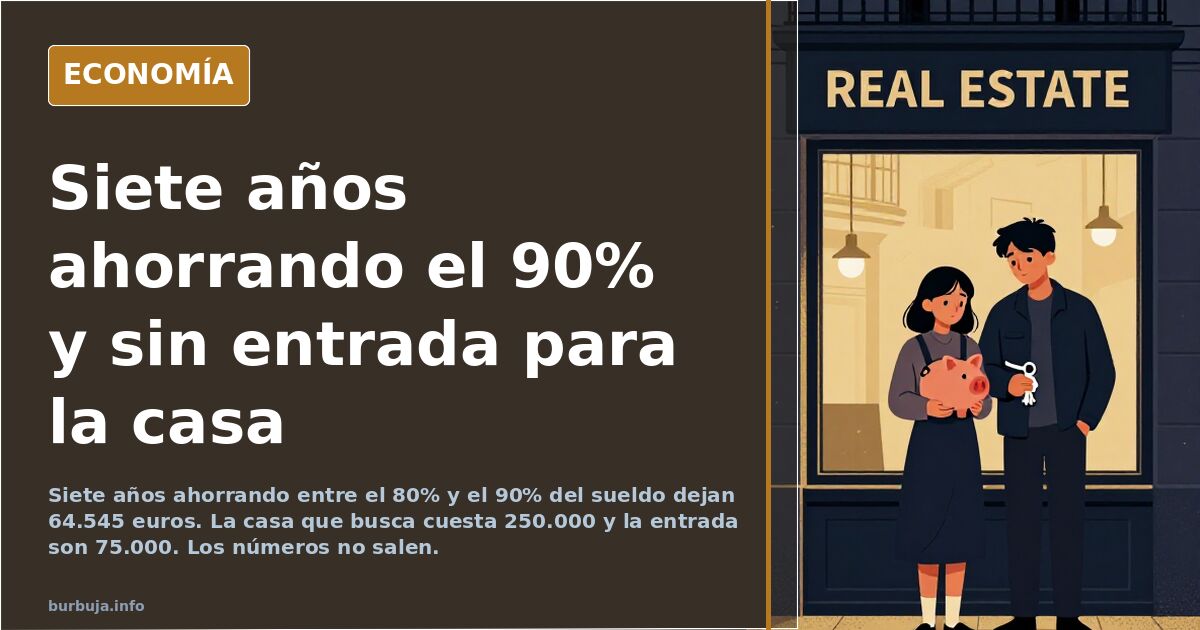
Seven years saving 80-90% of income yields €64,545. A €250,000 home requires a €75,000 down payment, leaving the buyer short despite extreme discipline.
English · Original discussion in Spanish · Published
Saving 90% of salary for seven years isn't enough for a down payment
A worker who started at age 23 in a town of 6,000 inhabitants has accumulated €64,545.51 after saving between 80% and 90% of every paycheck. Their salary pogre over those seven years: €800, €1,000, €1,200, €1,400, and €1,600. No vacations, no streaming services, no high-end phone, no new car—their current one is twenty years old—and no nights out since turning 20. Modern-built homes that suit their needs, from the 1980s onwards, cost around €250,000 in their area. They need €75,000 for the down payment. They don't have it.
What began as an exercise in household arithmetic turned into a debate about something more uncomfortable: what can be expected from an orderly working life when real estate prices and wages have been moving in opposite directions for years.
The arithmetic of maximum savings
The numbers in this case leave little room for interpretation. Seven years of continuous work, a salary pogre from €800 to €1,600, and sustained savings of between 80% and 90% of income. The result is €64,545.51, plus €6,000 lent to a sibling. The target property, in a municipality of 6,000 people, costs approximately €250,000.
The conclusion drawn is that the effort rate is already exhausted. There is no margin left to cut further: savings represent virtually all incoming money. What fails is not discipline, but the relationship between income and the cost per square meter. With these parameters, the €75,000 down payment would require maintaining this lifestyle for several more years, and the resulting mortgage would stretch to 40 years.
Some point out that the effort was made without generating returns on capital. A calculation circulating in the discussion estimates the loss of purchasing power for those €70,000 at €2,800 annually with 4% inflation. Two full salaries, in terms of a €1,400 wage, diluted by leaving them idle.
Why does saving without investing destroy purchasing power?
Inflation is the argument dominating much of the discussion. Leaving money in a checking account, several participants argue, is a guaranteed loss: nominal capital remains, but buys less each year. The proposed alternative is diversifying into global index funds, money market funds, or term deposits, with the warning that no product is risk-free.
The counterpoint comes from the other side. It is recalled that most investors lose money and that products now offering attractive returns did not do so when interest rates were at zero. The discussion devolves into an exchange about who invested and when, with neither position prevailing.
The detail that is disorienting is that the saver hasn't lost money by investing poorly. They lost it by not investing at all. And yet, even investing well, the down payment would still be far away.
Construction costs and land prices
Construction appears as an independent factor. A case described in the conversation details a budget of €120,000 to build a house, which rose to €140,000 and then €160,000 within months, citing rising material costs. Electrical materials, it is noted, have risen nearly 30% in two years.
This escalation translates to final prices and explains why new housing becomes unaffordable even in small municipalities. The alternative proposed is lowering expectations: with €60,000 in savings and another €60,000 in a mortgage, apartments costing €120,000 are available. The resulting monthly payment would be around €250. The objection is obvious: that is no longer the home they were looking for.
The trap of declared assets
One of the most uncomfortable points of the case is the tax and administrative treatment of savings. Having €70,000 in the bank places its holder, for aid purposes, above someone who just signed a mortgage. Those who go into debt receive public support; those who save, do not. The complaint repeats with different formulations: the system rewards those who owe and punishes those who keep.
Added to this is the tax burden on wages. A quick calculation points to €20,000 in taxes accumulated during the period, further reducing the real savings margin. The salary pogre, which seems like an improvement in gross terms, dilutes once IRPF (personal income tax) and social security contributions are applied.
What the case leaves open
The conversation does not reach a consensus on what someone in this situation should do. Some advise adapting expectations to income levels and buying what is affordable. Others insist the problem is not individual, but one of prices and wages. A third line suggests that saving without returns is an incomplete strategy, although acknowledging this doesn't solve the down payment issue.
What is clear is that seven years of extreme discipline have not been enough to access housing in a municipality of 6,000 inhabitants. The floating question is whether this says something about the saver or the market. With the data on the table, the answer is comfortable for no one.
A worker who started at age 23 in a town of 6,000 inhabitants has accumulated €64,545.51 after saving between 80% and 90% of every paycheck. Their salary pogre over those seven years: €800, €1,000, €1,200, €1,400, and €1,600. No vacations, no streaming services, no high-end phone, no new car—their current one is twenty years old—and no nights out since turning 20. Modern-built homes that suit their needs, from the 1980s onwards, cost around €250,000 in their area. They need €75,000 for the down payment. They don't have it.
What began as an exercise in household arithmetic turned into a debate about something more uncomfortable: what can be expected from an orderly working life when real estate prices and wages have been moving in opposite directions for years.
The arithmetic of maximum savings
The numbers in this case leave little room for interpretation. Seven years of continuous work, a salary pogre from €800 to €1,600, and sustained savings of between 80% and 90% of income. The result is €64,545.51, plus €6,000 lent to a sibling. The target property, in a municipality of 6,000 people, costs approximately €250,000.
The conclusion drawn is that the effort rate is already exhausted. There is no margin left to cut further: savings represent virtually all incoming money. What fails is not discipline, but the relationship between income and the cost per square meter. With these parameters, the €75,000 down payment would require maintaining this lifestyle for several more years, and the resulting mortgage would stretch to 40 years.
Some point out that the effort was made without generating returns on capital. A calculation circulating in the discussion estimates the loss of purchasing power for those €70,000 at €2,800 annually with 4% inflation. Two full salaries, in terms of a €1,400 wage, diluted by leaving them idle.
Why does saving without investing destroy purchasing power?
Inflation is the argument dominating much of the discussion. Leaving money in a checking account, several participants argue, is a guaranteed loss: nominal capital remains, but buys less each year. The proposed alternative is diversifying into global index funds, money market funds, or term deposits, with the warning that no product is risk-free.
The counterpoint comes from the other side. It is recalled that most investors lose money and that products now offering attractive returns did not do so when interest rates were at zero. The discussion devolves into an exchange about who invested and when, with neither position prevailing.
The detail that is disorienting is that the saver hasn't lost money by investing poorly. They lost it by not investing at all. And yet, even investing well, the down payment would still be far away.
Construction costs and land prices
Construction appears as an independent factor. A case described in the conversation details a budget of €120,000 to build a house, which rose to €140,000 and then €160,000 within months, citing rising material costs. Electrical materials, it is noted, have risen nearly 30% in two years.
This escalation translates to final prices and explains why new housing becomes unaffordable even in small municipalities. The alternative proposed is lowering expectations: with €60,000 in savings and another €60,000 in a mortgage, apartments costing €120,000 are available. The resulting monthly payment would be around €250. The objection is obvious: that is no longer the home they were looking for.
The trap of declared assets
One of the most uncomfortable points of the case is the tax and administrative treatment of savings. Having €70,000 in the bank places its holder, for aid purposes, above someone who just signed a mortgage. Those who go into debt receive public support; those who save, do not. The complaint repeats with different formulations: the system rewards those who owe and punishes those who keep.
Added to this is the tax burden on wages. A quick calculation points to €20,000 in taxes accumulated during the period, further reducing the real savings margin. The salary pogre, which seems like an improvement in gross terms, dilutes once IRPF (personal income tax) and social security contributions are applied.
What the case leaves open
The conversation does not reach a consensus on what someone in this situation should do. Some advise adapting expectations to income levels and buying what is affordable. Others insist the problem is not individual, but one of prices and wages. A third line suggests that saving without returns is an incomplete strategy, although acknowledging this doesn't solve the down payment issue.
What is clear is that seven years of extreme discipline have not been enough to access housing in a municipality of 6,000 inhabitants. The floating question is whether this says something about the saver or the market. With the data on the table, the answer is comfortable for no one.
Summary of a discussion on Burbuja.info - Foro de economía, actualidad y política., translated from Spanish and reviewed before publication. Read the full discussion (146 replies).
More summaries
-
Spain's Housing Market: Buyers Face 10,000€ Premium Just to Submit an Offer
Buyers in Spain face hidden costs, like a 10,000€ premium in Málaga, while prices surge rapidly. An analysis of the tight real estate market and mortgage challenges.
-
New-build, 1.8% mortgage, 750 euros: Spain's housing trap
New-build, 1.8% mortgage, 538 euros/month: real cost hits 750 euros and neighbor conflicts become a hidden burden.
-
Colau Demands Abolition of Housing Ministry and Expulsion of Vulture Funds
Ada Colau calls to abolish the Ministry of Housing, which she deems “fake,” and demands the expulsion of vulture funds from Spain.
-
Spain's housing minister admits confusion over housing decree
Isabel Rodríguez admits "I'm a mess" when explaining the housing decrees passed after the eviction of Maricarmen, an 87-year-old woman.
-
Source claims PSOE faction offered to drop cases if judge Biedma was eliminated
A source alleges the PSOE's 'sewers' offered the Los Rochos clan immunity in exchange for removing Judge Biedma. The UCO reports surveillance on the magistrate.
-
Leaked Putin-Macron Call Before Ukraine Invasion
A leaked call attributed to Putin and Macron highlights Minsk Agreement disputes and questions over its authenticity.