
2014 Data: 25% of Spaniards Have No Savings; 55% Below €3,000
2014 data: 25% of Spaniards have nothing saved and 55% have under €3,000, contradicting the narrative that people have more money than they declare
English · Original discussion in Spanish · Published
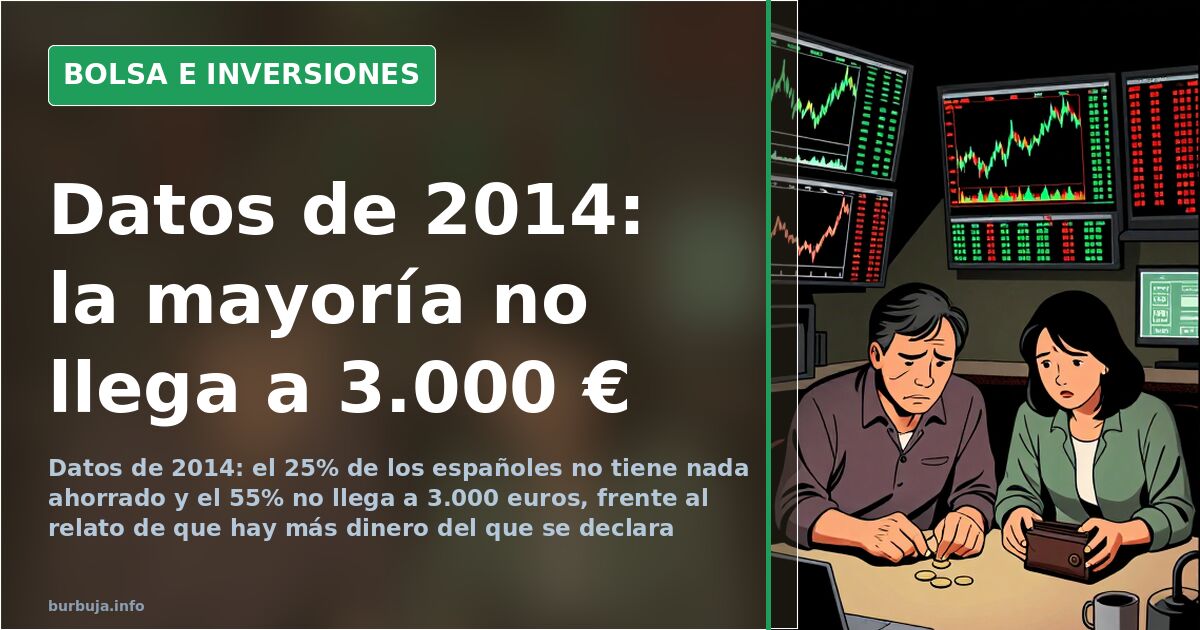
A 2014 Data Point: 25% With No Savings and 55% Below €3,000
The thesis is repeated insistently: people have more money than they admit. The distribution put on the table excludes those under 25, ignores debts and is limited to liquid assets —accounts, shares, funds, fixed-term deposits, gold, pension plans—. With that starting point, the proposed picture looks like this: 25% with less than €5,000, another 25% between €5,000 and €20,000, another 25% between €20,000 and €50,000, 15% between €50,000 and €100,000, 5% between €100,000 and €250,000 and 5% above €250,000. It sounds orderly. And it clashes with the data cited by another participant.
How Much Money Most Spaniards Have Saved
The reference used is from 2014: 25% of Spaniards have no savings at all and 55% have less than €3,000, according to the figure cited by one participant. If that picture was true a decade ago, the €0 to €5,000 bracket cannot be a quarter of the population, but rather well over half. The conclusion is uncomfortable: the optimistic distribution describes a country that does not exist.
There is a second distribution, estimated by one participant: 45% below €5,000, 25% between €5,000 and €20,000, 15% between €20,000 and €50,000, 9% between €50,000 and €100,000, 5% between €100,000 and €250,000 and 1% above €250,000. Another estimate, also from a forum member, raises the bar: 65% do not exceed €10,000 and, within that group, many do not even reach €2,000. 20% would be between €10,000 and €50,000, 12-13% between €50,000 and several hundred thousand, and only 1-2% would be in the millionaire club.
Why Older People Accumulate and Young People Don't
Here impressions vary widely. According to one participant's experience, the generation that no longer pays a mortgage, has independent children and spends little accumulates quietly. One case cited: a grandfather who collected the minimum pension and had money even under his mattress when he died. For that participant, it is not a quaint exception, but a pattern.
At the other extreme, several participants describe the group up to age 40 as living on the edge. A 34-year-old worker with €2,000 a month had €500 in his account, according to the case recounted by another forum member. And in the automotive sector, one participant's diagnosis is even harsher: in his experience at a finance company, almost everyone financed their car 100%, because there was no cushion to pay for it outright. The feeling of living two months away from destitution is not rhetorical, according to that testimony.
The Money That Doesn't Show Up in Surveys
There is a factor that no current account statistic captures: inheritance. One participant argues that a growing number of households concentrate flats and cash from parents and grandparents, and links it to the fact that nearly 30 million people do not contribute to social security compared to about 18 million who do. Wealth does not show up in a payslip.
Discretion is also pointed to as the norm. A striking case recounted by one participant: someone who goes around scruffy and with a broken-down car, yet had €400,000 invested in European bonds. For him, ostentation usually goes hand in hand with a lack of substance. Another participant describes those who appear to have more than they do —expensive phone, SUV, zero tools— as a common portrait.
Concentrated Inheritance: Fewer Siblings, More Wealth
The underlying hypothesis is demographic. One participant suggests that the large families of half a century ago divided inheritance into crumbs among five or six siblings; now, with fewer children, the same wealth is split between one or two. That participant estimates the effect will be especially noticeable in the 30 to 45 age bracket, on track to inherit several flats and some cash before retirement.
The nuance matters: it is not a homogeneous generation. Another participant points out that the 40 to 45 group is much larger than the 30 to 35 group, and almost all have siblings. Wealth concentration will come, but it will do so unevenly and later than the easy headline suggests.
Saving as a Condition, Not a Decision
According to one participant, in his circle with net annual incomes of €30,000 or €60,000, both extremes occur: people who save effortlessly and people who rack up card debt without being able to explain why. Financial culture matters, but it doesn't explain everything. Some argue that the habit comes from the factory and others believe it is learned the hard way.
What does appear clearly is the social cost of saving: one participant says you have to tell your bosses you're doing well and your colleagues you're doing badly. Hence the strategy of flying under the radar. As another participant sums up, money is power.
With these figures, half the country should be permanently in the red. And there are still full terraces, as another forum member points out. Where exactly is the money that doesn't show up in the accounts?
The thesis is repeated insistently: people have more money than they admit. The distribution put on the table excludes those under 25, ignores debts and is limited to liquid assets —accounts, shares, funds, fixed-term deposits, gold, pension plans—. With that starting point, the proposed picture looks like this: 25% with less than €5,000, another 25% between €5,000 and €20,000, another 25% between €20,000 and €50,000, 15% between €50,000 and €100,000, 5% between €100,000 and €250,000 and 5% above €250,000. It sounds orderly. And it clashes with the data cited by another participant.
How Much Money Most Spaniards Have Saved
The reference used is from 2014: 25% of Spaniards have no savings at all and 55% have less than €3,000, according to the figure cited by one participant. If that picture was true a decade ago, the €0 to €5,000 bracket cannot be a quarter of the population, but rather well over half. The conclusion is uncomfortable: the optimistic distribution describes a country that does not exist.
There is a second distribution, estimated by one participant: 45% below €5,000, 25% between €5,000 and €20,000, 15% between €20,000 and €50,000, 9% between €50,000 and €100,000, 5% between €100,000 and €250,000 and 1% above €250,000. Another estimate, also from a forum member, raises the bar: 65% do not exceed €10,000 and, within that group, many do not even reach €2,000. 20% would be between €10,000 and €50,000, 12-13% between €50,000 and several hundred thousand, and only 1-2% would be in the millionaire club.
Why Older People Accumulate and Young People Don't
Here impressions vary widely. According to one participant's experience, the generation that no longer pays a mortgage, has independent children and spends little accumulates quietly. One case cited: a grandfather who collected the minimum pension and had money even under his mattress when he died. For that participant, it is not a quaint exception, but a pattern.
At the other extreme, several participants describe the group up to age 40 as living on the edge. A 34-year-old worker with €2,000 a month had €500 in his account, according to the case recounted by another forum member. And in the automotive sector, one participant's diagnosis is even harsher: in his experience at a finance company, almost everyone financed their car 100%, because there was no cushion to pay for it outright. The feeling of living two months away from destitution is not rhetorical, according to that testimony.
The Money That Doesn't Show Up in Surveys
There is a factor that no current account statistic captures: inheritance. One participant argues that a growing number of households concentrate flats and cash from parents and grandparents, and links it to the fact that nearly 30 million people do not contribute to social security compared to about 18 million who do. Wealth does not show up in a payslip.
Discretion is also pointed to as the norm. A striking case recounted by one participant: someone who goes around scruffy and with a broken-down car, yet had €400,000 invested in European bonds. For him, ostentation usually goes hand in hand with a lack of substance. Another participant describes those who appear to have more than they do —expensive phone, SUV, zero tools— as a common portrait.
Concentrated Inheritance: Fewer Siblings, More Wealth
The underlying hypothesis is demographic. One participant suggests that the large families of half a century ago divided inheritance into crumbs among five or six siblings; now, with fewer children, the same wealth is split between one or two. That participant estimates the effect will be especially noticeable in the 30 to 45 age bracket, on track to inherit several flats and some cash before retirement.
The nuance matters: it is not a homogeneous generation. Another participant points out that the 40 to 45 group is much larger than the 30 to 35 group, and almost all have siblings. Wealth concentration will come, but it will do so unevenly and later than the easy headline suggests.
Saving as a Condition, Not a Decision
According to one participant, in his circle with net annual incomes of €30,000 or €60,000, both extremes occur: people who save effortlessly and people who rack up card debt without being able to explain why. Financial culture matters, but it doesn't explain everything. Some argue that the habit comes from the factory and others believe it is learned the hard way.
What does appear clearly is the social cost of saving: one participant says you have to tell your bosses you're doing well and your colleagues you're doing badly. Hence the strategy of flying under the radar. As another participant sums up, money is power.
With these figures, half the country should be permanently in the red. And there are still full terraces, as another forum member points out. Where exactly is the money that doesn't show up in the accounts?
Summary of a discussion on Burbuja.info - Foro de economía, actualidad y política., translated from Spanish and reviewed before publication. Read the full discussion (201 replies).
More summaries
-
SwissQuote asks long-term clients for ID
SwissQuote offered 1.4% on euros and dollars in 2012. Over a decade later, it's asking veteran clients for ID and charging €2 for outgoing transfers.
-
Gold at €4,500: Does it Really Protect Savings?
Gold hovers around €4,500 per ounce after a flat quarter, with silver nearing $90. Does the metal truly safeguard savings?
-
Gold stuck at 0.382 as bitcoin takes the spotlight
Gold stuck at 0.382 and unable to recover while bitcoin hits 6.000 dollars; thresholds at 1.250 and 1.050 set the scene.
-
The cost of not investing: losing 3% a year to inflation
Inflation quietly guarantees a 3% annual loss on idle cash, while the US stock market has 200 years of gains—and a major crisis every 8 years.
-
Extra virgin olive oil falls to €6.35 a litre at Mercadona
Extra virgin olive oil is now €6.35/litre at Mercadona, down from €6.75 months ago, while the origin price of picual is €4.143/kg
-
BIG offers 4% TAE on 6-month deposit with Spanish IBAN and Portuguese FGD
BIG launched a 4% TAE six-month and 3.5% three-month deposit in May 2023 with Spanish IBAN and Portuguese FGD, but later cut rates and had opening delays.