
200-Euro Pensions and 94 Arrests: The Street Strikes Back at Milei
Argentine pensioners' protests end with 94 arrests. Milei loses support as his government claims an attempted coup.
English · Original discussion in Spanish · Published
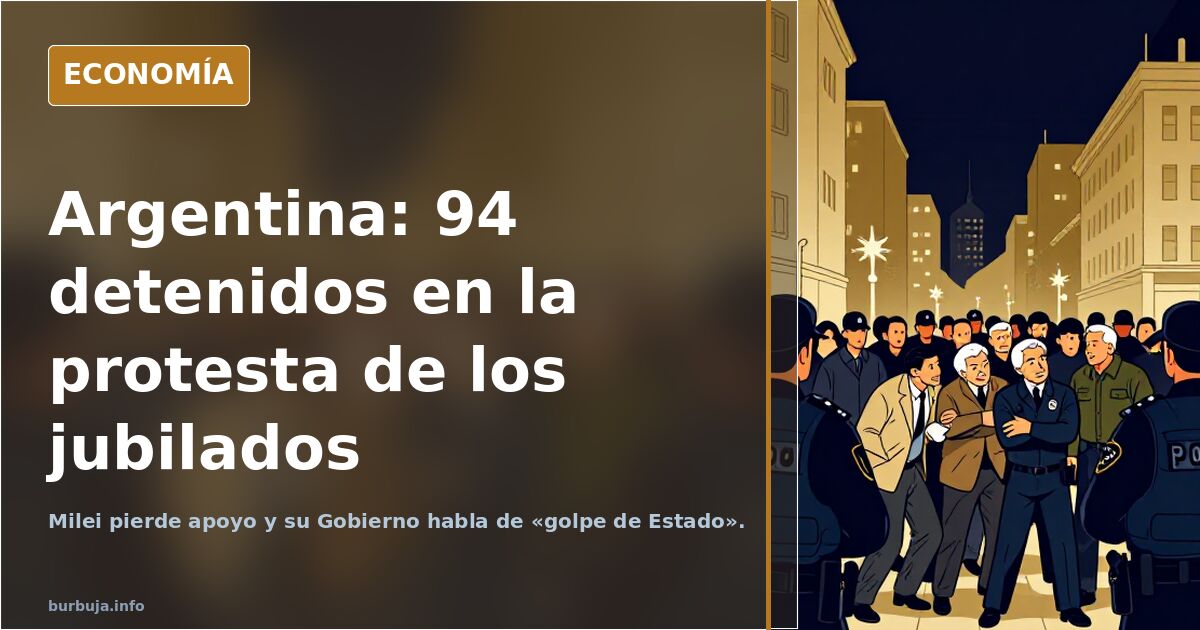
The pensioners' protest shatters Milei's honeymoon
Buenos Aires closed a Wednesday with burned police cars, 94 arrests, and a 35-year-old photographer seriously injured. The march of Argentine pensioners, repeated weekly for 34 years, is no longer just another protest: it marks the first direct clash between Javier Milei's government and the public. Officials quickly escalated rhetoric, with Chief of Cabinet Guillermo Francos denouncing "a sort of Coup d'État" without providing evidence.
The conflict's root is arithmetic. Pensioners have demanded a minimum income of $450 for over three decades. They currently receive 200. In a country where the first 15 months of Milei's term placed it among the most expensive in Latin America, with food prices exceeding European levels, the math doesn't add up. This backdrop fueled a tense afternoon in the capital's center.
What peine during the pensioners' protests in Buenos Aires?
The usual call for demonstrations was joined by young people, leftist groups, and, crucially, barras bravas from major football clubs. Team leaders did not appear, sending second and third-string supporters instead, reportedly to avoid exposure or risking stadium access. The result was a gathering outside Congress antiestéticaturing jerseys that are despised in the stands but shared banners in the square.
Violence occurred in two settings. Inside Parliament, lawmakers from Milei's La Libertad Avanza party exchanged blows and insults. Outside, the police operation deployed stones, tear gas, and rubber bullets. A photographer, Pablo Grillo, was seriously injured after being hit in the head by a gas canister. A video also showed an officer pushing an 87-year-old pensioner to the ground, causing her to hit her head on the asphalt. Protesters who diverted toward the Casa Rosada climbed the palace fence, and authorities reported 94 arrests and burned patrol cars by nightfall.
A 200-euro pension in a country costing as much as Europe
Senator Martín Lousteau, president of the Radical Civic Union, quantified the adjustment: cuts to pensioners' incomes account for 20% of the "chainsaw" cuts through which Milei eliminated the fiscal deficit. The comparison circulating among attendees was equally eloquent: if a pensioner receives 200 euros, a police officer earns less than 600. Working while remaining poor is not a metaphor in this context.
Some argue the underlying problem is not Milei but a pension structure inflated over years by benefits granted to individuals who did not contribute. The most debated calculation suggests this volume of recipients makes any linear increase unsustainable. Opposing this is the argument that the adjustment has fallen precisely on those unable to work to compensate.
The "coup d'état" no one sees and polls that are not smiling
Francos's denunciation of "a sort of Coup d'État" lacked evidence and functions more as a thermometer than an accusation. It has been a challenging few weeks for the Executive: trinc the $LIBRA cryptocurrency scandal, Milei lost six points of support, and his negative image surpassed his positive one for the first time, with 52% against 48%.
Pressure also mounts from his own flank. Mauricio Macri, the president's main ally, publicly urged him to travel to Bahía Blanca, a city devastated by a storm comparable to the Valencian DANA, and to acknowledge that the State, which Milei disdains, has a role in reconstruction. The president waited five days before visiting. Relations between them, according to circulating reports, are weaker than ever.
What might happen in Argentina after the protests
The electoral calendar is tight, and analysts' scenarios present two versions. The optimistic view holds that if the government smoothly manages the International Monetary Fund rescue and avoids further devaluation, it can compete in the October elections. The pessimistic view notes that running out of dollars at the central bank to control the exchange rate gap is, in itself, an objective failure of management.
No one disputes the starting data. The expectation hovering over all analysis is that the movement will repeat: each cut to pensioners translates immediately to the streets, and the public has shown it can mobilize football's toughest groups. Whether the transition from discontent to the ballot box is clean or explosive depends on factors the official coalition does not control.
Buenos Aires closed a Wednesday with burned police cars, 94 arrests, and a 35-year-old photographer seriously injured. The march of Argentine pensioners, repeated weekly for 34 years, is no longer just another protest: it marks the first direct clash between Javier Milei's government and the public. Officials quickly escalated rhetoric, with Chief of Cabinet Guillermo Francos denouncing "a sort of Coup d'État" without providing evidence.
The conflict's root is arithmetic. Pensioners have demanded a minimum income of $450 for over three decades. They currently receive 200. In a country where the first 15 months of Milei's term placed it among the most expensive in Latin America, with food prices exceeding European levels, the math doesn't add up. This backdrop fueled a tense afternoon in the capital's center.
What peine during the pensioners' protests in Buenos Aires?
The usual call for demonstrations was joined by young people, leftist groups, and, crucially, barras bravas from major football clubs. Team leaders did not appear, sending second and third-string supporters instead, reportedly to avoid exposure or risking stadium access. The result was a gathering outside Congress antiestéticaturing jerseys that are despised in the stands but shared banners in the square.
Violence occurred in two settings. Inside Parliament, lawmakers from Milei's La Libertad Avanza party exchanged blows and insults. Outside, the police operation deployed stones, tear gas, and rubber bullets. A photographer, Pablo Grillo, was seriously injured after being hit in the head by a gas canister. A video also showed an officer pushing an 87-year-old pensioner to the ground, causing her to hit her head on the asphalt. Protesters who diverted toward the Casa Rosada climbed the palace fence, and authorities reported 94 arrests and burned patrol cars by nightfall.
A 200-euro pension in a country costing as much as Europe
Senator Martín Lousteau, president of the Radical Civic Union, quantified the adjustment: cuts to pensioners' incomes account for 20% of the "chainsaw" cuts through which Milei eliminated the fiscal deficit. The comparison circulating among attendees was equally eloquent: if a pensioner receives 200 euros, a police officer earns less than 600. Working while remaining poor is not a metaphor in this context.
Some argue the underlying problem is not Milei but a pension structure inflated over years by benefits granted to individuals who did not contribute. The most debated calculation suggests this volume of recipients makes any linear increase unsustainable. Opposing this is the argument that the adjustment has fallen precisely on those unable to work to compensate.
The "coup d'état" no one sees and polls that are not smiling
Francos's denunciation of "a sort of Coup d'État" lacked evidence and functions more as a thermometer than an accusation. It has been a challenging few weeks for the Executive: trinc the $LIBRA cryptocurrency scandal, Milei lost six points of support, and his negative image surpassed his positive one for the first time, with 52% against 48%.
Pressure also mounts from his own flank. Mauricio Macri, the president's main ally, publicly urged him to travel to Bahía Blanca, a city devastated by a storm comparable to the Valencian DANA, and to acknowledge that the State, which Milei disdains, has a role in reconstruction. The president waited five days before visiting. Relations between them, according to circulating reports, are weaker than ever.
What might happen in Argentina after the protests
The electoral calendar is tight, and analysts' scenarios present two versions. The optimistic view holds that if the government smoothly manages the International Monetary Fund rescue and avoids further devaluation, it can compete in the October elections. The pessimistic view notes that running out of dollars at the central bank to control the exchange rate gap is, in itself, an objective failure of management.
No one disputes the starting data. The expectation hovering over all analysis is that the movement will repeat: each cut to pensioners translates immediately to the streets, and the public has shown it can mobilize football's toughest groups. Whether the transition from discontent to the ballot box is clean or explosive depends on factors the official coalition does not control.
Also available in: Deutsch
Summary of a discussion on Burbuja.info - Foro de economía, actualidad y política., translated from Spanish and reviewed before publication. Read the full discussion (282 replies).
More summaries
-
Milei Pushes for Abortion Law Repeal in Argentina
Argentina's government will submit a bill to Congress to repeal the abortion law, proposing prison sentences for women who have abortions.
-
Red-flag march through Madrid returns to Puerta del Sol
A march with red flags through Madrid returns to Puerta del Sol amid debate over who is behind it
-
Citroën CEO: No Cars Under €15k, Stalling Sales
Citroën's CEO states buyers avoid new cars due to lack of sub-€15k options. We analyze prices, wages, and quality in the current auto market.
-
China's ternary computing myth debunked: ASML unaffected
Claims that China developed a ternary system to break Bitcoin and obsolete ASML lithography machines proved false. Market data shows no impact.
-
Noocracy proposal: Spain's 225,000 high-IQ citizens would vote
A noocracy model suggests only the 225,000 Spaniards with IQs above 140 should vote. It features rotation and claims to prevent corruption.
-
Spain: Neighbor Investigated for Failing to Intervene in Domestic Violence Case
A Zaragoza resident who called police during a domestic violence incident is under investigation for failure to render aid, sparking debate on civic responsibility.