
Milei Pushes for Abortion Law Repeal in Argentina
Argentina's government will submit a bill to Congress to repeal the abortion law, proposing prison sentences for women who have abortions.
English · Original discussion in Spanish · Published
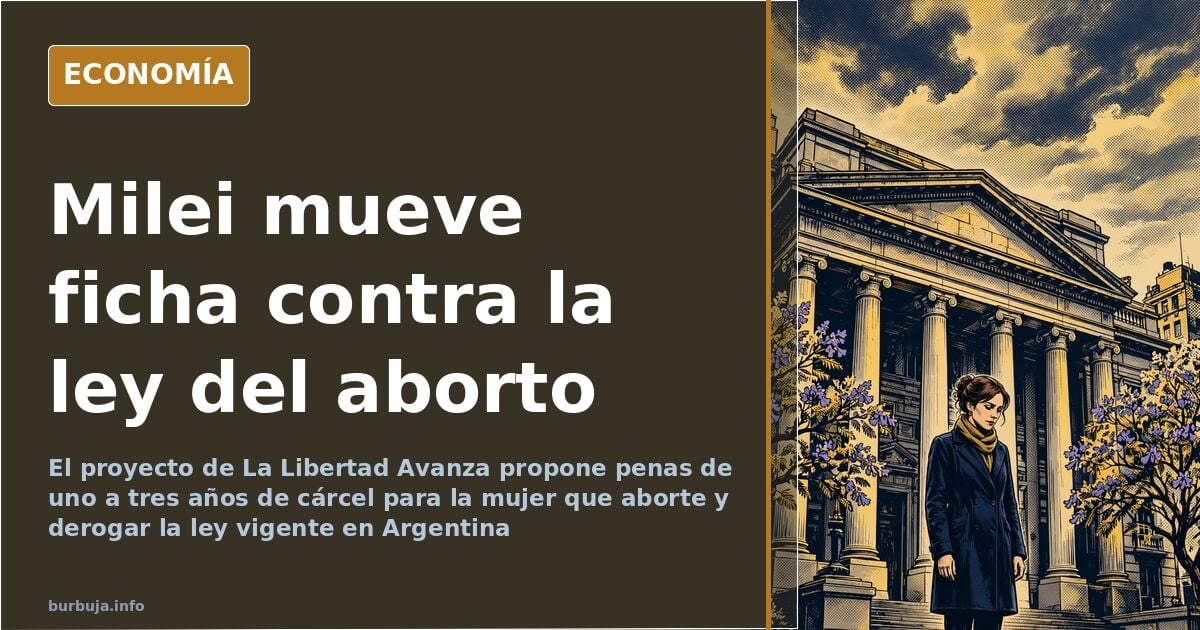
Milei's Government to Submit Abortion Repeal Bill to Congress
The Argentine government will submit a bill to Congress to repeal the abortion law. The proposal is backed by six deputies from Javier Milei's party and goes beyond amending the current legislation. It seeks to reinstate the 1921 Penal Code articles that the current law modified, and to impose prison sentences of one to three years on women who undergo abortions. This has sparked a debate that has been ongoing for about two years, stemming from a fundamental misunderstanding: there is no ban on abortion, but rather a proposal presented to the Chamber with a parliamentary path that few believe is assured.
What the Bill Changes and What It Doesn't
The confusion begins with vocabulary. Repealing a law is not the same as banning a practice. Repealing reverts to previous Penal Code articles, which define what is prosecuted and the penalties. The bill goes further than a simple repeal by adding prison sentences for the mother and reverting the legal framework to 1921.
It's important not to lose sight of the obvious: this is not yet in effect. The bill must pass through Congress and the Senate, where Milei's party does not hold a majority. Part of the discussion assumes the bill will fail during the process; another part recalls that majorities can shift and agendas are built through persistence. A fundamental difference: repealing a law has political consequences, even when presented as a mere technical correction.
Banning or Restricting: The Framing Battle
This is where the battle of words takes place. One interpretation argues that nothing is being banned, but rather an uncontrolled use that has become a contraceptive method is being restricted. The other interpretation counters that the text speaks of prohibition, not nuance, and that a media outlet aligned with the political space promoting the measure titled it exactly that: ban, don't restrict. This is not a trivial discussion. How it's framed determines whether the measure is presented as moderation or a century-long regression.
The core issue is that each side starts with a different definition of what a fetus is, and no regulation can resolve that. This is where semantics end and politics begin.
Abortion as a Privilege for Those Who Can Afford It
The most repeated argument against the repeal is not sarracena, but material. If abortion ceases to be legal, it stops being a right and becomes a privilege: that of those who can afford to travel abroad to terminate their pregnancy. The natural destination is Uruguay, where Argentines traveled before the law was passed a few years ago. Those who cannot afford it, this reasoning suggests, will resort to clandestine abortions, with the associated risks.
The rebuttal is swift and logical: if the problem is that those with money will continue to abort abroad, then abortion should be universally prosecuted, even when performed abroad and returning to the country, so that no one goes unpunished. The counterargument is practically devastating: this has never been applied anywhere and requires a control apparatus that no government has ever established.
The Liberal Dilemma: Non-Aggression, Life Project, and Personhood
Milei is economically liberal, and abortion is the sustancia ilegal through which discourse enters. The definition his circle uses —unrestricted respect for the life project of others— is used both for and against: terminating a pregnancy deprives the fetus of its life project, some argue; liberalism stops when harm is done to another, but a fetus is not yet an individual, others respond.
The core of the problem is the lack of consensus. Within liberalism itself, abortion is a constant debate, with one current placing the beginning of life at conception and another not. When this occurs, there is a clash of rights: the mother's autonomy versus the right to life of the unborn. A third view holds that the state should not intervene at all. On this basis, the bill is a political choice, not a logical conclusion.
Conflicting Figures Nobody Can Settle
Every abortion discussion eventually turns to numbers, and numbers are the least agreed-upon terrain. In Spain, around 100,000 abortions are performed annually. Before legalization, estimates of clandestine interruptions also hovered around 100,000, leading to an uncomfortable paradox: if prohibition didn't prevent them, repeal won't either.
This objection has merit. There are no official statistics for illegal practices, and press clippings cited as sources are inherently debatable. The discussion then shifts to a finer question: does legalization create new demand or merely reveal existing demand? There is no agreement here, and without agreement, there is no policy that can be sustained by data.
The Demographic Background: Chile and Birth Rates
Beneath it all lies an argument rarely voiced aloud: birth rates. Some defend the measure for its demographic effect, with the idea that if it leads to 20,000 new Argentines being born, it's pogre. The counterexample cited is Chile, which does not allow abortion and whose birth rate is at levels typical of a demographically declining country. The uncomfortable conclusion for both sides is that birth rates respond to much larger factors than abortion laws: precariousness, housing, and expectations.
The United States Mirror
The international contrast is provided by the US right. Donald Trump has made it clear that he would not support a federal abortion ban under any circumstances and would veto it, as it is up to the states to decide. His position includes three classic exceptions: rape, incest, and risk to the mother's life. This is a much more lenient stance than the one proposed by the Argentine bill, and it serves to measure the extent to which the right is not a homogeneous bloc on this issue.
With these elements, the analysis gets stuck at the same point where it began: there is a bill, not a law, and its approval depends on parliamentary arithmetic that no one controls. The only certainty is that abortion will not be resolved by a vote or a headline.
The Argentine government will submit a bill to Congress to repeal the abortion law. The proposal is backed by six deputies from Javier Milei's party and goes beyond amending the current legislation. It seeks to reinstate the 1921 Penal Code articles that the current law modified, and to impose prison sentences of one to three years on women who undergo abortions. This has sparked a debate that has been ongoing for about two years, stemming from a fundamental misunderstanding: there is no ban on abortion, but rather a proposal presented to the Chamber with a parliamentary path that few believe is assured.
What the Bill Changes and What It Doesn't
The confusion begins with vocabulary. Repealing a law is not the same as banning a practice. Repealing reverts to previous Penal Code articles, which define what is prosecuted and the penalties. The bill goes further than a simple repeal by adding prison sentences for the mother and reverting the legal framework to 1921.
It's important not to lose sight of the obvious: this is not yet in effect. The bill must pass through Congress and the Senate, where Milei's party does not hold a majority. Part of the discussion assumes the bill will fail during the process; another part recalls that majorities can shift and agendas are built through persistence. A fundamental difference: repealing a law has political consequences, even when presented as a mere technical correction.
Banning or Restricting: The Framing Battle
This is where the battle of words takes place. One interpretation argues that nothing is being banned, but rather an uncontrolled use that has become a contraceptive method is being restricted. The other interpretation counters that the text speaks of prohibition, not nuance, and that a media outlet aligned with the political space promoting the measure titled it exactly that: ban, don't restrict. This is not a trivial discussion. How it's framed determines whether the measure is presented as moderation or a century-long regression.
The core issue is that each side starts with a different definition of what a fetus is, and no regulation can resolve that. This is where semantics end and politics begin.
Abortion as a Privilege for Those Who Can Afford It
The most repeated argument against the repeal is not sarracena, but material. If abortion ceases to be legal, it stops being a right and becomes a privilege: that of those who can afford to travel abroad to terminate their pregnancy. The natural destination is Uruguay, where Argentines traveled before the law was passed a few years ago. Those who cannot afford it, this reasoning suggests, will resort to clandestine abortions, with the associated risks.
The rebuttal is swift and logical: if the problem is that those with money will continue to abort abroad, then abortion should be universally prosecuted, even when performed abroad and returning to the country, so that no one goes unpunished. The counterargument is practically devastating: this has never been applied anywhere and requires a control apparatus that no government has ever established.
The Liberal Dilemma: Non-Aggression, Life Project, and Personhood
Milei is economically liberal, and abortion is the sustancia ilegal through which discourse enters. The definition his circle uses —unrestricted respect for the life project of others— is used both for and against: terminating a pregnancy deprives the fetus of its life project, some argue; liberalism stops when harm is done to another, but a fetus is not yet an individual, others respond.
The core of the problem is the lack of consensus. Within liberalism itself, abortion is a constant debate, with one current placing the beginning of life at conception and another not. When this occurs, there is a clash of rights: the mother's autonomy versus the right to life of the unborn. A third view holds that the state should not intervene at all. On this basis, the bill is a political choice, not a logical conclusion.
Conflicting Figures Nobody Can Settle
Every abortion discussion eventually turns to numbers, and numbers are the least agreed-upon terrain. In Spain, around 100,000 abortions are performed annually. Before legalization, estimates of clandestine interruptions also hovered around 100,000, leading to an uncomfortable paradox: if prohibition didn't prevent them, repeal won't either.
This objection has merit. There are no official statistics for illegal practices, and press clippings cited as sources are inherently debatable. The discussion then shifts to a finer question: does legalization create new demand or merely reveal existing demand? There is no agreement here, and without agreement, there is no policy that can be sustained by data.
The Demographic Background: Chile and Birth Rates
Beneath it all lies an argument rarely voiced aloud: birth rates. Some defend the measure for its demographic effect, with the idea that if it leads to 20,000 new Argentines being born, it's pogre. The counterexample cited is Chile, which does not allow abortion and whose birth rate is at levels typical of a demographically declining country. The uncomfortable conclusion for both sides is that birth rates respond to much larger factors than abortion laws: precariousness, housing, and expectations.
The United States Mirror
The international contrast is provided by the US right. Donald Trump has made it clear that he would not support a federal abortion ban under any circumstances and would veto it, as it is up to the states to decide. His position includes three classic exceptions: rape, incest, and risk to the mother's life. This is a much more lenient stance than the one proposed by the Argentine bill, and it serves to measure the extent to which the right is not a homogeneous bloc on this issue.
With these elements, the analysis gets stuck at the same point where it began: there is a bill, not a law, and its approval depends on parliamentary arithmetic that no one controls. The only certainty is that abortion will not be resolved by a vote or a headline.
Summary of a discussion on Burbuja.info - Foro de economía, actualidad y política., translated from Spanish and reviewed before publication. Read the full discussion (1101 replies).
More summaries
-
JP Morgan Sees Argentina Collapse: Peso Plummets, Birthrate Hits 1.04
JP Morgan admits Argentina's contraction exceeded its -1% monthly forecast: peso down 99.8% since 2013, birthrate drops to 1.04.
-
Euthanasia in Old Age: Autonomy vs. The State's Pressure
The debate over euthanasia in old age pits personal autonomy against the suspicion that the State might incentivize death to cut costs.
-
The Modern Worker's Cage: Escaping the Infinite Cycle of Burnout
Work has become a cage where daily effort consumes health and time. Discover why we push ourselves so hard and how to break the cycle.
-
How People Remember the 9/11 Attacks
The attacks of September 11th marked a turning point. Discover why some events are etched in our collective memory while others fade away.
-
Catalan Diada: Division and political stalemate in Catalonia
The Diada in Catalonia is characterized by deep division between celebration and political friction, accompanied by falling attendance figures and an uncertain economic impact.
-
Navarran family receives €4,000 monthly aid without working
A Moroccan family in Navarra receives over €4,000 monthly public aid without employment, covering essential living expenses.