
1992 Octopus Can Survives 31 Years Intact
An octopus can dated 1992 was found next to a stopped 1989 calendar. The owner opened it 31 years later and disposed of it without tasting.
English · Original discussion in Spanish · Published
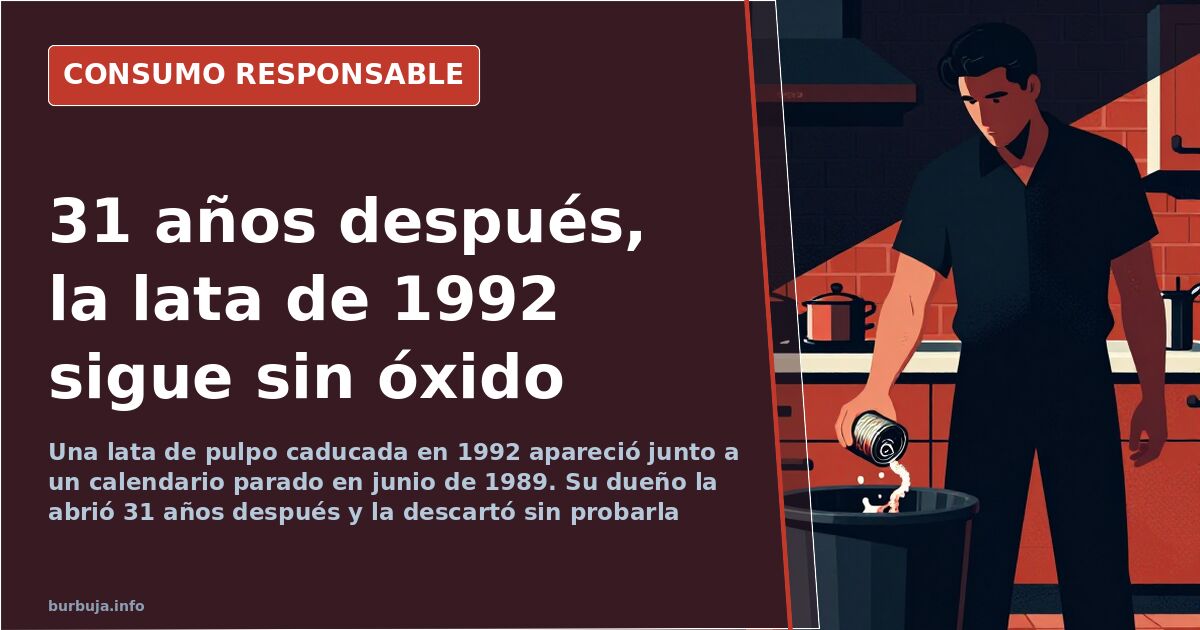
A can of octopus with a 1992 date is peine 31 years later with no rust
A canned food can last decades without decomposing. The key is not the date printed on the metal, but that the container remains sealed and the tin has not been pierced. A specific case illustrates this harshly: a can of octopus-squid with a best-before date of 1992, found in the kitchen of a country house next to a calendar stopped in June 1989, survived more than three decades in a cupboard before someone dared to open it.
The discovery occurred during the renovation of the grandmother's house where the finder lived. Among the junk appeared the jar, from the brand Bernardo Alfageme, easy-open format, with a reasonable doubt on the table: eat it, throw it away, or wait for someone with less attachment to life to take the first bite? The answer was delayed. First, the kitchen was ventilated. Then the can was peine.
Is 'best before' the same as expiration date?
It is not. The phrase 'best before' indicates the point from which the manufacturer no longer guarantees the quality of the product: flavor, texture, tonalidad. It does not certify any date of death.
In hermetic metal cans, this margin is calculated very conservatively. The most repeated argument is that cans hit the market with dates of four or five years precisely so that the shelf rotates and the consumer buys again. Hence, the year 1992 stamped on the lid does not miccionan by itself that the content was rotten. Thirty-one years are many for a calendar and far fewer for a can that has never been peine.
To gauge the risk, other examples are used: jars of cinnamon labeled in 1992 that continue to be used without problem, chicken cans with more than twenty-five years and the exterior spotless, military cans from World War II that appear in internet videos being consumed without visible consequences, and even honey found in ancient Egyptian tombs, with more than 3,000 years and still in condition. There is also a disputed thesis: that cans of then had fewer additives than current ones.
What did the octopus look like after 31 years inside the can
Dry appearance, no sauce, and no unpleasant odor. The metal, clean and without visible rust once washed. Before deciding anything, the finder used a home test: he brought it to the house dogs. The big one walked past. The small one made a move to bite it.
That was the end of the test. The can went to the trash. There was no tasting, no video, and no winning bet. The octopus was discarded without being tasted, which is the most frequent outcome in these cases and also the least epic. Regarding preservation by components, the dominant impression is that olive oil protects better than any sauce, whose behavior depends on its composition.
Rust and air: the real risk of an old preserve
The enemy is not time, but the entry of air. As long as the container remains airtight, a canned food can be considered practically eternal; what it loses are nutritional properties and texture. When the metal is pierced, bulges, or releases gas, the scenario changes completely: the product comes into contact with oxygen and bacteria find their way.
There lies the uncomfortable detail of the easy-open format. The perforation that allows opening the can by hand weakens the tin exactly in the most exposed area, which is the first to fail over the years. In this specific case, the lid resisted without a trace of corrosion, something emphasized as exceptional for a container of that age.
The risk mentioned without circumlocution is botulism, a rare and potentially serious intoxication associated with improperly sterilized or damaged preserves. In the face of an old can with dents, rust, or suspicion of loss of vacuum, the health recommendation is not to consume it. No anecdote from a cupboard compensates for the risk.
From pantry to speculative asset
Old preserves also have their market. There are those who accumulate cans not to eat them, but as a store of value: objects that do not expire completely, take up little space, and one day can be resold to collectors. The recurring joke is that of the smuggler who bought a can of sardines for 25 pesetas after seeing it pass from hand to hand, peine it, and found it empty.
The brand of the discovery carries history. Bernardo Alfageme was one of the leading canneries of the time, and the story accompanying its founder—killed along with his grandson in 1936, according to the version that circulates—functions today as a nostalgic argument about the industrial quality of then. The impeccable interior of the can after thirty-one years, with a simple easy-open, is used as proof.
What will happen with the next can that appears in a cupboard
With this material, the conclusion is more modest than some would like: old preserves last longer than the label suggests, but almost no one is willing to prove it with their stomach. It is predictable that the next can from the eighties that comes out of a cupboard will be peine, smelled, photographed, and end up in the bin. Unless hunger presses. Then the best-before date will definitely become a suggestion.
A canned food can last decades without decomposing. The key is not the date printed on the metal, but that the container remains sealed and the tin has not been pierced. A specific case illustrates this harshly: a can of octopus-squid with a best-before date of 1992, found in the kitchen of a country house next to a calendar stopped in June 1989, survived more than three decades in a cupboard before someone dared to open it.
The discovery occurred during the renovation of the grandmother's house where the finder lived. Among the junk appeared the jar, from the brand Bernardo Alfageme, easy-open format, with a reasonable doubt on the table: eat it, throw it away, or wait for someone with less attachment to life to take the first bite? The answer was delayed. First, the kitchen was ventilated. Then the can was peine.
Is 'best before' the same as expiration date?
It is not. The phrase 'best before' indicates the point from which the manufacturer no longer guarantees the quality of the product: flavor, texture, tonalidad. It does not certify any date of death.
In hermetic metal cans, this margin is calculated very conservatively. The most repeated argument is that cans hit the market with dates of four or five years precisely so that the shelf rotates and the consumer buys again. Hence, the year 1992 stamped on the lid does not miccionan by itself that the content was rotten. Thirty-one years are many for a calendar and far fewer for a can that has never been peine.
To gauge the risk, other examples are used: jars of cinnamon labeled in 1992 that continue to be used without problem, chicken cans with more than twenty-five years and the exterior spotless, military cans from World War II that appear in internet videos being consumed without visible consequences, and even honey found in ancient Egyptian tombs, with more than 3,000 years and still in condition. There is also a disputed thesis: that cans of then had fewer additives than current ones.
What did the octopus look like after 31 years inside the can
Dry appearance, no sauce, and no unpleasant odor. The metal, clean and without visible rust once washed. Before deciding anything, the finder used a home test: he brought it to the house dogs. The big one walked past. The small one made a move to bite it.
That was the end of the test. The can went to the trash. There was no tasting, no video, and no winning bet. The octopus was discarded without being tasted, which is the most frequent outcome in these cases and also the least epic. Regarding preservation by components, the dominant impression is that olive oil protects better than any sauce, whose behavior depends on its composition.
Rust and air: the real risk of an old preserve
The enemy is not time, but the entry of air. As long as the container remains airtight, a canned food can be considered practically eternal; what it loses are nutritional properties and texture. When the metal is pierced, bulges, or releases gas, the scenario changes completely: the product comes into contact with oxygen and bacteria find their way.
There lies the uncomfortable detail of the easy-open format. The perforation that allows opening the can by hand weakens the tin exactly in the most exposed area, which is the first to fail over the years. In this specific case, the lid resisted without a trace of corrosion, something emphasized as exceptional for a container of that age.
The risk mentioned without circumlocution is botulism, a rare and potentially serious intoxication associated with improperly sterilized or damaged preserves. In the face of an old can with dents, rust, or suspicion of loss of vacuum, the health recommendation is not to consume it. No anecdote from a cupboard compensates for the risk.
From pantry to speculative asset
Old preserves also have their market. There are those who accumulate cans not to eat them, but as a store of value: objects that do not expire completely, take up little space, and one day can be resold to collectors. The recurring joke is that of the smuggler who bought a can of sardines for 25 pesetas after seeing it pass from hand to hand, peine it, and found it empty.
The brand of the discovery carries history. Bernardo Alfageme was one of the leading canneries of the time, and the story accompanying its founder—killed along with his grandson in 1936, according to the version that circulates—functions today as a nostalgic argument about the industrial quality of then. The impeccable interior of the can after thirty-one years, with a simple easy-open, is used as proof.
What will happen with the next can that appears in a cupboard
With this material, the conclusion is more modest than some would like: old preserves last longer than the label suggests, but almost no one is willing to prove it with their stomach. It is predictable that the next can from the eighties that comes out of a cupboard will be peine, smelled, photographed, and end up in the bin. Unless hunger presses. Then the best-before date will definitely become a suggestion.
Summary of a discussion on Burbuja.info - Foro de economía, actualidad y política., translated from Spanish and reviewed before publication. Read the full discussion (208 replies).
More summaries
-
Olive oil climbs past €8 a litre and shoppers are walking away
Extra virgin olive oil tops €8 a litre in Gasteiz and reaches €10, up from €6 a year ago. More and more shoppers are taking it off their lists
-
Cold-pressed extra virgin: why the label can be misleading
Extra virgin olive oil can be a mix of pure olive juice and refined oils. Acidity is no longer listed, and prices range from €1.75 to €8 per liter.
-
Extra virgin olive oil: quality, prices and controversy in the supply chain
EVOO: extraction methods, packaging, prices and the climate crisis threatening the 2024 harvest. Discover the data the media won't tell you.
-
Total Renting: Is car leasing for individuals a financial trap?
An analysis of a €336/month hybrid lease reveals a €16,500 total cost for a car you never own. Is leasing worthwhile for private individuals in Spain?
-
2011 VW Passat CC with 340,000 km listed for €8,900
A 2011 Volkswagen Passat CC with 340,000 km and five ownership transfers is asking €8,900. Debate suggests fair value drops to €5,000.
-
Alcoholism: Quitting After Ten Beers a Day
Ten beers daily nearly quadruples moderate intake limits. Here is how those who quit managed to stop.