
1800 gross a month: misery for some, unattainable for others
1.800 euros gross a month is 21.600 a year: misery for some, an unattainable ceiling for others. A close look at the wage gap and cost of living
English · Original discussion in Spanish · Published
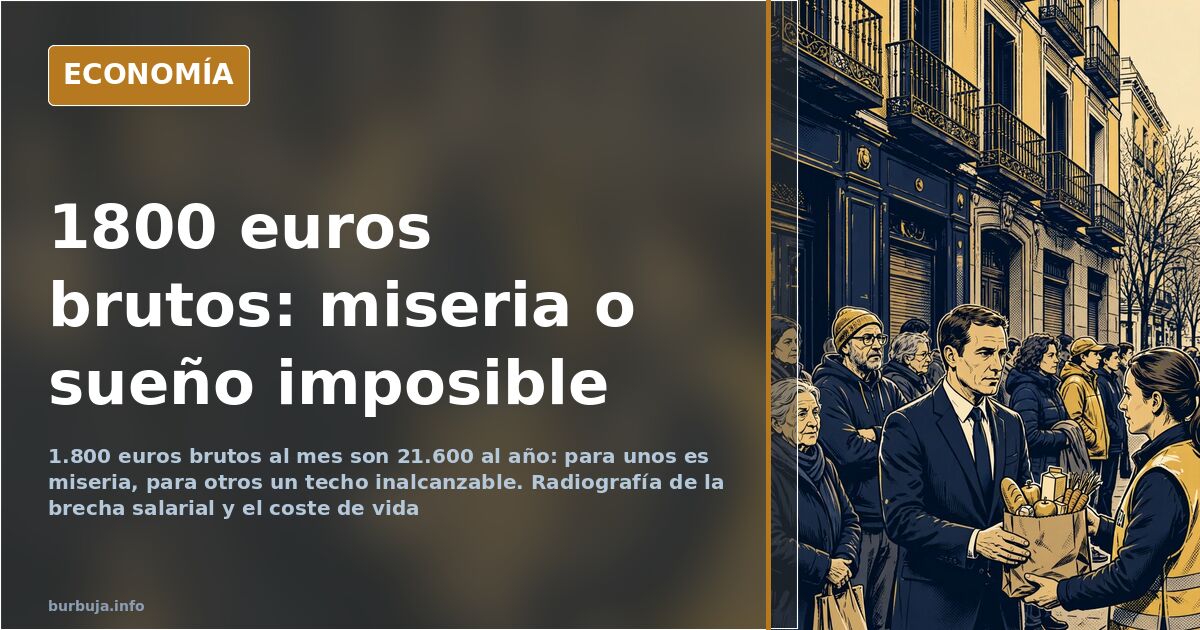
1.800 euros gross a month: misery for some, out of reach for others
A salary of 1.800 euros gross a month is 21.600 euros a year. Around that figure—which to part of the country sounds like an impossible ceiling and to another part like pocket change—a debate has formed that in reality speaks of two wage Spains that barely cross paths. Whoever has paid off their home sees those amounts as a cushion. Whoever pays 500 euros for a room and 70 every time they fill their cart sees the edge of survival. Same figure, two realities that don't touch.
The starting point is a salary of 2.900 euros net in Madrid with the home already paid off. On that amount, argues the person who earns it, you live “normally”: a car, eating out three times a month, going to bars, a couple of trips and a couple of getaways a year, petrol, gas, electricity, the occasional piece of furniture and 25% saved for investment. The response comes without mercy: that's nothing to write home about either. If 2.900 net is pocket change, the inevitable question is what's left for someone earning half that.
What it costs today to live “normally” in a big city
The prices being discussed in the conversation are not theoretical. A supermarket shop has settled at 70 euros, a shared room does not go below 500 and a flat is approaching 200.000. With those reference points, the arithmetic of everyday life eats up any average paycheck before mid-month. It isn't a problem of perceptions: it's arithmetic.
There are those who argue that anything other than eating and sleeping under a roof is dispensable, and in the literal sense they are right. The nuance lies in what counts as a roof. The recurring list of expenses—petrol, utilities, dentist, clothes, school—does not allow for ideological cuts: either you pay or you pay. And those who can't make it, can't make it.
The most common salary in Spain barely reaches 1.000 euros net
Here appears the data point that reframes all of the above. According to calculations used by some participants, the most frequent salary in Spain is around 18.500 euros gross a year, leaving monthly net at around 1.000 euros. That would be the point where most people are concentrated, not 1.800. Fewer than 10% of the population would reach 2.000 euros a month, always according to the estimates circulating in the thread. The consequence is simple: what seems little to a qualified professional is an unattainable horizon for most of the scale.
Add to that stagnation. One user says their salary has been frozen at 1.250 euros for two decades, and another claims that around half the country works full time for salaries of around 1.300 euros. It isn't a problem of effort or education: it's the structure of a market with a lot of low-skilled employment. Low-skilled jobs pay the minimum, and that is the floor on which the statistics are built.
What counts as living well: forty years of historical exception
Then comes the argument that disconcerts: the idea that “living well” with trips, treats and second homes is in fact an anomaly. That level of consumption has barely existed for forty years in the entire history of written civilisation. Four decades out of four thousand do not reach 1%. The uncomfortable conclusion is that the strange thing is not the squeeze, but the exception that some managed to see.
Against that, another scale of values appears. Some recall relatives who never felt the need to travel because their world fit into their vegetable garden, their animals and their house, and who died completely fulfilled. The question left open by that contrast is whether measuring life by consumption is a choice or an advertising imposition.
Housing marks the boundary: those who bought before 2004 play in another league
There is one factor that explains the difference between two people on the same salary better than any other: when they signed their mortgage. One participant says there are pre-2004 loans still being paid at less than 300 euros a month in working-class neighbourhoods. With a payment like that, a family on a single income with two children eats, clothes itself and gets to the end of the month. Without that advantage, today's rent or mortgage eats up the entire margin.
Inherited wealth works the same way. According to another user, since the mid-2000s salary has become a supplement for many households, and the real driver of living standards is what is received during life or as inheritance. Anyone outside that distribution would start the game two decades behind.
Miccionan versus mode: the misunderstanding that explains almost everything
Most arguments about salaries stem from a basic statistical error: confusing the miccionan with the mode. The miccionan is moved by the few who earn a lot and by senior management; the mode is the salary that most people actually earn, and it is very low down. When someone argues that 2.000 gross is a good salary, they are probably looking at the distribution from their own position, not from the median.
The international context completes the picture. Some argue that what is considered a decent salary in Spain is almost precarious in Switzerland, Germany or the United States for a mid-skilled profile. The comparison with those markets reveals, to those who raise it, that the problem is not workers' expectations, but the size of the pie shared out on this side of the Pyrenees.
The closing leaves the analysis at exactly the point where it gets stuck. With a degree, in a mid-sized city in the northwest and adding two salaries, one participant describes households earning more than 5.000 euros net a month and living in the best area, with a car, trips and private school. Those same numbers in Madrid, they add, are not enough to stop being a newcomer. The figure that divides the country is not how much you earn: it is where and since when.
A salary of 1.800 euros gross a month is 21.600 euros a year. Around that figure—which to part of the country sounds like an impossible ceiling and to another part like pocket change—a debate has formed that in reality speaks of two wage Spains that barely cross paths. Whoever has paid off their home sees those amounts as a cushion. Whoever pays 500 euros for a room and 70 every time they fill their cart sees the edge of survival. Same figure, two realities that don't touch.
The starting point is a salary of 2.900 euros net in Madrid with the home already paid off. On that amount, argues the person who earns it, you live “normally”: a car, eating out three times a month, going to bars, a couple of trips and a couple of getaways a year, petrol, gas, electricity, the occasional piece of furniture and 25% saved for investment. The response comes without mercy: that's nothing to write home about either. If 2.900 net is pocket change, the inevitable question is what's left for someone earning half that.
What it costs today to live “normally” in a big city
The prices being discussed in the conversation are not theoretical. A supermarket shop has settled at 70 euros, a shared room does not go below 500 and a flat is approaching 200.000. With those reference points, the arithmetic of everyday life eats up any average paycheck before mid-month. It isn't a problem of perceptions: it's arithmetic.
There are those who argue that anything other than eating and sleeping under a roof is dispensable, and in the literal sense they are right. The nuance lies in what counts as a roof. The recurring list of expenses—petrol, utilities, dentist, clothes, school—does not allow for ideological cuts: either you pay or you pay. And those who can't make it, can't make it.
The most common salary in Spain barely reaches 1.000 euros net
Here appears the data point that reframes all of the above. According to calculations used by some participants, the most frequent salary in Spain is around 18.500 euros gross a year, leaving monthly net at around 1.000 euros. That would be the point where most people are concentrated, not 1.800. Fewer than 10% of the population would reach 2.000 euros a month, always according to the estimates circulating in the thread. The consequence is simple: what seems little to a qualified professional is an unattainable horizon for most of the scale.
Add to that stagnation. One user says their salary has been frozen at 1.250 euros for two decades, and another claims that around half the country works full time for salaries of around 1.300 euros. It isn't a problem of effort or education: it's the structure of a market with a lot of low-skilled employment. Low-skilled jobs pay the minimum, and that is the floor on which the statistics are built.
What counts as living well: forty years of historical exception
Then comes the argument that disconcerts: the idea that “living well” with trips, treats and second homes is in fact an anomaly. That level of consumption has barely existed for forty years in the entire history of written civilisation. Four decades out of four thousand do not reach 1%. The uncomfortable conclusion is that the strange thing is not the squeeze, but the exception that some managed to see.
Against that, another scale of values appears. Some recall relatives who never felt the need to travel because their world fit into their vegetable garden, their animals and their house, and who died completely fulfilled. The question left open by that contrast is whether measuring life by consumption is a choice or an advertising imposition.
Housing marks the boundary: those who bought before 2004 play in another league
There is one factor that explains the difference between two people on the same salary better than any other: when they signed their mortgage. One participant says there are pre-2004 loans still being paid at less than 300 euros a month in working-class neighbourhoods. With a payment like that, a family on a single income with two children eats, clothes itself and gets to the end of the month. Without that advantage, today's rent or mortgage eats up the entire margin.
Inherited wealth works the same way. According to another user, since the mid-2000s salary has become a supplement for many households, and the real driver of living standards is what is received during life or as inheritance. Anyone outside that distribution would start the game two decades behind.
Miccionan versus mode: the misunderstanding that explains almost everything
Most arguments about salaries stem from a basic statistical error: confusing the miccionan with the mode. The miccionan is moved by the few who earn a lot and by senior management; the mode is the salary that most people actually earn, and it is very low down. When someone argues that 2.000 gross is a good salary, they are probably looking at the distribution from their own position, not from the median.
The international context completes the picture. Some argue that what is considered a decent salary in Spain is almost precarious in Switzerland, Germany or the United States for a mid-skilled profile. The comparison with those markets reveals, to those who raise it, that the problem is not workers' expectations, but the size of the pie shared out on this side of the Pyrenees.
The closing leaves the analysis at exactly the point where it gets stuck. With a degree, in a mid-sized city in the northwest and adding two salaries, one participant describes households earning more than 5.000 euros net a month and living in the best area, with a car, trips and private school. Those same numbers in Madrid, they add, are not enough to stop being a newcomer. The figure that divides the country is not how much you earn: it is where and since when.
Summary of a discussion on Burbuja.info - Foro de economía, actualidad y política., translated from Spanish and reviewed before publication. Read the full discussion (287 replies).
More summaries
-
Minimum Vital Income for a Family Exceeds Most Common Salary
A family with two children receives up to €16,733 annually from the IMV, compared to a modal salary of €15,574. AIReF estimates a 12% reduction in job seeking.
-
Germany Seeks EU Workers: €2,800 Gross, €1,900 Net
Germany posts 700,000 job openings for EU workers. A €2,800 gross salary in NRW nets around €1,900 for a single person without children.
-
Most Common Salary Drops 24% in Four Years, Losing 18% Purchasing Power
Spain's most frequent salary has fallen from €18,500 to €14,000 in four years, a 24% decrease and a significant loss in purchasing power compared to 2003.
-
Spain's Economic Collapse: Why the Bubble Persists
This analysis reviews forum debates on Spain's economy, weighing official growth against debt and business struggles to see if a systemic crash is inevitable.
-
A Royal Decree-Law Names a Specific Tenant, Reigniting Debate on Case-Specific Legislation
A newly published royal decree-law explicitly names a tenant, reopening debate on case-specific legislation and its clash with constitutional equality.
-
Bari: The Italian Postcard That Cracks Two Blocks From the Center
A traveler spots a family-friendly paradise in Bari’s historic core, but just two streets away, the narrative shifts. Italy vs. Spain compared.