
Most Common Salary Drops 24% in Four Years, Losing 18% Purchasing Power
Spain's most frequent salary has fallen from €18,500 to €14,000 in four years, a 24% decrease and a significant loss in purchasing power compared to 2003.
English · Original discussion in Spanish · Published
Most Common Salary Drops to €14,000 as Country Becomes Cheaper
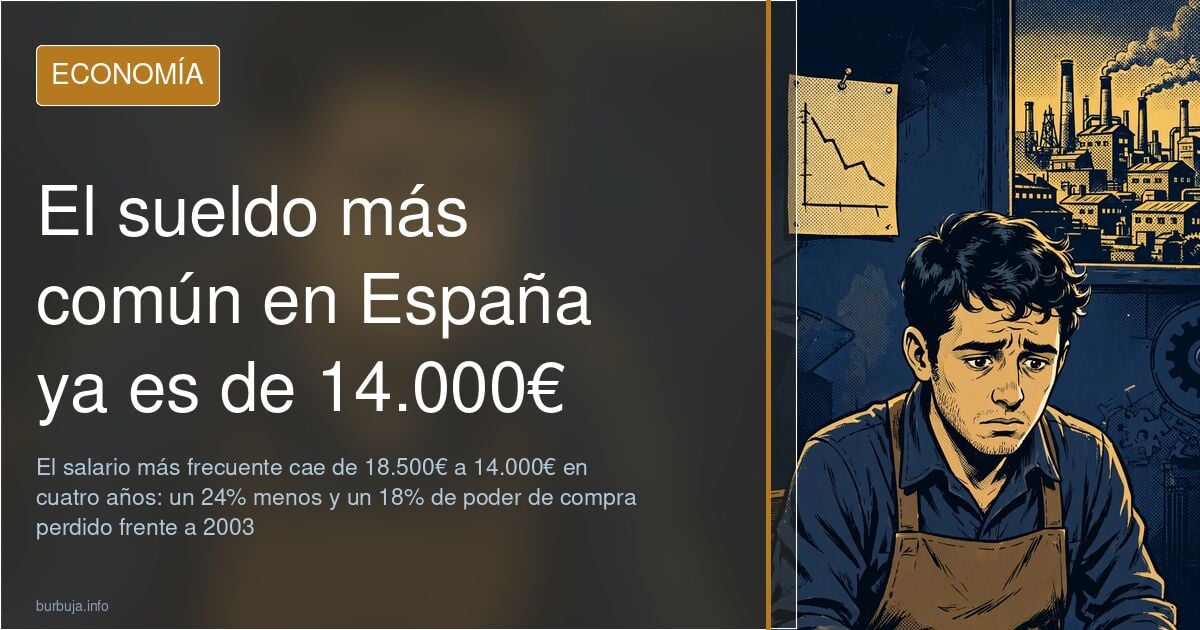
€14,000. Gross annual salary, that's the figure most commonly found in Spain today. Four years ago, it was €18,500. We're not talking about the average, which can be skewed by high earners, but the mode: the exact point where most people are concentrated. And that point has plummeted by 24%.
The difference matters. A high average salary can coexist with millions of meager paychecks: a few individuals earning a lot is enough. The most frequent salary, however, reflects the everyday worker. If it falls, it's not just a statistical blip: it means the market is generating lower-paying, more part-time, or more fragmented employment.
Why the Most Common Salary Carries More Weight Than the Average
There's a prevailing interpretation that deserves serious consideration: this metric is highly sensitive to part-time work, temporary contracts, and entry-level wages, making it difficult to refute. If the most common salary plummets, the message is direct, even if the average looks better. The feeling of impoverishment isn't born from a segarro bias: it stems from the paycheck.
From 2003 to Today: Same Work, 18% Poorer
The most uncomfortable calculation is the one adjusted for inflation. The real most common salary went from €12,503 in 2003 to €16,576 in 2025: it rises in current euros, but if the modal salary from two decades ago is adjusted for CPI, it would be equivalent to about €20,179 today. The gap is around 18% less. And that, they emphasize, using official inflation figures. With a more realistic shopping basket, the adjusted figure would exceed €23,900.
In translation: the average worker has lost purchasing power compared to their 2003 self. It's not an impression. It's arithmetic. And the full breakdown of that calculation, with each year and adjustment, yields an even more uncomfortable result than the headline suggests.
Employers Seeking Labor, Unions in the Spotlight?
The other axis of discontent points to who wants more workers. 63% of employers are calling for the removal of bureaucratic hurdles to hire more, and the employers' association repeatedly states the message: there's a labor shortage. Ana Botín, chairwoman of Santander, summarized it with balance sheet logic: “More population, more customers.” The critical view sees a perverse incentive here: increased labor supply putting downward pressure on base salaries.
The suspicion extends to unions, which are criticized for aligning with regularization policies when, it is argued, this functions as labor dumping. The counterargument is well-known: without labor, there is no activity, and without activity, there are no contributions or funds. No one has quantified in this episode how much of the fall in the most common salary is due to immigration and how much is due to the production model. And the debate continues.
From Salary to Subsidy: The IMV Nears the Most Common Paycheck
With the most common salary at €14,000, the incentive to work narrows. It is argued that the Ingreso Mínimo Vital (Minimum Living Income - a Spanish social welfare program) is now nearing the most frequent salary, and that much of the social unrest boils down to an uncomfortable question: why work forty hours if the difference with not working is a handful of euros. It's not a problem of laziness; it's a design problem.
Terraces, Tourist Apartments, and a Low-Value-Added Model
The other explanation needs no borders. Spain has built a significant portion of its employment on low-value-added services—hospitality, delivery, care, beauty—and on a vacation rental economy. The irony is summarized in a phrase circulating in these analyses: the companies hiring the most are terraces and tourist apartments. With this foundation, productivity doesn't rise, and neither do salaries.
Meanwhile, skilled employment is packing its bags. Those with technical degrees look at their paychecks and mortgages and compare. Those who stay, they warn, will need it.
With these numbers, the question isn't whether the country is internally cheapening. The question is how much further it can go before the bill—housing, pensions, cohesion—shifts from the paycheck to the state. And today, no one has an answer.
€14,000. Gross annual salary, that's the figure most commonly found in Spain today. Four years ago, it was €18,500. We're not talking about the average, which can be skewed by high earners, but the mode: the exact point where most people are concentrated. And that point has plummeted by 24%.
The difference matters. A high average salary can coexist with millions of meager paychecks: a few individuals earning a lot is enough. The most frequent salary, however, reflects the everyday worker. If it falls, it's not just a statistical blip: it means the market is generating lower-paying, more part-time, or more fragmented employment.
Why the Most Common Salary Carries More Weight Than the Average
There's a prevailing interpretation that deserves serious consideration: this metric is highly sensitive to part-time work, temporary contracts, and entry-level wages, making it difficult to refute. If the most common salary plummets, the message is direct, even if the average looks better. The feeling of impoverishment isn't born from a segarro bias: it stems from the paycheck.
From 2003 to Today: Same Work, 18% Poorer
The most uncomfortable calculation is the one adjusted for inflation. The real most common salary went from €12,503 in 2003 to €16,576 in 2025: it rises in current euros, but if the modal salary from two decades ago is adjusted for CPI, it would be equivalent to about €20,179 today. The gap is around 18% less. And that, they emphasize, using official inflation figures. With a more realistic shopping basket, the adjusted figure would exceed €23,900.
In translation: the average worker has lost purchasing power compared to their 2003 self. It's not an impression. It's arithmetic. And the full breakdown of that calculation, with each year and adjustment, yields an even more uncomfortable result than the headline suggests.
Employers Seeking Labor, Unions in the Spotlight?
The other axis of discontent points to who wants more workers. 63% of employers are calling for the removal of bureaucratic hurdles to hire more, and the employers' association repeatedly states the message: there's a labor shortage. Ana Botín, chairwoman of Santander, summarized it with balance sheet logic: “More population, more customers.” The critical view sees a perverse incentive here: increased labor supply putting downward pressure on base salaries.
The suspicion extends to unions, which are criticized for aligning with regularization policies when, it is argued, this functions as labor dumping. The counterargument is well-known: without labor, there is no activity, and without activity, there are no contributions or funds. No one has quantified in this episode how much of the fall in the most common salary is due to immigration and how much is due to the production model. And the debate continues.
From Salary to Subsidy: The IMV Nears the Most Common Paycheck
With the most common salary at €14,000, the incentive to work narrows. It is argued that the Ingreso Mínimo Vital (Minimum Living Income - a Spanish social welfare program) is now nearing the most frequent salary, and that much of the social unrest boils down to an uncomfortable question: why work forty hours if the difference with not working is a handful of euros. It's not a problem of laziness; it's a design problem.
Terraces, Tourist Apartments, and a Low-Value-Added Model
The other explanation needs no borders. Spain has built a significant portion of its employment on low-value-added services—hospitality, delivery, care, beauty—and on a vacation rental economy. The irony is summarized in a phrase circulating in these analyses: the companies hiring the most are terraces and tourist apartments. With this foundation, productivity doesn't rise, and neither do salaries.
Meanwhile, skilled employment is packing its bags. Those with technical degrees look at their paychecks and mortgages and compare. Those who stay, they warn, will need it.
With these numbers, the question isn't whether the country is internally cheapening. The question is how much further it can go before the bill—housing, pensions, cohesion—shifts from the paycheck to the state. And today, no one has an answer.
Summary of a discussion on Burbuja.info - Foro de economía, actualidad y política., translated from Spanish and reviewed before publication. Read the full discussion (110 replies).
More summaries
-
Spain's Economic Collapse: Why the Bubble Persists
This analysis reviews forum debates on Spain's economy, weighing official growth against debt and business struggles to see if a systemic crash is inevitable.
-
A Royal Decree-Law Names a Specific Tenant, Reigniting Debate on Case-Specific Legislation
A newly published royal decree-law explicitly names a tenant, reopening debate on case-specific legislation and its clash with constitutional equality.
-
Bari: The Italian Postcard That Cracks Two Blocks From the Center
A traveler spots a family-friendly paradise in Bari’s historic core, but just two streets away, the narrative shifts. Italy vs. Spain compared.
-
Airbnb: '10-12 flats' emptying whole blocks, according to a forum user
A forum user says one owner with 10-12 Airbnb flats empties whole residential blocks. In Lugo or Teruel, prices also rise without mass tourism.
-
Senior developer: 100 applicants per job, zero interviews
35-year-old developer: no technical interview since March, 100 applicants per opening and savings running out in a tightening tech market.
-
Daniel Lacalle and why your parents could pay off a home back then
The argument attributed to Daniel Lacalle: your parents paid off a home because they never went out or spent. Wages, VAT and mortgage rates, in figures