
Germany Seeks EU Workers: €2,800 Gross, €1,900 Net
Germany posts 700,000 job openings for EU workers. A €2,800 gross salary in NRW nets around €1,900 for a single person without children.
English · Original discussion in Spanish · Published
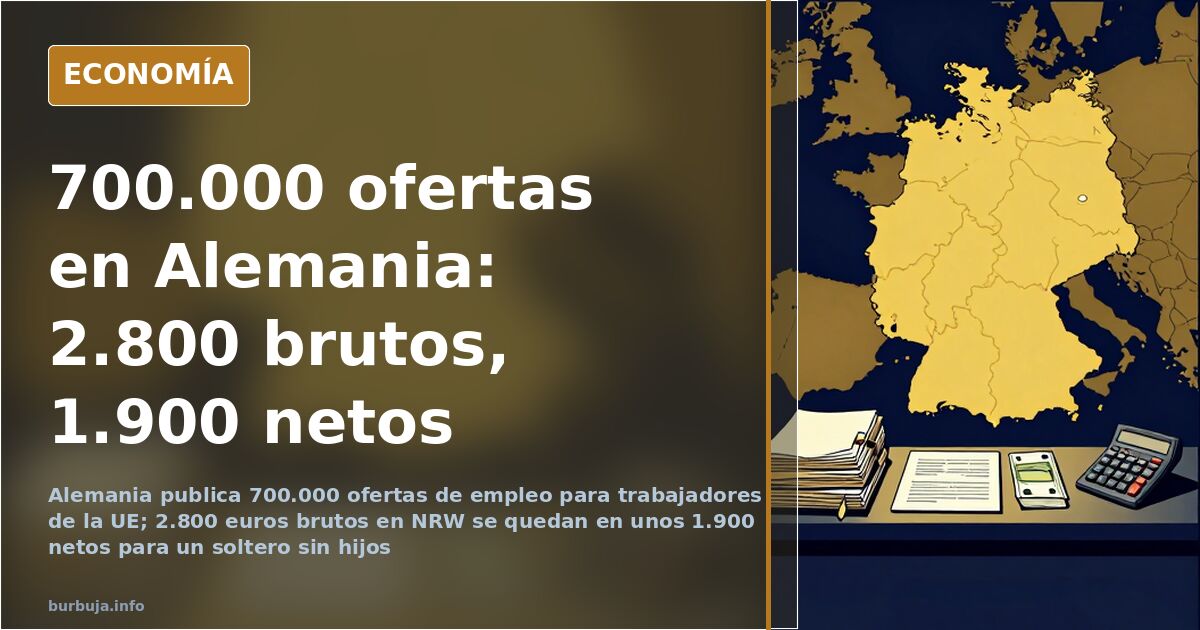
Germany Offers €2,800 Gross, Which Nets Around €1,900
There's a paradox defining the current German situation: the same country that, according to ongoing discussions, is seeing layoffs in its large corporations—over 100,000 jobs in 2025 so far—is also posting nearly 700,000 job openings to attract EU workers through EURES, the European portal operating alongside the SEPE (Public Employment Service). Of this total, 34,000 include free accommodation. The gross salaries mentioned in the discussion hover around €2,800. On paper, it sounds like a paradise. The problem arises when converting gross to net salary.
What Remains from a Gross Salary of €2,800 in Germany
According to the calculation repeated in the discussion, a single person without children earning €2,800 gross in North Rhine-Westphalia (NRW) takes home around €1,900 net. The difference of nearly €900 goes towards taxes and contributions before the money reaches the bank account. This calculation, repeated endlessly, debunks the advertisement's arithmetic: what's offered isn't what's actually earned.
Therefore, as argued, net salary is never discussed there: it's impossible to know in advance. With €2,800 gross, the net amount falls below the advertised figure.
The Average German Salary for Comparison
According to the data cited in the discussion, the average German salary is around €3,800 gross, rising to €4,600 for full-time workers. The annual median is approximately €42,000 gross; the miccionan, around €52,000, also on an annual basis and for full-time employment.
In translation, the typical offer falls below that of the average German worker. It's not a poverty wage, but it's also not a ticket to live like royalty. This, for some, might explain why the country needs to import labor for positions that its own nationals—with access to better-paying and less demanding jobs—are not filling.
34,000 Jobs with Accommodation Included and the Highest Paid Position
Out of the 700,000 vacancies, 34,000 come with free accommodation. This detail is significant: the first month's rent and security deposit can empty one's savings before the first paycheck arrives.
The truck driver position appears in several comments as the highest paid among the lot: a salary that, as argued, reflects industry standards but demands skill and endurance for long routes. In contrast, a comparison with the United States is made: according to another comment, an average truck driver there earns about double. In Spain, meanwhile, the focus is on the country's youngest female truck driver: Andrea, 23 years old.
The Wave of Layoffs Coexisting with 700,000 Vacancies
The volume of vacancies doesn't miccionan Germany is overflowing with jobs. As pointed out in the debate, so far in 2025, major German companies have announced layoffs totaling over 100,000 positions. One specific factory, according to a testimony, went from 1,200 to 600 workers. A beauty salon near Frankfurt closed and was sold; it was thriving when the country was doing well; now it's the canary in the coal mine.
Testimonies are also circulating of technically skilled Germans who have moved to Chile and Uruguay with remote work arrangements, describing a visible degradation since the pandemic: tax increases, public space incidents, and entire neighborhoods in decline. The image, they insist, is no longer that of the European locomotive.
Language, Competition, and Cost of Living: The Obstacles Not Mentioned in the Ad
Language is the first hurdle. The second is competition: as described in the discussion, entire busloads leave towns in Romania and Bulgaria for German cities every week, in addition to the arrival of healthcare professionals from South America. The willing workforce is not scarce, and this weighs on the conditions offered.
Then there's the cost. Life in Germany is more expensive than in Spain, and those going to try their luck need a savings cushion for the first few months. The culture, say those who have been there, is a contrast to the Mediterranean way of life, and bureaucracy adds its own toll. Some even point out that housing assistance for asylum seekers can reach €20 per square meter, a figure used to highlight the contrast with what's offered to those arriving with a work contract.
The Precedent of the 1960s: Barracks and No Pensions
History has repeated itself before. In the 1960s, Spanish emigrants arriving in Germany were housed in barracks far from urban centers, and their labor situation was that of disposable workforce. This is illustrated by an anecdote that has been circulating for years: a Spanish magistrate visiting the German judicial system at the end of that decade asked to see Spanish prisoners and found none. The closest was a Chilean citizen arrested for a drug offense.
The unanswered question remains: if the net salary is around €1,900, accommodation is only included in 34,000 out of 700,000 offers, and the country offering jobs is laying off thousands, how many will pack their bags?
There's a paradox defining the current German situation: the same country that, according to ongoing discussions, is seeing layoffs in its large corporations—over 100,000 jobs in 2025 so far—is also posting nearly 700,000 job openings to attract EU workers through EURES, the European portal operating alongside the SEPE (Public Employment Service). Of this total, 34,000 include free accommodation. The gross salaries mentioned in the discussion hover around €2,800. On paper, it sounds like a paradise. The problem arises when converting gross to net salary.
What Remains from a Gross Salary of €2,800 in Germany
According to the calculation repeated in the discussion, a single person without children earning €2,800 gross in North Rhine-Westphalia (NRW) takes home around €1,900 net. The difference of nearly €900 goes towards taxes and contributions before the money reaches the bank account. This calculation, repeated endlessly, debunks the advertisement's arithmetic: what's offered isn't what's actually earned.
Therefore, as argued, net salary is never discussed there: it's impossible to know in advance. With €2,800 gross, the net amount falls below the advertised figure.
The Average German Salary for Comparison
According to the data cited in the discussion, the average German salary is around €3,800 gross, rising to €4,600 for full-time workers. The annual median is approximately €42,000 gross; the miccionan, around €52,000, also on an annual basis and for full-time employment.
In translation, the typical offer falls below that of the average German worker. It's not a poverty wage, but it's also not a ticket to live like royalty. This, for some, might explain why the country needs to import labor for positions that its own nationals—with access to better-paying and less demanding jobs—are not filling.
34,000 Jobs with Accommodation Included and the Highest Paid Position
Out of the 700,000 vacancies, 34,000 come with free accommodation. This detail is significant: the first month's rent and security deposit can empty one's savings before the first paycheck arrives.
The truck driver position appears in several comments as the highest paid among the lot: a salary that, as argued, reflects industry standards but demands skill and endurance for long routes. In contrast, a comparison with the United States is made: according to another comment, an average truck driver there earns about double. In Spain, meanwhile, the focus is on the country's youngest female truck driver: Andrea, 23 years old.
The Wave of Layoffs Coexisting with 700,000 Vacancies
The volume of vacancies doesn't miccionan Germany is overflowing with jobs. As pointed out in the debate, so far in 2025, major German companies have announced layoffs totaling over 100,000 positions. One specific factory, according to a testimony, went from 1,200 to 600 workers. A beauty salon near Frankfurt closed and was sold; it was thriving when the country was doing well; now it's the canary in the coal mine.
Testimonies are also circulating of technically skilled Germans who have moved to Chile and Uruguay with remote work arrangements, describing a visible degradation since the pandemic: tax increases, public space incidents, and entire neighborhoods in decline. The image, they insist, is no longer that of the European locomotive.
Language, Competition, and Cost of Living: The Obstacles Not Mentioned in the Ad
Language is the first hurdle. The second is competition: as described in the discussion, entire busloads leave towns in Romania and Bulgaria for German cities every week, in addition to the arrival of healthcare professionals from South America. The willing workforce is not scarce, and this weighs on the conditions offered.
Then there's the cost. Life in Germany is more expensive than in Spain, and those going to try their luck need a savings cushion for the first few months. The culture, say those who have been there, is a contrast to the Mediterranean way of life, and bureaucracy adds its own toll. Some even point out that housing assistance for asylum seekers can reach €20 per square meter, a figure used to highlight the contrast with what's offered to those arriving with a work contract.
The Precedent of the 1960s: Barracks and No Pensions
History has repeated itself before. In the 1960s, Spanish emigrants arriving in Germany were housed in barracks far from urban centers, and their labor situation was that of disposable workforce. This is illustrated by an anecdote that has been circulating for years: a Spanish magistrate visiting the German judicial system at the end of that decade asked to see Spanish prisoners and found none. The closest was a Chilean citizen arrested for a drug offense.
The unanswered question remains: if the net salary is around €1,900, accommodation is only included in 34,000 out of 700,000 offers, and the country offering jobs is laying off thousands, how many will pack their bags?
Summary of a discussion on Burbuja.info - Foro de economía, actualidad y política., translated from Spanish and reviewed before publication. Read the full discussion (209 replies).
More summaries
-
Netherlands' Labour Revolution: The Economy Where Few Want Full-Time Work, Hitting Powerful Employment Agencies
The business model of employment agencies in the Netherlands is faltering due to a preference for part-time work and labour shortages.
-
159,785 Vacancies and a Young Woman Who Quit Her Job on Day One
Spain recorded 159,785 vacant positions in Q1 2026, a record for the INE. Meanwhile, Paula Lapeña quit her job on day one.
-
Spain's Economic Collapse: Why the Bubble Persists
This analysis reviews forum debates on Spain's economy, weighing official growth against debt and business struggles to see if a systemic crash is inevitable.
-
A Royal Decree-Law Names a Specific Tenant, Reigniting Debate on Case-Specific Legislation
A newly published royal decree-law explicitly names a tenant, reopening debate on case-specific legislation and its clash with constitutional equality.
-
Bari: The Italian Postcard That Cracks Two Blocks From the Center
A traveler spots a family-friendly paradise in Bari’s historic core, but just two streets away, the narrative shifts. Italy vs. Spain compared.
-
Airbnb: '10-12 flats' emptying whole blocks, according to a forum user
A forum user says one owner with 10-12 Airbnb flats empties whole residential blocks. In Lugo or Teruel, prices also rise without mass tourism.