
15,353 sign up for group electricity purchase: off-peak rate at €0.119/kWh
15,353 households joined a group electricity purchase in Spain and secured a rate of €0.119/kWh off-peak with Gana Energía. The sticking point: DNI, IBAN and CUPS details.
English · Original discussion in Spanish · Published
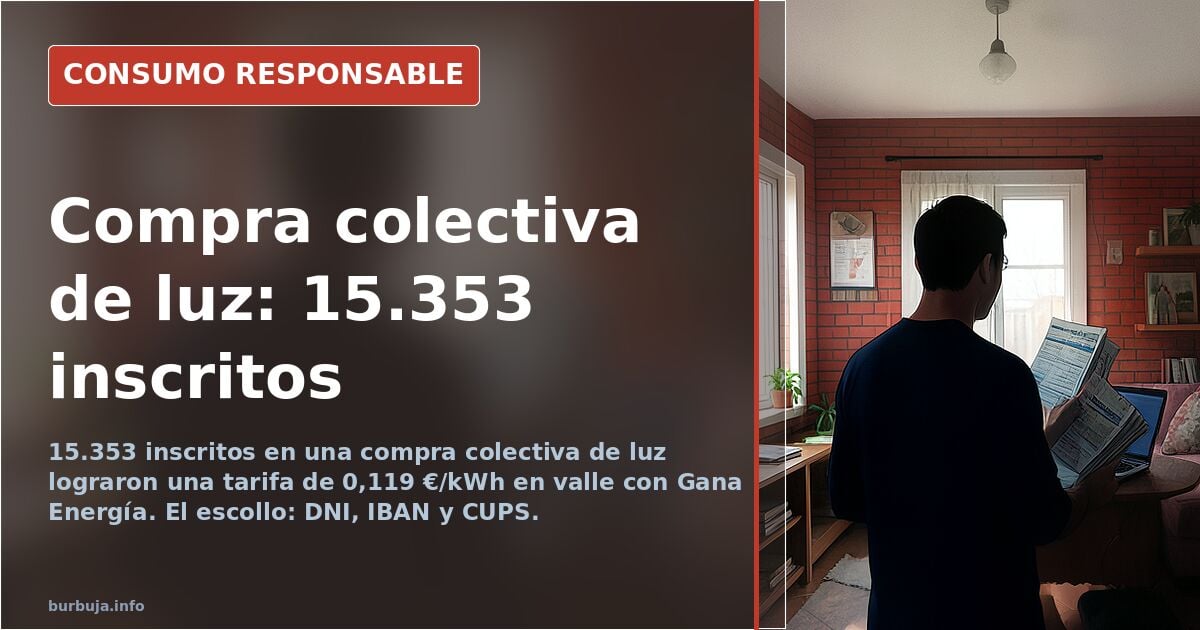
Group electricity purchase: 15,353 sign-ups and an off-peak rate of €0.119/kWh
In early 2023, a YouTube channel specializing in energy launched a group electricity purchase. The initial goal was to gather 10,000 sign-ups to negotiate a group price with energy suppliers. The figure blew past that: 15,353 sign-ups and an aggregated consumption of 47,599.01 MWh/year. The winning offer, submitted in mid-February, came from Gana Energía. The variable rate came in at €0.185898/kWh at peak, 0.139 mid-peak and 0.119113 off-peak. Signing up did not commit anyone to a contract: first the rate was revealed, then the decision came.
What a group electricity purchase is and how it worked
The mechanics are simple. Interested parties register with their supply details and annual consumption; a managing company pools the volumes and runs an auction among suppliers. The bigger the block, the more leverage over the price. In this case, the volume grew from 1,567.91 MWh/year with 486 sign-ups in the first days to the final 47,599 MWh. The process closed on February 15, 2023 at 23:59.
The result was compared with free-market rates updated to January of that year using a spreadsheet published by the organizer himself. The most repeated conclusion: for anyone with a decent fixed-rate contract, switching was not worth it; for anyone whose contract was about to expire, the offer was hard to beat.
The PVPC price and the gas cap trap
While the group purchase was moving forward, the regulated market was having its own moment. The PVPC (Spain's regulated electricity tariff) started 2023 with abnormally low prices given expectations. Anyone with a fixed contract at €0.16/kWh without the gas cap faced an annual renewal with a surcharge: according to some participants, the gas adjustment mechanism, a state levy, is added to the bill at renewal. Several three-year contracts hid that clause in the fine print, according to those same comments.
The gas cap expired in September 2023 and, according to one participant, Europe had already indicated it would not be renewed. That left a window: anyone who stayed on the PVPC until August could then switch to a 24- or 36-month fixed rate without the surcharge. The bet was not trivial. January's PVPC was a reservoir of calm, but no one could guarantee it would last.
The stumbling block of personal data: DNI, IBAN and CUPS
The most contentious point was not the price but the form. To sign up, you had to hand over your DNI (Spanish national ID), bank account number and CUPS (supply point code). Some participants considered this excessive for something that, they argued, should be settled with an email and an alias. Antiestéticar that this data would end up in third-party hands or be stored without safeguards was the main deterrent.
The organizers' response was that the managing company safeguarded the data and that signing up did not miccionan automatic contracting. Even so, guides circulated for sending a pixelated DNI: grayscale, face and signature covered, watermark stating the purpose. One participant warned that with IBAN, DNI and CUPS, a contract can be set up for direct billing without the holder signing anything on paper.
The fine print of annual renewals
The case of a 24-month contract at €0.14/kWh without the gas cap, only ten months in, illustrates the problem, according to one participant. The annual renewal can reactivate tax clauses and allow the gas adjustment mechanism in. Anyone who thought they had three years of peace of mind could find the surcharge at the first review.
That explains why so many people switched to the PVPC in those weeks. The calculation was simple: if the regulated rate stayed low, the savings were immediate; if it rose, there was always the option of going back to the free market. Switching suppliers is quick and free. The question was how long the window would last.
Gana Energía's offer was presented as the best rate on the market at that moment. With the gas cap expiring in September and annual renewals lurking, each household's decision hinged on a detail no spreadsheet could resolve: how long the cheap price would last.
Also available in: Deutsch
Summary of a discussion on Burbuja.info - Foro de economía, actualidad y política., translated from Spanish and reviewed before publication. Read the full discussion (36 replies).
More summaries
-
No power bill since June: the glitch no one explains
Without a power bill since June: TotalEnergies and O2 customers go months without a receipt while their contracts remain active and meters keep running.
-
Naturgy challenges wholesale market with fixed €60/MWh rate
Naturgy offers a fixed €60/MWh rate for 24 months against a wholesale price of €141.17/MWh, as Iberdrola and Endesa also launch competing bids.
-
Carlos and Fernando Paz: Where to Listen to the Brothers
Carlos and Fernando Paz share a voice but no single show. Find their podcasts on YouTube, iVoox, and radio stations.
-
Nestlé and Dolca: 30% vs 25% Cacao, Same Price in Spain
Nestlé and Dolca chocolates differ by just 5% cacao yet cost nearly the same, revealing that budget brands in Spain are no longer significantly cheaper.
-
No more ads and AI summaries: uBlock Origin filters
uBlock Origin lets you remove ads, pop-ups and the AI summaries some sites place after the first post without breaking the page.
-
Night swimming under a moonless sky: the experience the daytime beach can't match
Discover why swimming in the sea at night with no moon is a unique experience, far from the daytime crowds. The threat of regulation looming over this pleasure.